For someone with coeliac disease, the first thing to look for is a ‘gluten-free’ label on the product, rather than simply checking whether it contains buckwheat, rice or maize. According to AFDIAG, this label means the product contains less than 20 mg/kg of gluten. Fresh buckwheat pancakes are ideal for filling at mealtimes, while crispbreads are better for toast-style toppings or snacks—provided you check the label on each product. In France, the DGCCRF distinguishes between the nutrition declaration required for most prepacked foods and the optional Nutri-Score.
Who are these pancakes for?
People with coeliac disease
AFDIAG recommends paying close attention to the finished product and the risk of cross-contamination. When planning meals for the week, check that each product is labelled ‘gluten-free’, then avoid contact with gluten-containing foods or utensils at home.
People making filled pancakes
If you’re looking for a soft base for lunch or dinner, be sure to distinguish fresh buckwheat pancakes from crispbreads intended for toast-style toppings. The fresh products listed by Carrefour France and Auchan France are labelled ‘gluten-free’.
People who prefer crunchy toast-style toppings and snacks
A crunchy cereal cake is a good choice for this, but recipes and nutritional information vary from one product to another. The Bjorg listings on Auchan France make it easy to compare ingredients, salt, fibre and protein.
What should you check when shopping?
If someone in your household has coeliac disease, start by checking the gluten-free labelling. Then choose between a fresh pancake to fill or a crunchy product, depending on the meals you have planned.
| What to check | Look for | Who it matters to |
|---|
| Gluten-free labelling |
The ‘gluten-free’ label on the exact product and the allergens listed; look for the Crossed Grain symbol if it appears on the pack. |
When coeliac disease requires a strict diet, the type of grain used alone isn’t enough to determine whether the finished product is suitable. Around 39% of consumers put gluten-free safety first. |
| Format for your meals |
Fresh or crunchy pancakes, pack size and storage instructions. |
If you want to quickly fill something for lunch or dinner, a soft, fresh base is the right choice. Around 23% of consumers prioritise products for filling. |
| Nutritional information |
Values per 100 g, particularly fat, sugars, salt, fibre and protein, as well as the portion you’ll eat. |
If several crunchy pancakes would work for my toast-style toppings, I want to be able to compare their nutritional content rather than assume that ‘gluten-free’ tells me about their nutritional profile. Around 23% of consumers put comparing nutritional information first. |
| Regular availability |
Whether the product is stocked by your usual retailer and whether the same pack size is available each time you shop. |
When planning your weekly shop, it’s easier to plan meals if you can find a product whose labelling you’ve already checked. Around 15% of consumers prioritise regular availability. |
Common pitfalls to avoid
-
Assuming all ‘galettes’ are gluten-free
The name is also used for biscuits that contain wheat. St Michel’s BIO good butter biscuit listing states that it contains 66% wheat flour and gluten.
Read the ingredients list and look for the ‘gluten-free’ label on the exact product. Don’t rely on the product name alone.
-
Relying on a naturally gluten-free grain alone
According to AFDIAG, contamination can happen before you buy a product, and gluten-containing foods can also come into contact with the pancake during preparation.
Check the labelling on the finished product and use a clean work surface and utensils at home.
-
Thinking the absence of a Nutri-Score means something is wrong
In France, the DGCCRF states that the Nutri-Score is optional, while a nutrition declaration is required for most prepacked foods.
Compare the nutritional information available per 100 g and take into account the portion you plan to eat.
-
Relying on a product that’s only available occasionally
Lidl France states that its gluten-free products are not part of its permanent range. So a product you buy one week may not be available on your next shop.
Before planning several meals around the same product, check that it’s stocked by your retailer and check the labelling of any replacement product.
Brands to know
Carrefour No Gluten
Carrefour France lists fresh gluten-free buckwheat pancakes in a pack of four, weighing 200 g.
- The product listing gives a recipe made with water, buckwheat flour, salt and sunflower oil.
- Check the label on the pack you actually choose.
Crêperie de Guerlédan
Auchan France lists a pack of four fresh organic gluten-free buckwheat pancakes, weighing 280 g.
- The listing gives organic buckwheat flour, water and Guérande salt as ingredients.
- This description applies to the 280 g product. Check the label if you choose a different size.
Bjorg
The products listed by Auchan France include crunchy four-grain pancakes and maize and lentil pancakes, both labelled gluten-free.
- The four-grain product listing gives wholegrain rice, maize, buckwheat and quinoa, as well as 0.2 g of salt per 100 g.
- The figures of 18 g of protein and 4.5 g of fibre per 100 g apply to the maize and lentil product, not all Bjorg pancakes.
Marque Repère — Chaque Jour Sans Gluten
E.Leclerc Drive lists this range among its gluten-free pastries.
- Before choosing a pancake from this range, check the exact product, its ingredients and its ‘gluten-free’ label.
St Michel
The BIO good butter biscuit described by St Michel is a different product from fresh buckwheat pancakes and gluten-free cereal pancakes.
- This product contains wheat flour and is labelled as containing gluten. It isn’t suitable for someone with coeliac disease who follows a gluten-free diet.
Crispbread available on Joybuy
This selection features a crunchy four-grain pancake, which is a good option for toast-style toppings or a snack—not a fresh pancake to fill.
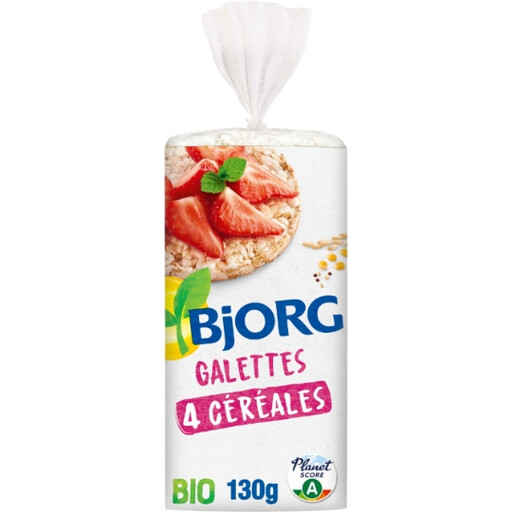 Image unavailable
BJORG four-grain pancakes, 130 g
These crunchy pancakes are suitable for toast-style toppings or snacks; they aren’t a substitute for a soft, fresh pancake to fill.
The listing for this product on Auchan France gives wholegrain rice, maize, buckwheat and quinoa, as well as 0.2 g of salt per 100 g. Check the ‘gluten-free’ label and allergens on the pack you buy.
View on Joybuy
Frequently asked questions
Are buckwheat pancakes automatically suitable for someone with coeliac disease?
No. The grain used alone doesn’t confirm that the finished product is gluten-free. According to AFDIAG, check that the exact pancake is labelled ‘gluten-free’; this means it contains less than 20 mg/kg of gluten. The Crossed Grain symbol can also be a helpful guide.
Is the Nutri-Score compulsory on pancakes in France?
No. The DGCCRF states that the Nutri-Score is optional in France, while a nutrition declaration is required for most prepacked foods. So, even if there’s no Nutri-Score, you should still read the nutritional information available.
How can you avoid cross-contamination at home?
Keep gluten-free foods separate from those that contain gluten, and prepare pancakes on a clean work surface using clean utensils. AFDIAG specifically highlights shared equipment, such as a toaster used for bread containing gluten.
Can you count on finding the same gluten-free products at Lidl every week?
Not necessarily. Lidl France says its gluten-free products are available as occasional offers rather than as part of a permanent range. Check what your local store stocks before planning your meals, and check the labelling if you choose a different product.


