People with coeliac disease
The priority is to check that the specific variant you buy is labelled ‘gluten-free’, rather than relying on a recipe that simply appears to contain no wheat. This label is governed by EU regulations.


If you have coeliac disease, first choose a pancake whose specific variant is labelled ‘gluten-free’. For a busy morning, a crisp pancake can be used as a base for toppings, a sachet is easy to take with you, while a soft pancake needs a filling. Nutri-Score can help you compare products when it is displayed, but it is still voluntary in France, so check the ingredients and nutritional information too.
The priority is to check that the specific variant you buy is labelled ‘gluten-free’, rather than relying on a recipe that simply appears to contain no wheat. This label is governed by EU regulations.
If you want to put together a quick snack, some crisp pancakes are ideal: Bjorg, for example, describes its maize, amaranth and linseed pancakes as a base for toppings.
You can check the Nutri-Score when it appears on the product, then compare the nutritional information per 100 g and the ingredients list. According to the French Ministry of the Economy, displaying the Nutri-Score remains voluntary in France.
For breakfast, first check the labelling that’s relevant to your needs. Then choose a format to suit the time you have and compare the nutritional information.
| Criteria | What to check | Who is it for? |
|---|---|---|
| ‘Gluten-free’ label | Look for this label on the packaging of the variant you choose and check for any other allergens relevant to you. | If I need to avoid gluten completely because I have coeliac disease, the ingredients alone aren’t enough to guide my choice. Around 50% of consumers put this check at the top of their list. |
| Morning-friendly format | Choose between a crisp pancake for toppings, sachets to take with you or a soft pancake to fill. | If I’m leaving early, I want to know whether I can take the pancake with me or still need to add a filling. For around 30% of consumers, convenience is the top priority. |
| Nutritional profile | Check the Nutri-Score if it is displayed; also compare the figures per 100 g, particularly for sugars, salt, fat and fibre. | I want to compare what the pancakes contain, even when a product doesn’t display a Nutri-Score. This is the main concern for around 20% of consumers. |
If you have coeliac disease, a recipe that appears to contain no wheat is not a substitute for a ‘gluten-free’ label. In the EU, this label means the product contains no more than 20 mg/kg of gluten, in line with European Regulation 828/2014.
Check the label again on the packaging of the variant you plan to buy.
In France, the Ministry of the Economy states that displaying the Nutri-Score is voluntary. Its absence therefore doesn’t tell you what a pancake’s nutritional profile is like.
Compare the nutritional information per 100 g and the ingredients list, taking into account the portion and toppings you plan to have too.
A crisp pancake for toppings, a sachet to take with you and a soft pancake to fill are all used differently on a busy morning.
Decide whether you want to make a quick snack, take a sachet with you or prepare a filled pancake, then check the labelling of the product you choose.
The range includes 200 g packs of gluten-free buckwheat pancakes, which Carrefour describes as suitable for filling.
Bjorg offers crisp maize, amaranth and linseed pancakes, as well as extra-thin maize pancakes, both described as gluten-free.
Carrefour describes Aglina’s 160 g organic, gluten-free five-grain pancakes as being packed in freshness sachets, making them easy to take with you.
E.Leclerc has a dedicated category for Chaque Jour Sans Gluten crêpes and pancakes.
In its gluten-free breakfast section, Auchan lists Bjorg’s maize, amaranth and linseed pancakes, among other products.
This selection features a BJORG 4-Grain Pancake described as crisp and suitable for breakfast. If you need to avoid gluten completely, check that the packaging of the variant on sale carries the relevant label before choosing it.
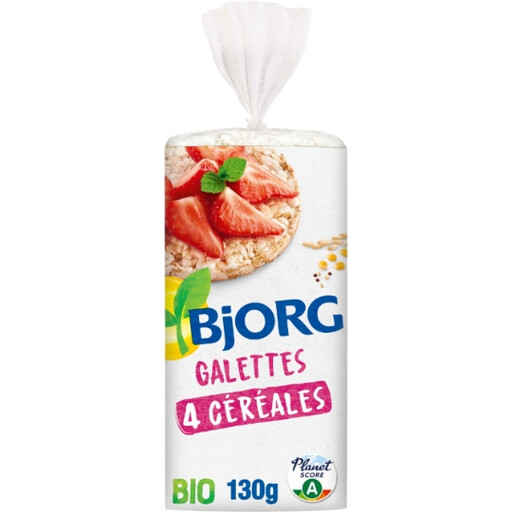 Image unavailable
This 130 g product is described as crisp, making it a quick option for a snack. Its product information says ‘gluten-free’ and gives it a Nutri-Score of A. Check the ‘gluten-free’ label and grade on the packaging of the variant sold in France before relying on these details. Also check the allergen list if soya is a concern for you.
No. For this purpose, check that the product you buy is labelled ‘gluten-free’. European Regulation 828/2014 sets a maximum gluten content of 20 mg/kg for this label. An ingredients list that appears to contain no wheat is not a substitute for this indication.
No. According to the French Ministry of the Economy, displaying it remains voluntary in France, unlike the nutrition declaration, which is generally compulsory on prepacked foods. If the logo is missing, compare the nutritional information per 100 g rather than assuming the pancake has a poor nutritional profile.
Crisp pancakes are a good choice if you want to make a quick snack or take a sachet with you. Bjorg suggests using its maize, amaranth and linseed pancakes with toppings, while Carrefour describes Aglina’s sachets as easy to carry. Soft buckwheat pancakes are a good option if you’d rather add a filling. Either way, check for a ‘gluten-free’ label if you need one.
Follow the storage instructions on the packaging for your product. Carrefour advises keeping Aglina pancakes in a cool, dry place; don’t apply this advice to fresh pancakes without checking their packaging first.