Organisers catering for someone with coeliac disease
You need to be able to check that the specific product being served to them is labelled gluten-free, rather than assume it is suitable simply because it contains fruit.


To serve fruit in syrup to someone with coeliac disease at a village fair, first check that the exact product is labelled ‘gluten-free’. Then choose a size to suit how you plan to serve it: a large container for preparing several desserts, or individual pots for separate portions. Next, compare the net drained weight, sugars per 100 g and storage instructions after opening. ‘Light syrup’ does not tell you whether a product contains gluten.
You need to be able to check that the specific product being served to them is labelled gluten-free, rather than assume it is suitable simply because it contains fruit.
You’re planning fruit bowls or a dish for everyone to share, and want to compare the amount of drained fruit as well as the storage instructions for leftovers.
You’re looking for pots that are easy to hand out, while checking separately that the specific product intended for someone with coeliac disease is labelled gluten-free.
For this buffet, start with the product intended for someone with coeliac disease. Then work out how much fruit you need to serve and which format will suit the way you plan to hand it out.
| What to check | Look for | Who it matters to |
|---|---|---|
| Gluten-free labelling | The labelling and product information for the exact product you’re buying; don’t assume it’s suitable just from the list of fruit. | If I’m serving someone with coeliac disease, I want to be able to confirm that this specific product is suitable for them. Around 50% of consumers would make this their top priority. |
| Size and portions | The net drained weight for a dish to share, or the number of individual pots for single servings. Also check the storage instructions after opening. | To serve dessert without running short of fruit or having too many leftovers, I choose a container that suits the planned service. This would be the top priority for around 30% of consumers. |
| Ingredients | The ingredients, the liquid the fruit is packed in and the ‘of which sugars’ value per 100 g, comparing like with like. | When choosing between two recipes, I want to understand what they contain rather than rely on the words ‘light syrup’ alone. Around 20% of consumers would make this their top priority. |
A list that appears to contain only fruit and syrup doesn’t, on its own, confirm that the exact product is suitable for someone with coeliac disease.
Check the gluten-free labelling on the packaging of the product you’ve bought before serving it. Don’t assume the same applies to other products from the brand.
The container’s weight includes the liquid the fruit is packed in, so it doesn’t necessarily reflect how much fruit you’ll have to share among your guests.
To plan buffet portions, compare the net drained weights shown on the products you’re considering.
According to the Auchan France product pages for peach halves and POUCE fruit cocktail, these products should be transferred to an airtight container, kept in the fridge and eaten within two days of opening.
Check the instructions for the product you choose and pick a container size that matches how much you can serve or use afterwards.
The Carrefour France product page for ST MAMET peaches in syrup states ‘Gluten-free’ for this specific product.
The range shown by Auchan France includes peaches, fruit cocktails and individual pots.
Aldi France lists BACCARA individual pots and a fruit cocktail in light syrup.
This selection features cherries in syrup in a jar, which could be used to add a finishing touch to desserts at the fair. Before setting the jar aside for someone with coeliac disease, check its gluten-free labelling.
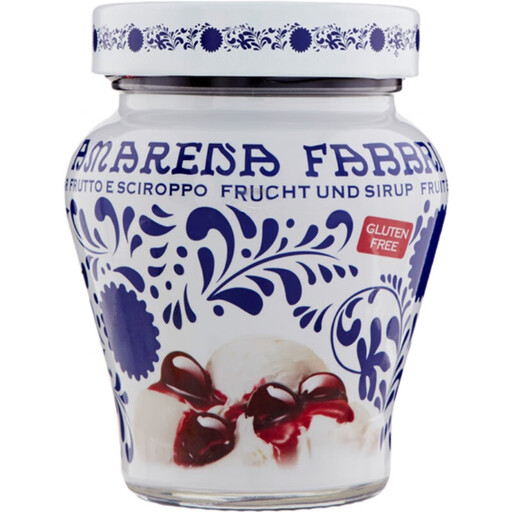 Image unavailable
These cherries in syrup could be used to top desserts on a buffet, provided you confirm that the jar intended for someone with coeliac disease is labelled ‘Gluten free’.
Before planning portions and leftovers, check the net drained weight and storage instructions after opening on the label.
No. For this choice, check that the exact product is labelled gluten-free or has documented confirmation that it’s suitable. Not seeing wheat in the ingredients list doesn’t, on its own, confirm that it’s suitable.
Compare the ‘of which sugars’ figure in the nutritional information on the same basis, usually per 100 g. The DGCCRF states that nutritional information is given per 100 g or 100 ml. Also distinguish between fruit in syrup, light syrup and fruit juice, but don’t treat this as an indication of whether a product contains gluten.
Follow the instructions for the product you’ve bought. For the peach halves and POUCE fruit cocktail shown on the Auchan France product pages, the instructions say to transfer the contents to an airtight container, keep it in the fridge and eat it within two days of opening.
Not necessarily: the total weight also includes the liquid the fruit is packed in. Check the net drained weight of the product you choose to estimate how much fruit you’ll have for the buffet.