Cyclists with coeliac disease
For you, the gluten-free claim must apply to the exact product and format you’re buying. Carrefour displays this claim on the product page for its St Mamet peaches; it doesn’t apply to the brand’s other recipes.


If you have coeliac disease, first check that the ‘gluten-free’ claim applies to the recipe and format you’re buying. An ingredients list with no obvious cereals isn’t enough to confirm this. When choosing a snack for cycling, compare the carbohydrate content per portion, the packaging and how easy it is to use. Try the product during training before relying on it for a ride.
For you, the gluten-free claim must apply to the exact product and format you’re buying. Carrefour displays this claim on the product page for its St Mamet peaches; it doesn’t apply to the brand’s other recipes.
You compare how much you’ll actually eat and the carbohydrate content per portion when choosing a snack before or after a ride. A ‘no added sugars’ claim is no substitute for checking the nutritional information.
You’re considering a larger container with several portions in mind, and taking the drained weight and storage instructions after opening into account.
Gluten-free status needs to be confirmed for each specific recipe. The format and nutritional values then help you decide whether the portion suits when you plan to eat it.
| Criteria | What to check | Who it matters to |
|---|---|---|
| Gluten-free claim | Check the packaging or product page for a claim that applies to the exact recipe and format you’re buying. | If I have coeliac disease, I need to confirm the status of this specific product rather than infer it from the ingredients. Around 42% of consumers prioritise this need. |
| Portion and portability | Compare the drained weight, packaging and how it opens. If you plan to take it with you, try the portion during training. | For a snack before or after a ride, I want packaging I can handle and a portion I can tolerate. Around 33% of consumers put this need first. |
| Carbohydrates per portion | Check the carbohydrate and sugar values per 100 g, then work out the amounts for the portion you’ll eat. | If I eat this fruit after cycling, I want to know what my portion provides rather than relying on the ‘no added sugars’ claim alone. Around 25% of consumers prioritise this calculation. |
An ingredients list with no obvious cereals doesn’t, on its own, confirm that a product is gluten-free. Carrefour’s product page for St Mamet peaches carries an explicit claim, but this doesn’t apply to every St Mamet recipe.
Check the label for the exact product and format you’re buying. If in doubt, ask the manufacturer to confirm.
Carrefour describes its Classic’ tropical fruit cocktail as having no added sugars, while listing 13 g of carbohydrates per 100 g.
Compare the ‘carbohydrates’ and ‘of which sugars’ values per 100 g, then take the portion you’ll eat into account.
A container with liquid can be awkward to carry and open while exercising. A review published in Nutrients recommends trying carbohydrate sources during training before using them in competition.
Test the portion, how easy it is to carry and how well you tolerate it during training. Don’t assume it will meet all your needs on a long ride.
If you’re sharing a container over several days, you’ll need to follow the storage instructions once it’s open. For its Williams pears in light syrup, Auchan says to keep them refrigerated in the liquid and eat them soon after opening.
If you’re planning several small snacks at different times, compare these storage requirements with those for individual pots.
Carrefour displays the claim ‘Gluten-free’ on the product page for St Mamet peaches in a tin with a net drained weight of 475 g.
The tropical fruit cocktail comes in four pots, each with a net drained weight of 70 g.
Williams pears in light syrup come in an 820 g container, with a net drained weight of 460 g.
Aldi offers Baccara fruit-in-syrup pots for enjoying in smaller portions.
This jar of cherries in syrup is better suited to preparing a portion at home before or after a ride than to taking an individual container to open on your bike. If gluten-free status is essential, check the label on the variant you buy.
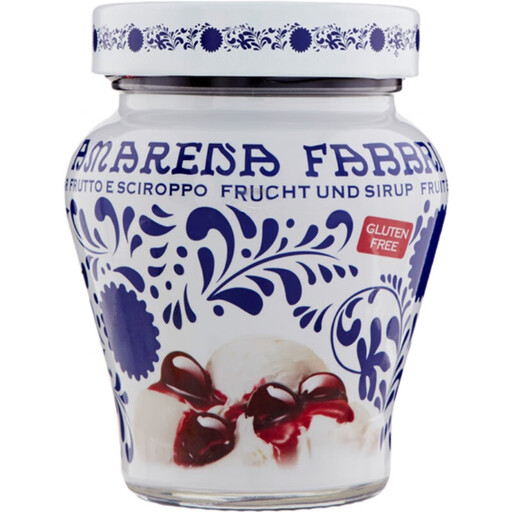 Image unavailable
This jar could be used to prepare a portion at home before or after a ride. If you have coeliac disease, check the label on the product you buy for a gluten-free claim.
Format: 230 g jar.
Yes. Check that it applies to the exact recipe and format you’re buying, or get reliable confirmation for that specific product. The European Commission regulates the use of claims relating to the absence of gluten. Simply checking the ingredients may not tell you how gluten is managed during manufacturing.
It may be an option if the container, portion and eating it while exercising suit you, but the liquid and bulky packaging can make it harder to carry. Try the product during training before relying on it for a long ride or race.
No. Carrefour’s product page lists 13 g of carbohydrates per 100 g for its Classic’ tropical fruit cocktail, which is described as having no added sugars. To work out what your snack provides, adjust the per-100 g value to match the portion you eat.
Follow the instructions for the exact product you’ve bought. Auchan says to keep its Williams pears refrigerated in their liquid and eat them soon after opening. For its 425 g St Mamet fruit cocktail, Joybuy says to refrigerate it in a suitable container and eat it within 3 to 4 days. These instructions don’t automatically apply to other products.