People who need to avoid gluten strictly
If you have coeliac disease or need to avoid gluten, the “gluten-free” label and the information on the pack matter more than the brand or shape.


To stock your cupboard with gluten-free dried pasta, first choose a product whose packaging explicitly says “gluten-free”, rather than relying on a recipe made with maize or rice. Then pick the shapes that suit your meals and check the pack weight, ingredients and nutritional information for each product.
If you have coeliac disease or need to avoid gluten, the “gluten-free” label and the information on the pack matter more than the brand or shape.
If you regularly swap out wheat pasta, keeping a range of dried shapes in the cupboard means you can choose the one that suits your usual sauces, salads or bakes.
If you keep gluten-free pasta in the cupboard, check the pack sizes and which shapes you actually use before buying several packs.
First, check that the product you’ve chosen is labelled “gluten-free”. The shape, quantity and ingredients can then help you choose between products that meet this first requirement.
| Criterion | What to check | Who is it for? |
|---|---|---|
| “Gluten-free” label | The label on the exact pack, along with the listed ingredients and allergens. Under European Commission Regulation (EU) No 828/2014, this claim means the food sold to the final consumer contains no more than 20 mg/kg of gluten. | If I need to avoid gluten strictly, I want to clearly identify the claim before choosing a shape; around 36% of consumers make this check a priority. |
| Pasta shape | The shapes available for the dishes you usually make, including macaroni, spaghetti, penne, fusilli or lasagne. | To vary my sauces, salads and bakes, I need a few different shapes in my cupboard; this variety comes first for around 29% of consumers. |
| Pack size | The net weight and the quantity you need for your planned meals. Products listed by E.Leclerc and Carrefour include 400 g and 500 g packs respectively. | When I restock, I want a quantity that suits my household without buying lots of packs I won’t use; around 21% of consumers prioritise this. |
| Ingredients | The ingredients list and nutritional information for the exact product, particularly fibre and protein per 100 g if you’re comparing them. | If I’m comparing several recipes made with maize and rice, I want to check their ingredients and nutritional information; for around 14% of consumers, this is the main criterion after checking that the product is gluten-free. |
A list of the grains used is no substitute for the regulated “gluten-free” claim, particularly when gluten must be avoided strictly.
Look for the claim on the pack you buy and check the label again if you switch products or the recipe changes.
A 400 g pack won’t cover the same number of meals as a 500 g pack. Weight matters if you’re planning several dishes using the same shape.
Check the net weight and choose the shapes you’ll actually use before stocking up.
A pasta brand may also sell wheat products: the product listing for Lustucru short spaghetti states that it naturally contains gluten.
Check the “gluten-free” claim, ingredients and allergens on the exact pack you choose.
Barilla France offers a range of gluten-free dried pasta, including macaroni, penne rigate, tagliatelle and lasagne.
E.Leclerc offers several gluten-free pasta shapes in this range, including penne, macaroni and spaghetti.
Carrefour France offers gluten-free spaghetti and fusilli under this brand.
Auchan offers a range of gluten-free dried pasta, including macaroni, penne, fusilli, spaghetti and coquillettes.
The short spaghetti listed by Lustucru is a wheat product, so it’s different from pasta labelled “gluten-free”.
This selection features Barilla penne rigate in a 400 g pack for your gluten-free pasta cupboard. Check the label and information on the pack you receive before use.
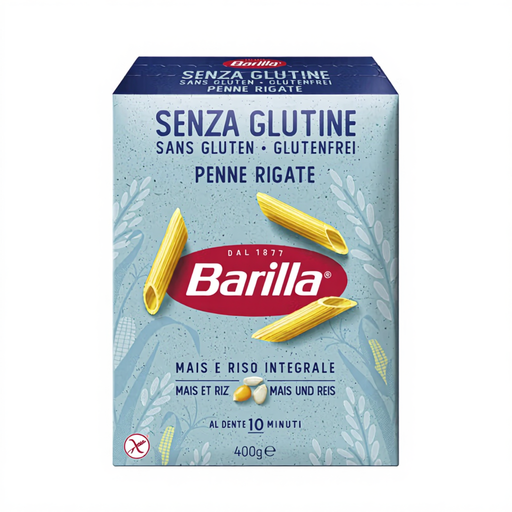 Image unavailable
Consider these penne rigate if you’re looking for this shape for gluten-free meals. Check the “gluten-free” label and allergen information on the pack you receive.
400 g pack.
No: choose a product explicitly labelled “gluten-free”. Under European Commission Regulation (EU) No 828/2014, this claim can only be used if the food sold to the final consumer contains no more than 20 mg/kg of gluten.
No: first check for the “gluten-free” claim and read the information on the exact pack. The logo can provide an extra reassurance when it’s present; E.Leclerc says it is awarded by AFDIAG.
No: follow the instructions on the pack you choose. Auchan gives a cooking time of 8 to 9 minutes for its gluten-free maize and rice spaghetti, but this may not apply to another shape or brand.
Follow the instructions on the pack and seal it again after use. For its gluten-free spaghetti, Auchan recommends keeping the product away from heat and moisture, and observing the date shown on the packaging.