What should you check before buying?
For someone with coeliac disease, the words “gluten-free” are essential. Format, storage and nutritional information can then help you choose a crispbread that suits your break at work.
| What matters |
What to check |
Who is it for? |
| Gluten and allergens |
The words “gluten-free” and the allergens listed on the packaging. According to AFDIAG, this claim means the product contains less than 20 mg/kg of gluten. |
If I have coeliac disease, I want a clear indication rather than assuming a buckwheat crispbread is suitable. Around 38% of consumers are said to make this their main priority. |
| Transport and storage |
Whether it’s dry or fresh, the packaging and storage instructions, especially after opening. |
If I keep my snack in a drawer or carry it in a bag, the format needs to suit those conditions. Ease of transport and storage is said to come first for around 23% of consumers. |
| Snack composition |
Protein and fibre per 100 g, followed by the amount you actually eat. |
For a break between meetings, I want to compare what I get from my portion without assuming it will make me feel full. Around 23% of consumers are said to put this comparison at the heart of their choice. |
| Nutritional information |
Nutritional values per 100 g for comparable crispbreads; check the Nutri-Score only if it’s shown. |
If I’m choosing between two crispbreads for the same purpose, I want to compare things like salt and sugars without confusing a nutrition score with being gluten-free. This is said to be the main priority for around 16% of consumers. |
Brands to know
These products show the different formats available, from dry crispbreads to fresh pancakes to fill. The features mentioned apply to the specific products listed, not to every product in each brand’s range.
Carrefour No Gluten
Carrefour’s product information describes fresh, gluten-free buckwheat pancakes in a 200 g pack, ready to be filled.
- The listed recipe combines water, buckwheat flour, salt and sunflower oil.
- This chilled product isn’t a substitute for a dry crispbread to keep in a desk drawer; check its storage instructions.
Bjorg
Auchan’s product information lists gluten-free Bjorg crunchy crispbreads, including a four-grain recipe and another made with maize and lentils.
- The product information for the maize and lentil variety lists 18 g of protein and 4.5 g of fibre per 100 g.
- The products reviewed aren’t individually wrapped, and their product information warns that they may contain traces of soya.
Aglina
The gluten-free Aglina dry buckwheat crispbread featured by Auchan comes in freshness sachets, making it easy to carry.
- The product information lists a recipe containing 96.8% buckwheat flour.
- It warns that the product may contain traces of soya and milk, and lists 1.18 g of salt per 100 g. Check these details if they affect your choice.
Crêperie de Guerlédan
Auchan’s product information lists four fresh organic buckwheat pancakes labelled “gluten-free”.
- The listed ingredients are organic buckwheat flour, water and Guérande salt.
- This fresh format needs preparing, so it’s less suitable as a snack that’s ready to eat when you don’t have access to a fridge.
A crunchy crispbread on Joybuy
This product suits anyone looking for a gluten-free crunchy crispbread for a break at work, with no preparation or fridge needed.
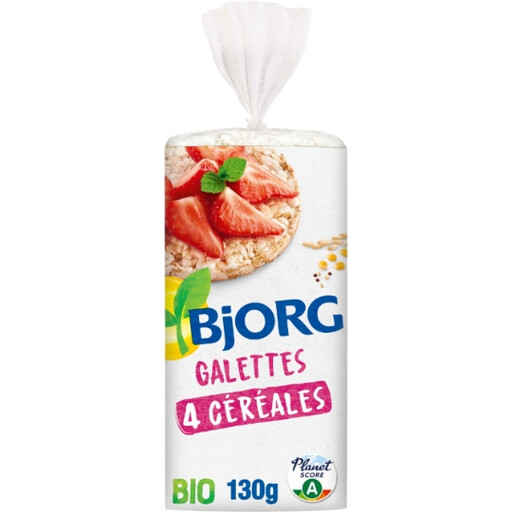 Image unavailable
BJORG 4-Grain Pancake 130 g
A crunchy crispbread to take with you for a break without a fridge. The product description says it’s gluten-free and has a Nutri-Score of A, with 8 g of protein, 3.5 g of fibre and 0.2 g of salt per 100 g. It may contain traces of soya, so check the “gluten-free” claim and allergens on the packaging when you buy it. Reseal the pack after opening.
View on Joybuy
Frequently asked questions
Is a buckwheat crispbread automatically suitable for someone with coeliac disease?
No. Buckwheat alone doesn’t guarantee that the finished product is suitable. If you have coeliac disease, check for the words “gluten-free” on the packaging. AFDIAG also highlights the risk of contamination in products that are naturally gluten-free.
What does “gluten-free” mean on a crispbread?
According to AFDIAG, this claim, which is covered by Regulation (EU) No 828/2014, means the product sold to the final consumer contains less than 20 mg/kg of gluten. If you have any other allergies, also read the other allergens listed on the packaging.
Is the Nutri-Score compulsory in France?
No. The DGCCRF says displaying it is voluntary in France, while a nutrition declaration is required for the relevant prepacked foods. A Nutri-Score on the pack doesn’t replace the “gluten-free” claim or a check of the allergens.
How do you choose a crispbread to keep at work?
If you don’t have access to a fridge, choose a dry crispbread with storage instructions that suit how you’ll use it, and check how to reseal the pack after opening. For a fresh pancake to fill, check the date and make sure you can keep it chilled as directed on the packaging.
Are St Michel’s Galettes au bon beurre BIO gluten-free?
Not this specific product: St Michel’s product information lists wheat flour and names gluten among the allergens. Don’t assume other crispbreads have the same ingredients; check their own labels.


