Who are these criteria for?

Parents managing a diagnosed allergy

Check the specific ingredient your child needs to avoid, rather than relying on a general “free from” claim. Anses stresses the importance of checking the ingredients list if you have an allergy or intolerance. Bars described as gluten-free may contain other allergens.

Families avoiding gluten

Look for a “gluten-free” label on the bar you choose, then check for other ingredients if another exclusion applies. Commission Implementing Regulation (EU) No 828/2014 sets out the rules for information about the absence or reduced presence of gluten.

Parents looking for a handy snack portion

If your main priority is a snack that fits in a lunchbox, check the packaging and the size of each bar. Then compare the sugar content per portion and the ingredients: individual wrapping alone tells you nothing about what a bar contains.

What should you check before choosing?

Start with the dietary restriction that applies to your child, then look at the bar’s format. Your Europe explains that allergens present in a product must be emphasised in the ingredients list.

What matters What to check Who is this for?
Specific allergen The ingredients list for the exact flavour and any precautionary allergen statements, in line with individual guidance. If my child needs to avoid a particular ingredient, I can’t rely on a “gluten-free” label alone. This check would be the top priority for around 42% of consumers.
Avoiding gluten An explicit “gluten-free” label, followed by a check of the other allergens listed on the packaging. If gluten is the ingredient to avoid, I first look for a bar carrying this label, without assuming it is free from other allergens too. This would be the top priority for around 33% of consumers.
Portion size and ingredients The packaging and nutritional information per bar, particularly the sugar content. When preparing a lunchbox without a specific dietary restriction to prioritise, I want a portable portion whose ingredients I can compare with other recipes. Format and this comparison would come first for around 25% of consumers.

Common mix-ups to avoid

  • Confusing “gluten-free” with “allergen-free”

    Auchan, Gerblé and Eat Natural product listings describe gluten-free bars whose recipes include ingredients such as hazelnuts, soya, almonds or peanuts. So a gluten-free claim does not address a different dietary exclusion.

    Start with the ingredient to avoid and check the label for the exact flavour and pack you’re buying, including any relevant precautionary allergen statements for your child.

  • Assuming a fruit-based flavour is suitable

    The Eat Natural almond, cranberry, coconut and dark chocolate bar described by Carrefour contains almonds and peanuts. An Auchan almond and honey bar listing, meanwhile, warns that it may contain traces of milk, peanuts and other tree nuts.

    Check the full ingredients list and any precautionary allergen statements rather than relying on the recipe name.

  • Comparing only the front of the pack

    The number of bars and how they’re presented aren’t enough to compare what’s in a portion. Anses also highlights the risk of children consuming too much sugar.

    When comparing different formats, check the portion actually eaten and the sugar content per bar, as well as the ingredients to avoid.

Brands to know

Auchan

Auchan offers a chocolate cereal bar described as gluten-free, in six 23 g portions individually wrapped.

  • Individual wrapping can make lunchbox preparation easier.
  • The listing for this recipe mentions natural hazelnut flavouring; a listing for an almond and honey recipe warns that it may contain traces of other allergens.

Gerblé

Gerblé’s range includes a chocolate bar described as gluten-free.

  • The Carrefour listing for this product explicitly says “gluten-free”.
  • Its ingredients list includes soya; Carrefour also says it is made in a factory that handles peanuts, tree nuts and milk.

Eat Natural

The brand offers bars containing fruit, seeds or tree nuts, including some products described as gluten-free.

  • The Carrefour listing for the almond, cranberry, coconut and dark chocolate recipe carries a gluten-free label.
  • This same recipe contains almonds and peanuts, so check each variety separately.

Kellogg's

Carrefour lists several formats and recipes of Kellogg's cereal bars.

  • The different pack sizes make it easier to compare formats for your lunchbox.
  • A brand’s presence in this category does not prove that a particular recipe is suitable for someone avoiding a specific allergen.

Nature Valley

A Protein chocolate and cranberry bar is described as gluten-free and individually wrapped.

  • The individual format is useful if you want to control portions.
  • According to the Carrefour listing for this product, the recipe contains peanuts, soya and milk, including lactose.

A bar to consider on Joybuy

This fruit and almond bar is one option to consider for a lunchbox. If your child has a dietary restriction, check the packaging for this recipe before choosing it.
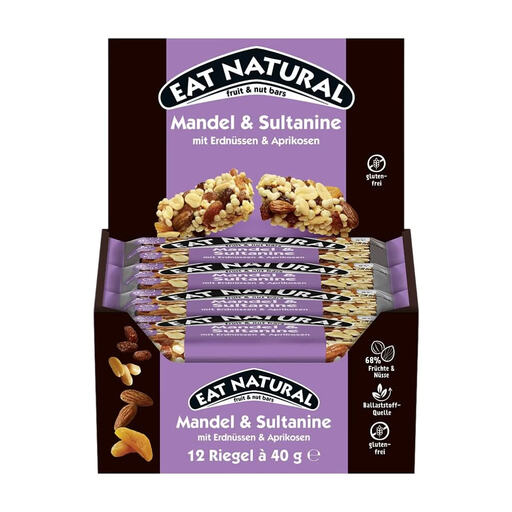
Eat Natural almond, raisin and apricot bar, 40 g

Eat Natural Almond, Raisin & Apricot Fruit & Nut Bar, 40 g

At 40 g, this bar gives you a portion size to compare with other lunchbox bars. Its name indicates that the recipe contains almonds, raisins and apricots. If your child needs to avoid a particular ingredient, check the full ingredients list, any precautionary allergen statements, the “gluten-free” label if needed and the sugar content per bar on the packaging.

View on Joybuy

Frequently asked questions

Is a “gluten-free” bar also free from other allergens?

No. Gluten-free recipes described by Auchan, Carrefour and Gerblé include ingredients such as hazelnuts, almonds, peanuts, soya or milk. If your child needs to avoid any of these ingredients, check the ingredients list and any precautionary allergen statements for the exact product.

Where can you find allergens on a prepacked bar?

Read the ingredients list on the packaging: according to Your Europe, any allergens present must be emphasised there. If you’re packing a lunchbox for a child with an allergy, also check any precautionary allergen statements against the guidance you’ve been given.

What does “gluten-free” mean?

Commission Implementing Regulation (EU) No 828/2014 sets out the rules for information about the absence or reduced presence of gluten in food. If your child needs to avoid gluten, look for this label on the bar you choose; it does not mean that other allergens are absent.

How can you compare two bars for a lunchbox if there are no specific dietary restrictions?

Check the packaging, portion size and nutritional information per bar, particularly the sugar content, then read the ingredients list. If the portions are different sizes, the values per 100 g can also help you compare the recipes on a like-for-like basis.