For a Christmas meal with a guest who has coeliac disease, don’t choose an almond drink based on its ingredients list alone: check that the carton you plan to use says ‘gluten-free’. Then compare the different varieties according to the dish or drink you’re making, paying particular attention to their sugar content, almond content and other ingredients.
Who is this guide for?
Hosts welcoming a guest with coeliac disease
You’re preparing a dish or drink for someone with coeliac disease. France’s national health insurance service stresses that a strict gluten-free diet must be followed for life. Check the label on the exact product you’re buying, just as you would for the other ingredients in the meal.
Anyone making festive desserts and drinks
You’re looking for an unsweetened base for a recipe, comparing the almond content shown on cartons or considering a barista variety for a hot drink. These features don’t remove the need to check separately for a ‘gluten-free’ label if one of your guests has coeliac disease.
Shoppers keeping an eye on sugars and ingredients
You want to compare the sugar content per 100 ml and read the ingredients before choosing. Preferring an unsweetened variety doesn’t, on its own, confirm that it carries a ‘gluten-free’ label.
What should you check?
If you’re catering for a guest with coeliac disease, start by checking the label on the carton you’ve bought. Then choose a variety to suit how you’ll use it and when you plan to open it.
| What to check |
Look for |
Who is this for? |
| Gluten-free label |
The ‘gluten-free’ label on the specific product and size you’re buying, and any relevant warnings. |
If I’m cooking for a guest with coeliac disease, I want to check the carton rather than assume it’s gluten-free from the ingredients. Around 36% of shoppers put this check first. |
| How you’ll use it |
The almond content and ingredients of the unsweetened, intense or barista variety you’re considering. |
For a Christmas dessert or hot drink, I want to choose a variety that suits what I’m making rather than assume they’re all the same. The result in the kitchen is the top priority for around 29% of shoppers. |
| Sugars and ingredients |
The ‘of which sugars’ figure per 100 ml and the list of added ingredients. |
If I’m already controlling the sweetness of a recipe, I want to know what’s in the drink before adding it. Around 21% of shoppers prioritise sugar content and ingredients. |
| Planning your shopping |
Whether the variety you want is available, how much you’ll need and the instructions for use after opening. |
If I’m making several dishes before Christmas, I want to buy the right amount without opening the cartons too early. Around 14% of shoppers put planning their purchase first. |
Mistakes to avoid
-
Confusing ‘plant-based’, ‘lactose-free’ and ‘gluten-free’
An ingredients list without cereals isn’t a substitute for a ‘gluten-free’ label on the product you’re serving to someone with coeliac disease.
Check the carton you’ve actually bought, including its variety and any warnings, then keep the packaging until the meal.
-
Choosing an unsweetened variety without considering your recipe
Unsweetened, higher-almond-content and barista varieties have different ingredients. The suggested use on the carton doesn’t, on its own, guarantee the result you want in your recipe.
Decide whether you’ll use the drink in a sauce, dessert or hot drink, then compare the ingredients, almond content and sugar per 100 ml.
-
Overlooking a nut allergy
A ‘gluten-free’ label doesn’t make an almond drink suitable for someone with an almond allergy. Anses lists almonds as tree nuts.
Check separately whether any guests have allergies, and read the allergen information and any warnings about possible traces before serving.
-
Opening cartons too early
Storage instructions after opening vary by product. Auchan’s product information says its unsweetened almond drink should be used within five days of opening.
Work out how much you’ll need and follow the storage instructions on each carton.
If you open a carton too early, it may no longer be suitable to serve on the day if the stated time limit has passed.
Almond drink brands to know
Alpro
The range includes Unsweetened Almond and an almond Barista variety, designed for different uses.
- Alpro’s product information for Unsweetened Almond states that it contains 0 g of sugars per 100 ml and 2.3% almonds, and carries a ‘gluten-free’ label.
- Joybuy’s product information for Alpro Barista Almond lists fructose and 2.5 g of sugars per 100 ml. If you’re serving a guest with coeliac disease, check the label on the specific variety and carton you’ve chosen; don’t assume that one variety’s label applies to another.
Bio Village / Marque Repère E.Leclerc
E.Leclerc’s product information lets you compare an unsweetened organic almond drink with an intense almond variety.
- According to E.Leclerc, the unsweetened variety contains 2.8% almond purée and 0.2 g of sugars per 100 ml, while the intense variety contains 7% almond purée and 4.1 g of sugars per 100 ml.
- These differences in ingredients don’t confirm that the carton you choose carries a ‘gluten-free’ label. Check it before cooking for someone with coeliac disease.
Auchan
The retailer offers a 1 l carton of unsweetened almond-based plant drink.
- Auchan’s product information states that it contains 2% almonds and should be kept in the fridge between 0 °C and +6 °C, and used within five days of opening.
- If you’re preparing a meal for a guest with coeliac disease, check that the carton you’ve bought carries a ‘gluten-free’ label.
Almond drink on Joybuy
This unsweetened Alpro variety is worth considering for recipes where you want to control the sweetness. If you’re serving it to a guest with coeliac disease, check for a ‘gluten-free’ label on the carton you receive before using it.
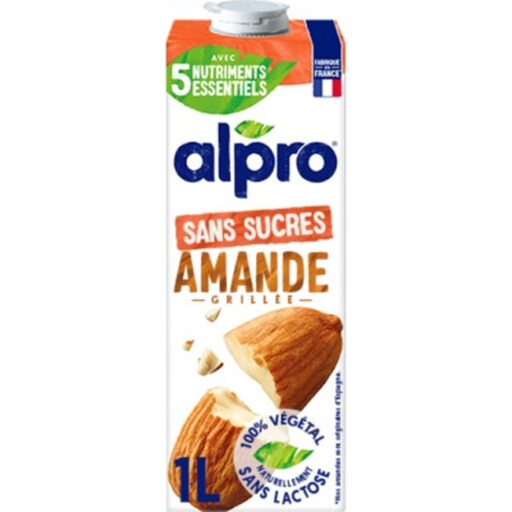 Image unavailable
Alpro Almond Unsweetened UHT 1 l
Worth considering for a recipe where you want to control the sweetness. Joybuy’s product information describes this variety as gluten-free; check the label on the carton you receive before serving it to someone with coeliac disease.
1 l UHT carton. Once opened, follow the refrigeration and use-by instructions on the packaging.
View on Joybuy
Frequently asked questions
Is an ingredients list without wheat enough for a guest with coeliac disease?
No. Check for a ‘gluten-free’ label on the packaging of the exact almond drink you plan to use. The DGCCRF notes that cross-contamination is one of the risks that must be managed for products labelled as gluten-free.
What does ‘gluten-free’ mean on an almond drink?
In the European Union, Commission Implementing Regulation (EU) No 828/2014 sets a maximum gluten content of 20 mg/kg for foods sold to the final consumer carrying this label. A drink described simply as ‘plant-based’ won’t necessarily carry it.
Is almond drink suitable for someone with a tree nut allergy?
Don’t assume it’s suitable without checking the specific allergy and the product label. Anses lists almonds as tree nuts; also read any warnings about possible traces.
How long can you keep a carton after opening?
Follow the storage time and temperature instructions on the carton you’ve bought. For example, Auchan’s instructions for its specific product say to keep it refrigerated between 0 °C and +6 °C and use it within five days of opening.
Is an unsweetened variety suitable for every Christmas recipe?
Not necessarily. Choose according to what you’re making and compare the ingredients rather than relying on the variety name alone. For example, E.Leclerc’s product information gives different almond contents and sugar levels for its Bio Village unsweetened and intense drinks. If the dish is for a guest with coeliac disease, check separately for a ‘gluten-free’ label.


