
Livraison le jour même ou le lendemain

Qualité garantie

Débloquez vos offres de bienvenue: Livraison GRATUITE | Jusqu'à -80 % | 30 jours d'essai gratuits à JoyPlus
Téléchargez l'application
A glue or repair paste can be used to assemble, fill, rebuild or reinforce a wide variety of objects. Yet choosing a product based solely on the words "extra-strong" often leads to disappointment. Metal, wood, ceramic and plastic all have different requirements, and the drying time stated on the packaging doesn't always match the point at which the bond can actually be put under stress.
Here are the key factors to consider before you buy, along with a selection of products suited to different tasks.
A fast-setting glue can hold two pieces together in a matter of minutes, but that doesn't mean it has reached its full strength straight away. Some epoxy glues claim a setting time of 5 minutes, yet complete curing takes 24 hours. Removing clamps or putting the repaired item under load too early can therefore weaken the repair.
A multi-purpose glue isn't necessarily compatible with every surface. The epoxy resins featured here, for example, are not suitable for polyethylene (PE), polypropylene (PP) or PTFE. Similarly, a wood glue won't replace a metal repair paste when you need to fill a hole or rebuild a missing section.
A standard wood glue can work perfectly well on an indoor piece of furniture. However, an item exposed to splashes, condensation or a sheltered outdoor environment needs appropriate moisture resistance. For vinyl-based wood glues, the EN 204 D2 or D3 classification is a useful benchmark.
Before application, surfaces must be clean, dry, dust-free and degreased. A greasy metal surface or overly damp wood will compromise adhesion, even if the formula is marketed as particularly strong.
Depending on the formula, the initial set can take anywhere from 5 to 40 minutes. This is usually enough to position the pieces, but full curing often takes much longer. For a planned joinery project, a standard wood glue gives you more time to adjust the assembly. For a one-off repair, a fast-setting epoxy resin reduces the waiting time, provided you hold the pieces securely in place.
For a repair in a kitchen, bathroom or covered garden shed, a water-resistant wood glue is often a better choice than a standard formula. The D3 classification indicates increased moisture resistance under the conditions specified by the manufacturer, but it doesn't turn the product into a universal solution for permanent immersion.
For metal, some epoxy pastes claim a working temperature range of -30 °C to +120 °C, as well as water resistance, including immersion. However, these figures should always be considered alongside the actual use, surface preparation and curing time.
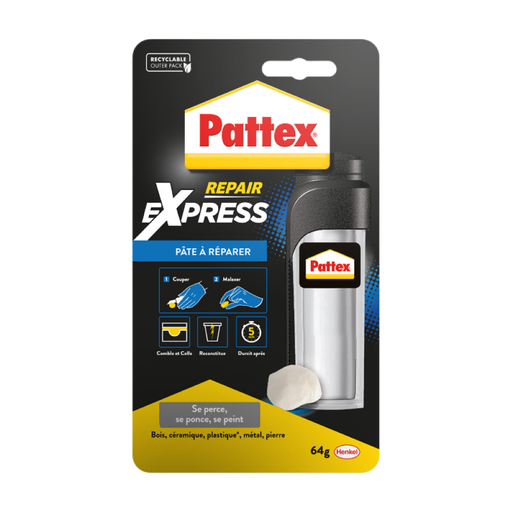
Why this choice suits this profile: Its malleable texture is ideal for small household repairs on wood, metal, ceramic, stone, glass or cement. You can use it to fill, patch, glue and rebuild missing sections.
It doesn't just glue two flat surfaces together: its texture also lets you tackle cracks, holes and irregular shapes. The manufacturer states a set time of 5 minutes and final strength after 24 hours.
A two-component epoxy formula that can be sanded and painted after curing, with claimed resistance to grease, solvents and temperature changes.
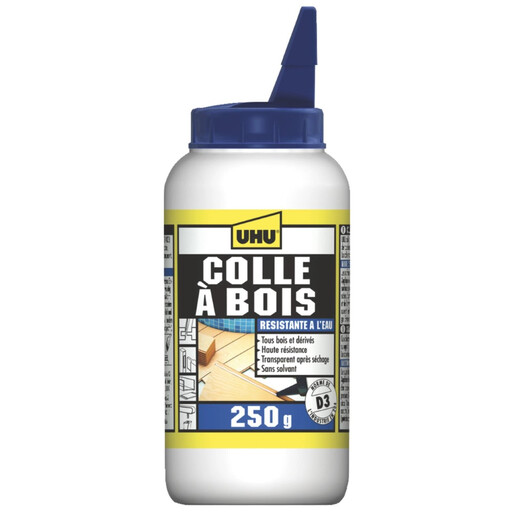
Why this choice suits this profile: This wood glue is designed for careful assemblies, veneers and laminating where moisture is a factor in the project.
The D3 rating provides a more precise technical benchmark than a simple promise of water resistance. However, it shouldn't be taken as a green light for all immersion scenarios.
An initial set claimed at 10 minutes, a solvent-free formula and a clear finish after drying, suitable for softwoods, hardwoods and exotic timbers.
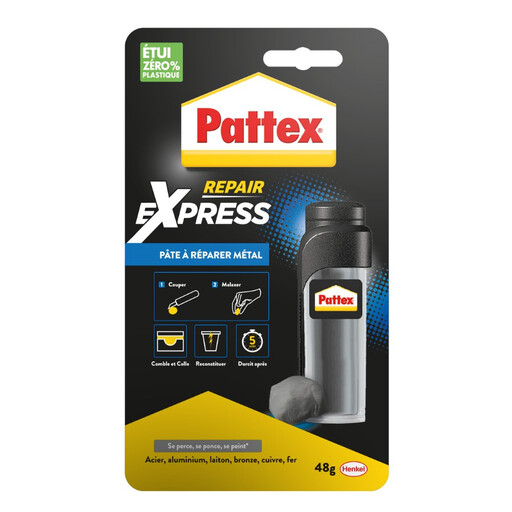
Why this choice suits this profile: Its formula, loaded with metal particles, is designed for steel, aluminium, copper, brass, bronze and iron, for repairs in the workshop, plumbing or on equipment.
Its compatibility is clearly limited to certain metal substrates and excludes PE, PP and PTFE. This clarity prevents you from applying a specialist paste to a plastic it can't bond with.
Claimed water resistance, a temperature range of -30 °C to +120 °C, and a finish that can be sanded, painted or drilled after curing.
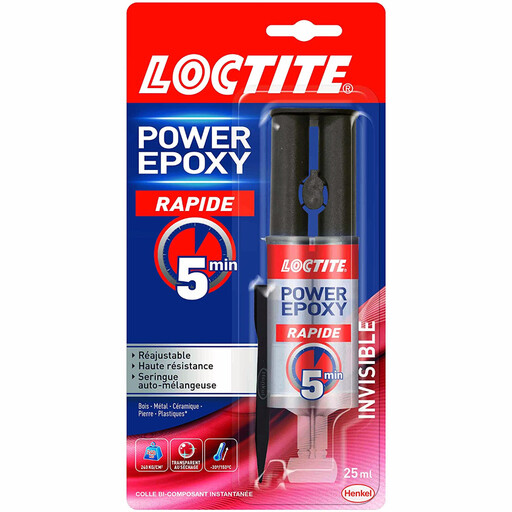
Why this choice suits this profile: Its self-mixing syringe is ideal for repairs that need consistent dosing and a discreet finish on glass, wood, ceramic, stone or metal.
The 5-minute set doesn't mean final curing is complete. The formula fills gaps with no claimed shrinkage, but the pieces must be held in place during the set.
A transparent epoxy adhesive, claimed to be resistant to water, oil and common solvents once cured.
We've put together a comprehensive, real-time updated selection of products that meet these demanding criteria as well as European safety standards.
For a crack, hole or metal area that needs rebuilding, a two-component metal repair paste is often more suitable than a liquid glue. Check its compatibility with steel, aluminium, copper or brass, as well as its water and temperature resistance for your project.
The set can take as little as 5 minutes for some products, but final strength is usually only reached after 24 hours. Always consult the product instructions and avoid putting the assembly under stress before the recommended time has passed.
It can be suitable for certain protected outdoor assemblies, depending on its classification and the manufacturer's guidance. A D3 glue is designed to withstand increased moisture exposure, but its suitability also depends on the design of the item, the fit of the pieces and exposure to the elements.