People who plan their meals
You choose the spices or blends you need for a few recipes and want to use them without having to organise a cupboard full of loose products.


To cook the recipes you have planned for this week without decanting anything, choose pre-filled spices and check that the bottle for your chosen product is made of glass. If you’re buying several loose spices, small bottles you can label are better suited to keeping them organised. Choose a larger airtight jar for a spice or blend you use regularly. For any container you plan to fill, check that it’s suitable for food contact, its capacity and how to care for its closure.
You choose the spices or blends you need for a few recipes and want to use them without having to organise a cupboard full of loose products.
You’re looking for small containers you can label to identify your dried spices and choose the right opening for sprinkling.
You want a dedicated, closed jar for a spice or blend you replenish regularly, while keeping the space you have available in mind.
Start with what you’ll actually buy for the week: a ready-to-use spice, several products to decant or a larger quantity of the same seasoning. Then consider portioning, closure and care to find the right container for the job.
| What you need | What to check | Who it suits |
|---|---|---|
| Ready-to-use spices | Check the weight, the ingredients in any blend and whether the specific product is explicitly described as being in glass. | If I’m making a few specific recipes, I want to buy the flavours I need without having to fill containers. This would be the top priority for around 42% of the consumers concerned. |
| Several loose spices | Compare the capacity of each jar, the labels and the dispensing openings. Check which parts are dishwasher-safe. | When I have several spice packets to put away, I want to identify what’s inside quickly and be able to measure it out. Around 33% of the consumers concerned would prioritise this kind of organisation. |
| A seasoning you use often | Check that it’s suitable for food contact, along with the closure, capacity and care instructions for the lid. | For a seasoning I replenish regularly, I prefer a dedicated, closed container that’s the right size for how I use it. Storage would be the main priority for around 25% of the consumers concerned. |
Ducros describes its new bottles as being made of glass, but that doesn’t necessarily apply to every product called a “bottle”. For example, Carrefour’s product listing for a 39 g Ducros Provençal herb blend uses the term without specifying the material.
If glass is important to you, look for it on the packaging or on the product listing for the exact item you’re buying.
An item that looks like a food jar isn’t necessarily designed for storing spices. The DGCCRF recommends using containers intended for food and not reusing those designed for single use.
Before decanting, check that the container is intended for food and follow its instructions for use.
A set is for organising spices you’ve bought separately: Lidl states that spices aren’t included in its Silvercrest set. Filling and labelling the bottles are also part of using it.
Choose the number of bottles according to how many spices you plan to decant, then allow time to fill and label them.
For its 350 ml airtight glass and wood jar, Le Parfait says the wooden lid must not be washed with water. This is worth bearing in mind if you want to wash every part in the same way.
Check the care instructions for the glass, seal and lid separately, and fill the jar when it’s clean and dry.
Pre-filled spices, herbs and blends for cooking, with no need to fill a container yourself.
A set of small, empty bottles for storing and identifying several spices.
An empty 350 ml glass and wood jar, designed for spices and seasonings, among other uses.
For storing dried spices in a container you fill yourself, this selection features a 600 ml glass jar. Compare its capacity with the amount you actually use; it isn’t a replacement for a pre-filled spice bottle.
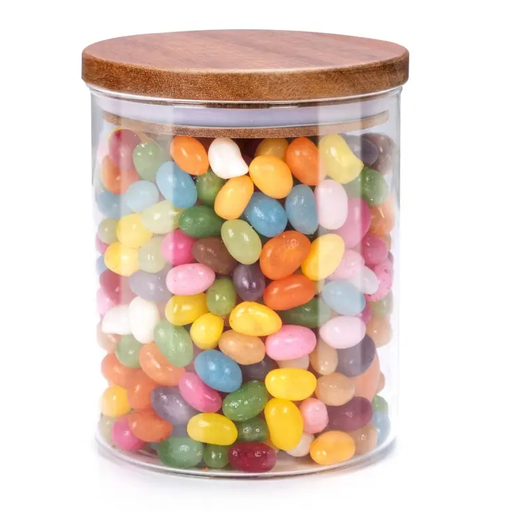 Image unavailable
This glass jar is designed for storing dried spices, among other things.
Stated capacity: 600 ml. If you want to measure out spices directly from the jar, check that its opening suits your needs.
The acacia lid needs to be cleaned by hand and must not be immersed in water. Bear this in mind if you prefer to wash every part with water.
No. Choose a container intended for food contact and follow its instructions for use. The DGCCRF explains that the glass-and-fork symbol can help you identify suitable containers, unless their intended use for food is obvious. Don’t reuse a single-use container.
Choose according to how much you buy and how often you use it, rather than choosing the same capacity for every spice. A pre-filled bottle saves you having to decant the contents. The Silvercrest bottles, at around 100 ml each, are for organising several spices, while the 350 ml Le Parfait jar suits a seasoning you replenish regularly.
No. Care instructions vary by model and by component. Lidl says that only the glass container from the Silvercrest set, without its label, is dishwasher-safe. Le Parfait says the wooden lid on its 350 ml jar must not be washed with water.
Yes, if you choose empty containers such as the Silvercrest set described by Lidl: spices aren’t included. A pre-filled spice bottle saves you this step, but check the ingredients and weight, especially if you need a blend for a specific recipe.
Glass packaging should be sorted for recycling in line with the French Ministry for Ecological Transition’s guidance. Check the product’s Info-tri label if you need specific sorting instructions. If you’d rather reuse a container for storing spices, make sure it’s intended for that purpose, and that it’s clean and dry.