
Livraison le jour même ou le lendemain

Qualité garantie

Débloquez vos offres de bienvenue: Livraison GRATUITE | Jusqu'à -80 % | 30 jours d'essai gratuits à JoyPlus
Téléchargez l'application
With a growing awareness of the materials we use in the kitchen, many households are turning to healthier and more sustainable alternatives. The glass pot is emerging as a prime choice for those who want to combine transparency, hygiene, and performance. A far cry from sometimes controversial non-stick coatings, glass offers an inert and non-porous cooking surface.
As a Joybuy Product Recommendation Officer, my role is to help you navigate the available options to make an informed choice that aligns with your habits and quality standards. This guide focuses on the essential criteria to consider before investing in a glass stockpot.
Choosing cookware should not be taken lightly. Here are a few practical tips to guide you.
Not all glass pots are created equal. The fundamental criterion is the type of glass used. Borosilicate glass is highly recommended for cooking. Its chemical composition gives it superior resistance to thermal shock—that is, rapid changes in temperature. This significantly reduces the risk of cracks or breakage when moving an oven-safe casserole dish to a colder work surface, for example. It's a guarantee of safety and durability for your investment.
Before making a purchase, check the pot's compatibility with your hob. Most glass models are designed for gas and electric hobs. However, glass is not natively compatible with induction, which operates via a magnetic field. If you have an induction hob, ensure the manufacturer offers an adapter disc to place between the hob and the pot, or consider a different material. Also, remember to check the maximum supported temperature if you plan to use it in the oven.
A good pot should be easy to use. Look at the handles: are they integrated into the structure or attached separately? Moulded, one-piece handles are often more robust. A well-fitted lid is essential for retaining heat and moisture, ensuring even cooking. A transparent pot with a lid offers the unique advantage of allowing you to monitor your food without lifting the lid, thus preventing heat loss. Some models even include a pouring spout, a practical detail for serving soups and broths without dripping.
Taking into account quality, safety, and practicality, here are two options that stand out in the market.
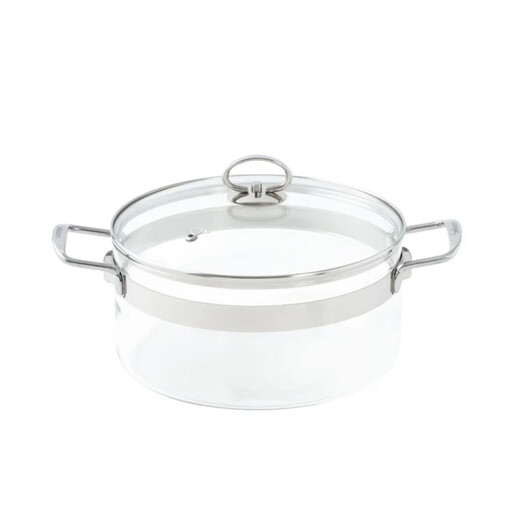
Why we recommend it
This model meets the needs of families or those who enjoy cooking in large quantities. Its 4.2-litre capacity is ideal for soups, stews, or cooking pasta. Made from borosilicate glass, it ensures healthy, PFAS-free and PTFE-free cooking, as the material is completely inert and has no coating. Its full transparency is a major asset for monitoring your cooking at a glance.
Pros
Who is this product for? For families and cooks who regularly prepare large-quantity meals and are looking for a non-toxic pot that is easy to monitor.
See product details on Joybuy.fr
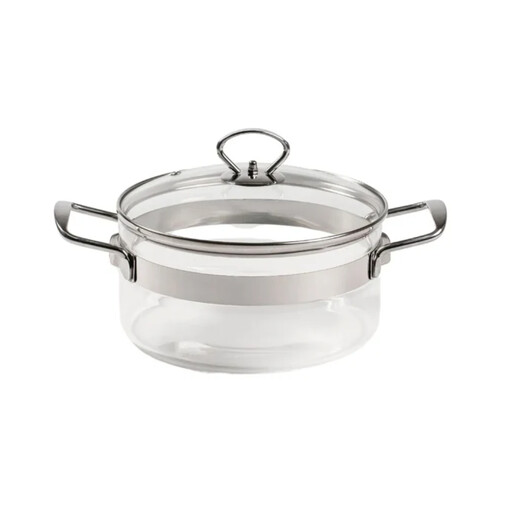
Why we recommend it
More compact, this 2.5-litre glass casserole dish is an excellent choice for couples, small families, or for preparing side dishes. It shares the same material qualities as the larger model: healthy, uncoated, and durable borosilicate glass. Its versatility is its key feature, as it moves easily from the hob to the oven (up to 180°C), making it a multifunctional tool for searing, simmering, and then browning a dish.
Pros
Who is this product for? For individuals, couples, or anyone looking for a medium-sized, oven-safe casserole dish for varied daily use.
See product details on Joybuy.fr
While a glass pot offers many advantages, especially for simmering on the hob, some users may prefer other solutions for oven cooking. If your priority is achieving perfectly even heat and precise temperature control for roasts, gratins, or baked goods, exploring modern cooking technologies could be a worthwhile path.
For those looking to optimise their oven baking and roasting, we invite you to discover our selection of Electric Ovens, which offer advanced features for consistently perfect results.
Generally, no. Glass is not a magnetic material and therefore does not react with induction hobs. However, some brands, like the Belissam models featured, offer an induction adapter disc (sold separately) that is placed between the hob and the pot to make it compatible. It is essential to verify this information before purchasing.
The main advantages are:
The main precaution is to avoid thermal shock. Never place a hot pot directly on a cold, wet surface or under cold water. Let it cool down gradually. For cleaning, although glass is durable, it is advisable to avoid abrasive sponges that could scratch it. Hand washing with warm, soapy water is often sufficient to maintain its clarity. Finally, handle it with care to avoid physical impacts that could weaken it.