For study snacks, choose a glass jar sized to suit the number of people sharing it and how often you’ll eat it. A small jar is easier to finish if you only use it occasionally, while a larger size may suit a household that shares it. Then compare the recipe, allergens, nutritional values per 100 g and storage instructions after opening. If a Nutri-Score is shown, it can be a useful guide.
Who is this option for?
Anyone preparing individual snacks
If you only open the jar now and then between study sessions, a smaller size may be easier to finish. Compare the net weight and storage instructions after opening. Carrefour, for example, lists a 250 g Jardin Bio étic glass jar.
Households sharing snacks
A larger size may suit several people, provided you can finish it within the timeframe stated for the product. Lucien Georgelin offers its organic hazelnut and cocoa range in 280 g, 400 g and 600 g glass jars.
Anyone keeping an eye on ingredients
If particular ingredients or allergens matter to you, check the exact recipe rather than relying on the jar material alone. Depending on the product, Carrefour and Lucien Georgelin list nuts, milk, soya or possible traces of other ingredients.
What should you check before buying?
When choosing a spread in a glass jar for study snacks, start with how often you’ll eat it, then check the recipe and the label on the exact product.
| What matters to you |
What to check |
Who it matters to |
| Size and storage |
Compare the net weight and storage instructions after opening. Lucien Georgelin’s 400 g organic product advises consuming it within 18 days. |
For occasional individual snacks, I want to avoid leaving a large jar open for too long. Around 29% of consumers prioritise choosing a size that suits how often they eat it. |
| Recipe and allergens |
Read the ingredients and any warnings about traces on the exact product. Don’t assume an ingredient is present or absent based on the range name alone. |
If I need to avoid an ingredient, the exact composition matters more than the look of the jar. Finding a recipe that meets their needs is the main priority for around 36% of consumers. |
| Nutritional information |
Compare the sugars and energy per 100 g; check the Nutri-Score if it appears on the packaging. |
If I’m comparing different recipes for my snacks, I need values shown on the same basis. Around 21% of consumers prioritise this nutritional comparison. |
| Product availability |
Check the size and jar material on the product listing offered by your retailer. |
I want to find the packaging I’m looking for in a size that suits me, without assuming the whole range comes in glass. Around 14% of consumers put this match between product and need first. |
Mistakes to avoid
-
Assuming a Nutri-Score is required
According to the European Commission, displaying nutrition information on the front of packaging is voluntary under current European Union rules. The absence of a Nutri-Score does not mean you can skip the nutrition declaration required for most prepacked foods.
Use the score when it’s shown, then compare the nutritional values per 100 g for the product you’re interested in.
-
Choosing a large jar without checking storage instructions after opening
A sharing size is only practical if it suits how often your household eats it. Lucien Georgelin advises consuming its 400 g organic product within 18 days of opening.
Check the instructions for the specific product before choosing between a small jar and a family size.
-
Assuming allergens from the product name
Ingredients and allergen warnings vary from one recipe to another. Carrefour’s listing for Jardin Bio étic Délicieux de noisette, for example, warns that it may contain traces of peanuts, other nuts and sesame.
If you need to avoid certain ingredients, check the ingredients and allergen information for the exact product every time you buy it.
-
Assuming the glass jar indicates a particular nutritional profile
The jar material tells you nothing about the recipe. Carrefour lists 641 kcal and 54 g of fat per 100 g for Jardin Bio étic Délicieux de noisette, which comes in a glass jar.
Check the packaging, ingredients list and nutritional values separately.
Brands to know when comparing products
Jardin Bio étic
Carrefour lists Délicieux de noisette in a 250 g glass jar, a size to consider if you eat it occasionally.
- Carrefour’s listing states that it contains 80% hazelnuts and has a recyclable metal lid.
- It warns that the product may contain traces of peanuts, other nuts and sesame. Compare its nutritional values per 100 g, too.
Lucien Georgelin
The brand offers its organic hazelnut and cocoa range in 280 g, 400 g and 600 g glass jars.
- These sizes let you choose a quantity to suit the number of people eating it.
- The 400 g organic product contains 55 g of sugars per 100 g and should be consumed within 18 days of opening. Check the instructions for the size you choose.
Nutella
This hazelnut and cocoa spread can be a useful recipe comparison, but don’t assume every jar available is made of glass.
- Carrefour’s listing lets you check the ingredients, which include hazelnuts and cocoa.
- It also lists milk and soya lecithins. The brand owner does not provide a Nutri-Score on this listing, so check the nutritional information and confirm the material of the exact jar.
Rigoni di Asiago
The brand describes Nocciolata as a range of organic cocoa and hazelnut spreads.
- The Auchan catalogue lists a 650 g size of Nocciolata, among others.
- If a glass jar is important to you, check the packaging, ingredients and nutritional information for the exact product.
The Joybuy selection
This selection features a 400 g speculoos spread, which could be shared as a snack. If a glass jar is important to you, check the packaging for this product before choosing.
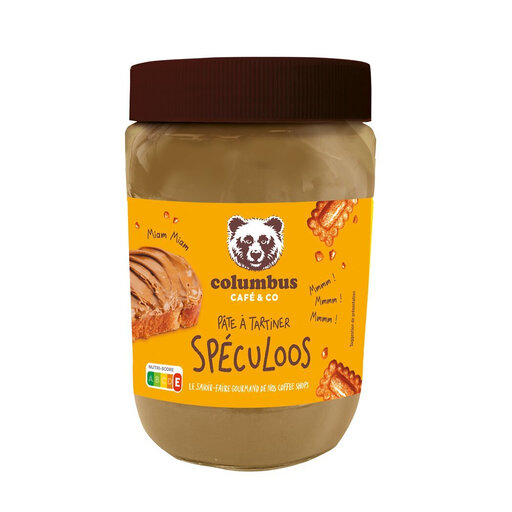 Image unavailable
COLUMBUS Speculoos Spread 400 g
The 400 g size may suit shared snacks if you can follow the storage instructions after opening. Check the packaging for the jar material, ingredients, allergens and nutritional information for this product.
View on Joybuy
Frequently asked questions
Is a Nutri-Score required on a spread sold in France?
No. According to the European Commission, displaying nutrition information on the front of packaging is voluntary under current European Union rules. However, most prepacked foods must carry a nutrition declaration. If no Nutri-Score is shown, check the values per 100 g in particular.
Does a glass jar tell you what’s in the spread?
No. Glass describes the packaging, not the recipe. Carrefour lists Jardin Bio étic Délicieux de noisette in a glass jar and gives values of 641 kcal and 54 g of fat per 100 g for this product. Check the ingredients and nutritional values separately.
What size should you choose if you only eat spread occasionally?
A smaller size may be easier to finish, but check the product’s storage instructions first. Lucien Georgelin advises keeping its 400 g organic product away from heat and moisture after opening and consuming it within 18 days.
What should you check if you need to avoid certain allergens?
Read the ingredients and any warnings about traces for the exact product. Carrefour’s Nutella listing includes hazelnuts, milk and soya, among other ingredients. Its listing for Jardin Bio étic Délicieux de noisette warns that it may contain traces of peanuts, other nuts and sesame.


