To make sandwiches for school, first choose a spread whose ingredients and allergens are suitable for your child, then check the size and storage instructions. A glass jar can be useful for storing spread at home, but its material alone does not mean it can be taken to school in a bag. Check the school's rules and, if a medical diet requires adjustments, follow the Individualised Welcome Plan (PAI).
Who are these options for?
Parents managing an allergy or intolerance
When preparing a meal for a child with an allergy or intolerance, check the ingredients of each product rather than relying on the brand name. The French Ministry of the Economy says allergens in prepacked foods must be emphasised. The French Ministry of National Education explains that an Individualised Welcome Plan (PAI) can set out any adjustments needed at school.
Parents looking for a small jar to use at home
If you make sandwiches before heading out, jar size mainly matters for storage and serving. Belle France offers a 200 g hazelnut spread in a glass jar; this does not mean the jar is allowed at school.
Households making several lunch boxes
A family-sized jar may be a good fit if you make several sandwiches at home. Carrefour Bio, Auchan and Bonne Maman list products in sizes from 700 g to 750 g. Compare their ingredients and storage instructions before choosing.
What should you check before buying?
For a school lunch box, the product’s ingredients and the school’s requirements come before the choice of jar. Size, nutritional information and storage instructions can then help you compare products suited to this use.
| What matters |
What to check |
Who it matters to |
| Allergens and school meals |
Check the ingredients, emphasised allergens and any ‘may contain’ warnings on the exact product. If needed, check the arrangements set out in the PAI. |
If a child has an allergy or follows a medical diet, the recipe’s suitability and meal arrangements matter more than the container. Around 36% of consumers put this need first. |
| Size and container |
Confirm the material and net weight of your chosen product, then ask the school which containers it allows. |
When making a sandwich at home, some consumers mainly want a jar that is easy to store and serve from, without intending to send the glass jar to school with their child. This is a priority for around 29% of them. |
| Nutritional information |
Compare the nutritional values per 100 g and the ingredients list; check the Nutri-Score if it appears on the packaging. |
If several recipes are already suitable for your child, comparing sugar and fat content may become the main consideration. Around 21% of consumers prioritise this information. |
| Storage at home |
Check the storage instructions for your chosen jar, particularly after opening, and choose a size that suits how often you use it. |
A household that often makes several lunch boxes may simply want to use its jar as directed, without keeping a large quantity for longer than necessary. This is the main consideration for around 14% of consumers. |
Which common mistakes should you avoid?
-
Assuming a glass jar is allowed at school
The words ‘glass jar’ describe the product’s packaging, not the conditions under which a child can carry it. This is useful information when choosing a jar to store and use at home.
Before sending a portion to school, check the school’s rules and put it in a container the school allows.
-
Assuming every jar must display a Nutri-Score
According to the French Directorate-General for Competition Policy, Consumer Affairs and Fraud Control, displaying the Nutri-Score is voluntary in France. Nutritional information on prepacked foods is generally mandatory.
Compare the nutritional information per 100 g and the ingredients. Use the Nutri-Score as additional guidance when it is displayed.
-
Inferring allergens from ‘organic’ or ‘palm oil-free’ claims
These claims do not describe all the ingredients. Product listings for Carrefour Bio, Auchan, Bonne Maman and Funkie specify ingredients such as hazelnuts or milk, depending on the recipe, and may also mention possible traces.
Read the label on the exact product and check any ‘may contain’ warnings. If your child has a PAI, follow the dietary arrangements set out in it.
Brands to consider by recipe and size
Belle France
The Belle France shop offers a 200 g hazelnut spread in a glass jar, worth considering for storage and serving at home.
- The material and weight are included in the product name.
- Check the ingredients and allergens on the exact jar. Its size does not tell you what the school allows children to bring.
Carrefour Bio
The 700 g hazelnut spread is suited to households that make several portions at home.
- Carrefour’s product listing states that this recipe contains 13% hazelnuts and is palm oil-free.
- The same listing mentions skimmed milk powder and possible traces of soya and other tree nuts.
Auchan
The 750 g jar of Pasta Cao spread is worth considering if you make several portions at home.
- Auchan’s product listing states that this product contains 13% hazelnuts.
- It also mentions milk and the possible presence of other tree nuts. Check the label on the jar you buy.
Bonne Maman
The 725 g hazelnut and cocoa spread is another family-sized option to compare.
- The product listing published by Auchan states that it contains 20% hazelnuts and is palm oil-free.
- This product contains hazelnuts and milk and may contain other tree nuts. Its listing says to store it away from heat and light and not to refrigerate it.
Funkie
The 200 g product offers a chance to consider a spread made with red bean purée rather than a classic hazelnut and cocoa recipe.
- Carrefour’s product listing states that it contains 28.2% red bean purée and 21% roasted hazelnuts.
- It still contains hazelnuts, so bear this in mind if your child has a hazelnut allergy.
A spread to consider on Joybuy
This speculoos spread is worth considering for making sandwiches at home. It is different from the hazelnut and cocoa recipes featured above, so check its ingredients before choosing it for a school lunch box.
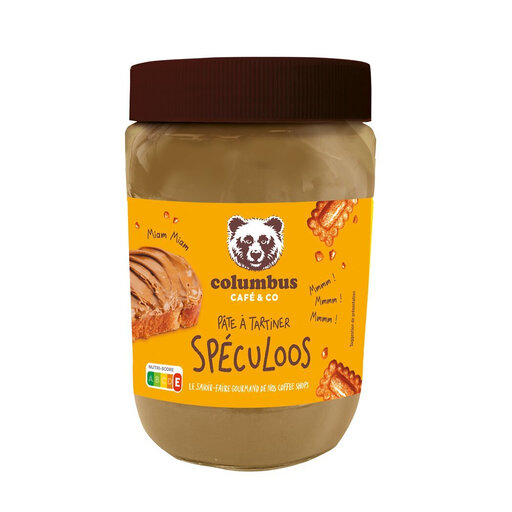 Image unavailable
COLUMBUS Speculoos Spread, 400 g
Worth considering for making sandwiches at home. Check the product’s ingredients and allergens before serving it to a child, and check the school’s rules on the container used in their lunch box.
View on Joybuy
Frequently asked questions
Is the Nutri-Score compulsory on spreads sold in France?
No. According to the French Directorate-General for Competition Policy, Consumer Affairs and Fraud Control, displaying it is voluntary. Nutritional information is generally mandatory for prepacked foods and lets you compare the sugar and fat content per 100 g, among other things.
Does spread always contain gluten?
No. Neither the category ‘spread’ nor serving it on bread tells you what is in the jar. If gluten or another ingredient could be an issue for your child, read the ingredients list and allergen information for the product you choose.
How should you prepare a lunch box if your child has a food allergy?
Check the allergens in the exact product and the meal arrangements made for your child. According to the French Ministry of National Education, an Individualised Welcome Plan (PAI) can be set up if an allergy or medical diet requires adjustments at school.
How should you store spread after opening?
Follow the instructions on the product you choose. For its 725 g hazelnut and cocoa spread, the Bonne Maman listing published by Auchan says to store it away from heat and light and not to refrigerate it. These instructions do not automatically apply to other recipes.


