Who is this guide for?

Those who prefer a glass jar

If you’re preparing snacks to share and want a glass container, look for an explicit statement on the product page or packaging. Ferrero confirms that Nutella comes in a glass jar; Carrefour specifies glass for its Jardin Bio étic ‘Délicieux de noisette’ product.

Those who compare recipes first

If ingredients or allergens will determine your choice, read the list for the exact product and compare its nutritional information per 100 g. A Nutri-Score, when displayed, is no substitute for these details.

Groups choosing the right size

If you’re buying for several people or regular sessions, the net weight can help you choose a jar the group can use while following the storage instructions. A larger size won’t necessarily suit occasional use.

What should you look for?

For gaming snacks, first confirm the container if glass is essential, then check the recipe and how much you expect to use.

Criteria What to check Who is it for?
Jar material Look for the word ‘glass’ stated explicitly for the product you’re considering; don’t rely on the word ‘jar’ alone. I want to keep or recycle a glass jar after our snacks, so I need confirmation of the material before choosing. Around 40% of consumers make this their priority.
Recipe and allergens Compare the nutritional values per 100 g and read the ingredients and allergen information provided. If anyone in the group needs to avoid certain ingredients, I check the exact product before serving it. This comes first for around 30% of consumers.
Size Match the net weight to the number of people, how often you meet and the storage instructions. For the occasional snack, I prefer a quantity we can use; for regular sessions, a different size may be more suitable. Around 30% of consumers prioritise getting the size right.

Mistakes to avoid

  • Assuming every jar will show a Nutri-Score

    According to the French Ministry of the Economy, displaying the Nutri-Score is optional in France. Its absence doesn’t tell you anything about the recipe.

    Use it if it appears on the packaging, but also compare the nutritional values per 100 g. The DGCCRF specifies this basis for the nutrition declaration of relevant food products.

  • Assuming ‘jar’ means it’s made of glass

    The name of the container doesn’t necessarily tell you what it’s made from. This is a separate consideration from the recipe and net weight.

    Look for an explicit statement on the product page or packaging for the item you’re buying.

  • Choosing a large size without planning how you’ll use it

    A jar intended for several sessions may be more than a group that meets infrequently needs.

    Choose the weight to suit the number of people, how often you’ll be having snacks and the product’s storage instructions.

  • Judging the nutritional profile by a recipe claim

    Claims such as ‘organic’ or ‘palm oil-free’ describe specific features, not the full nutritional information.

    Check the ingredients, allergens and values per 100 g separately for the jar you’re considering.

Brands and retailers to consider

Nutella

Hazelnut and cocoa spread available in several sizes. Ferrero states that Nutella comes in a glass jar.

  • The manufacturer confirms the jar material.
  • The Joybuy product pages mentioned list hazelnuts, milk and soya; check the details on the product you receive.

Jardin Bio étic

Carrefour describes its 250 g ‘Délicieux de noisette’ product as a glass jar with a metal lid.

  • The material is specified for this product.
  • The Carrefour product page mentions possible traces of peanuts, other nuts and sesame.

Carrefour Bio

Carrefour describes a 700 g jar of organic hazelnut spread with no palm oil.

  • The size and recipe features are listed for this product.
  • If glass is essential, check the packaging or ask the retailer about the material before choosing this jar.

ALDI

The retailer offers spreads with different recipes and sizes across its range.

  • The products on offer give you several sizes to consider.
  • Check the recipe and material of each jar directly on its packaging.

Lidl

Lidl has, for example, offered a 400 g jar of Favorina speculoos spread, which is different from a hazelnut and cocoa recipe.

  • This product may appeal if you’re looking for a speculoos recipe.
  • Check the container and product available in your store rather than assuming it’s a glass jar.

Nutella sizes available on Joybuy

These three Nutella hazelnut and cocoa spreads differ in size. Ferrero states that Nutella comes in a glass jar; if this material is essential, confirm that the specific size you’re buying comes in a glass container.
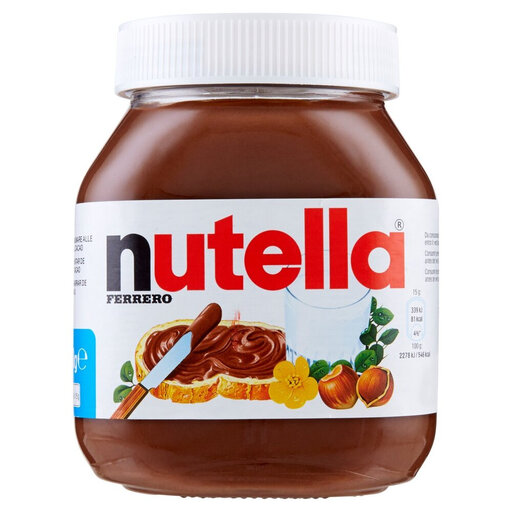
630 g jar of Nutella hazelnut spread

Nutella hazelnut spread, 630 g

This size could be a good choice if you’re sharing the spread but don’t need a one-kilogram jar. Check the packaging for allergens, including hazelnuts, milk and soya, as well as the storage instructions.

View on Joybuy

1 kg jar of Nutella hazelnut and cocoa spread

Nutella hazelnut and cocoa spread, 1 kg

Consider the 1 kg jar if you have regular sessions and will use this amount. Check the packaging for allergens, including hazelnuts, milk and soya, and follow the storage instructions.

View on Joybuy

3 kg jar of Nutella chocolate and hazelnut spread

Nutella chocolate and hazelnut spread, 3 kg

Choose this 3 kg size only if you genuinely need that much. The product page says to keep the lid tightly closed and not to refrigerate the product; also check the packaging for allergens if anyone in your group needs to avoid them.

View on Joybuy

Frequently asked questions

Is the Nutri-Score compulsory on spread sold in France?

No. The French Ministry of the Economy says this logo is optional. To compare two prepacked spreads, check their nutritional values per 100 g, even if one doesn’t display a Nutri-Score.

What should you compare between two spread recipes?

Compare their nutritional information using the same 100 g basis, then read their ingredient lists. The DGCCRF says that the nutrition declaration for relevant prepacked foods includes, among other things, energy, fat, sugars, protein and salt.

How can you check for allergens before sharing snacks?

Read the label on each product you’re planning to share with the group. The DGCCRF says allergenic ingredients must be highlighted; also check for any ‘may contain’ statements, as these vary from product to product.

Is a product described as a ‘jar’ necessarily made of glass?

No: the term alone doesn’t tell you what it’s made from. Ferrero confirms that Nutella comes in a glass jar, while Carrefour describes Jardin Bio étic ‘Délicieux de noisette’ as a glass jar with a metal lid. For any other product or size, check the information for the specific container you’re choosing.