
Livraison le jour même ou le lendemain

Qualité garantie

Débloquez vos offres de bienvenue: Livraison GRATUITE | Jusqu'à -80 % | 30 jours d'essai gratuits à JoyPlus
Téléchargez l'application
Tired of plastic containers that warp in the dishwasher, stain at the first sight of tomato sauce, and hold on to the odours of your meals?? Are you dreaming of a healthier solution for your food, a more sustainable one for the planet, and, let's be honest, a more stylish one for your fridge?? The glass food storage container stands out as the ideal alternative for families and meal prep enthusiasts.
As independent experts, our mission is to help you navigate the options. This guide breaks down the essential criteria for choosing food containers that truly meet your needs, without you falling for marketing hype.
Before we get to our top picks, here are the key points to consider to make the right choice.
Glass is praised for its absolute neutrality: it doesn't retain odours or stains, and it doesn't leach any substances into your food. Borosilicate glass, in particular, is highly sought after for its incredible resistance to thermal shock. This is what allows you to move a dish from the freezer to the microwave worry-free.
However, glass isn't the only option. Stainless steel, for example, is lightweight, unbreakable, and virtually indestructible, making it a prime choice for picnics or kids' snacks. As for high-quality, guaranteed BPA-free plastic, it remains a budget-friendly and feather-light solution that's unbeatable for transport. Your choice will ultimately depend on your intended use.
The effectiveness of an airtight food container rests entirely on its lid. Systems with four-sided locking clips and a silicone gasket guarantee a leak-proof seal. This is a non-negotiable feature if you plan on transporting saucy dishes or soups in your glass lunch box. Also, check that the lid is easy to clean and that the gasket can be removed for a thorough wash.
To optimise space in your cupboards and fridge, opt for a set of food containers in various sizes but with consistent shapes. Square or rectangular models are much easier to store than round ones. A stackable design is a real bonus for streamlined storage. A glass bento set with multiple compartments or an assortment of sizes will offer you maximum versatility, whether for storing leftovers, prepping meals in advance, or packing your lunch.
Here are the models that caught our eye, for all uses and budgets.
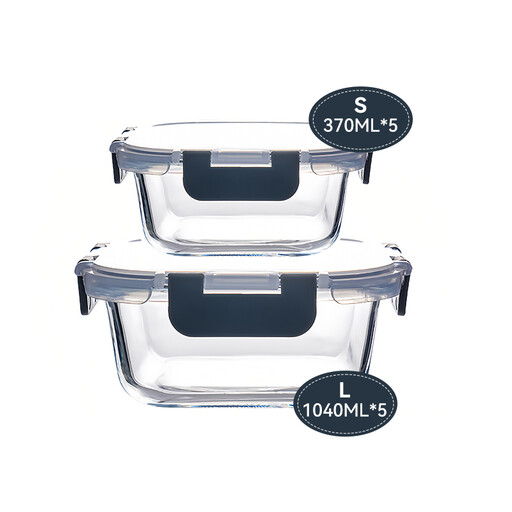
Why this set stands out: This set of food containers is the perfect solution to get fully equipped in one go. It combines two very practical sizes (370?ml and 1040?ml), suitable for both individual portions and family-sized meals. The high-density borosilicate glass ensures excellent durability and a safe transition from freezer to microwave.
Advantages:
Who is it for? For meal prep enthusiasts, families looking to replace their entire arsenal of plastic containers, or simply anyone seeking an all-in-one, healthy, and long-lasting solution.
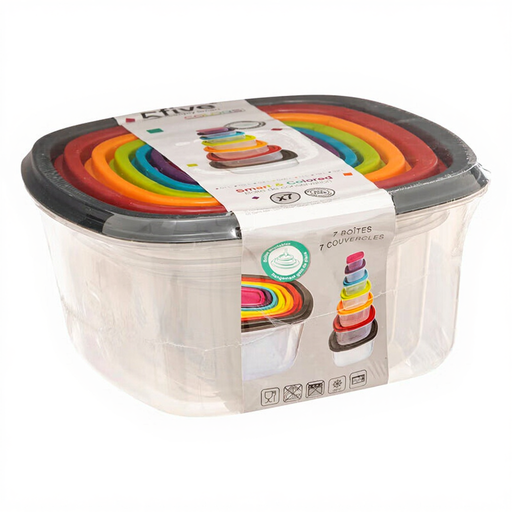
Why this set stands out: For those primarily seeking a lightweight, easy-to-organise, and budget-friendly option, this polypropylene set is an excellent alternative. The different colours make it easy to identify contents or assign a container to each family member. The nesting design is a real space-saver for storage.
Advantages:
Who is it for? Ideal for students, for organising dry ingredients in the pantry, or for anyone who wants a lightweight and economical solution for storing cold or room-temperature foods.
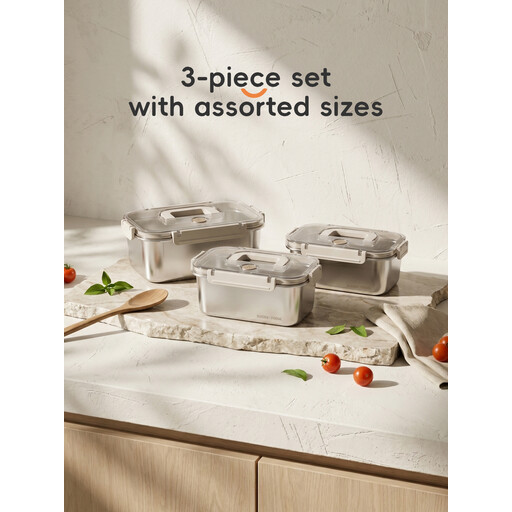
Why this set stands out: This set is the perfect alternative to glass for those worried about breakage. The food-grade 304 stainless steel is robust, lightweight, and perfectly hygienic. Its reinforced locking clip lids make it an ultra-reliable option for transport.
Advantages:
Who is it for? For adventurers, families with young children, or anyone needing sturdy, high-capacity containers for their outdoor activities.
Choosing the right storage container is an excellent start to a more organised kitchen. To go further and optimise your cupboards, pantry, or refrigerator, consider complementary storage solutions.
For top-notch organisation, take a look at our range of plastic storage drawers, perfect for structuring your spaces from top to bottom.
1. What is the difference between borosilicate glass and regular glass? Borosilicate glass contains boron trioxide, which gives it far superior resistance to thermal shock. In practical terms, this means you can take a glass dish with a lid from the refrigerator to the microwave without risking a crack, which is strongly advised against with regular glass (known as "soda-lime glass").
2. Are the plastic lids on glass containers safe? Yes, provided you choose them carefully. Reputable manufacturers use food-grade plastics that are guaranteed BPA-free (bisphenol A). It is crucial to check that this is mentioned on the packaging. When reheating in the microwave, it is recommended to remove the lid or to place it on top of the dish without locking it.
3. Can you put a glass container directly from the freezer into the microwave? Yes, as long as it is made of borosilicate glass. This is one of the major advantages of this material. As a precaution, it is still advisable to let the dish rest for a few minutes at room temperature to avoid a sudden thermal shock. Be careful not to move it directly from the freezer to a preheated conventional oven.