
Livraison le jour même ou le lendemain

Qualité garantie

Débloquez vos offres de bienvenue: Livraison GRATUITE | Jusqu'à -80 % | 30 jours d'essai gratuits à JoyPlus
Téléchargez l'application
Switching to glass for food storage is an excellent idea: it's a healthy, durable material that doesn't retain odours or stains. However, buying a set of glass food storage containers can quickly become a headache. A lid that leaks in your bag, a dish that cracks at the first thermal shock… These setbacks are common and often linked to technical details that packaging glosses over.
Before you make your choice, let's break down the two most common pitfalls:
This guide breaks down the technical criteria you need to check to choose a set of containers that won't let you down, whether for your weekly meal prep or for taking your glass lunch box to the office.
For a purchase you won't regret, three points must be scrutinised to judge the quality and durability of your future containers.
The type of glass used is THE number one criterion. Most entry-level containers are made of soda-lime glass, the same as your drinking glasses. While it's fine for use at room temperature, it is particularly sensitive to rapid temperature changes.
To shuttle between the freezer, refrigerator, and microwave, it's essential to opt for dishes made of borosilicate glass. Thanks to its composition, this type of glass has a low coefficient of expansion. In simple terms, it handles thermal shock without flinching. This means you can reheat a dish straight from the fridge without risking a crack. It's the guarantee of a safe product that will stand the test of time.
A glass meal container is only as reliable as its lid. Several points need to be inspected:
A good set of glass storage containers should suit your daily routine. A variety of sizes is therefore essential. An assortment of small and large containers is ideal for meal prep, allowing you to store main courses, sides, or snacks.
Also, check the compatibilities indicated by the manufacturer. A quality glass dish with a lid should be:
This versatility is key: a single container to cook, store, transport, and reheat your meals.
The right container for every need. Here is our selection, designed for different profiles and based on the demanding criteria we've just detailed.

Why it's a great choice: This set is the perfect companion for meal prep fans. With 10 pieces in two sizes (1040 ml and 370 ml), it makes it easy to store main dishes and sides, keeping your fridge perfectly organised.
The borosilicate glass dish eliminates any risk of cracking when going from the fridge to the microwave. The clip-on lids ensure a reliable seal for worry-free transport.
A complete 10-piece set for ultimate organisation. Healthy, ultra-durable material resistant to thermal shock.

Why it's a great choice: Perfect for those without a microwave at the office or who want to enjoy a hot meal anywhere. This isn't glass, but a smart stainless steel alternative that solves another challenge: keeping your food at the right temperature.
No need to reheat: it keeps food hot (or cold) for hours. Its lid is designed for a completely leak-proof seal, even during transit.
Vacuum insulation for temperature retention. Food-grade 316 stainless steel, robust and taste-neutral. Comes with its own carrying bag.
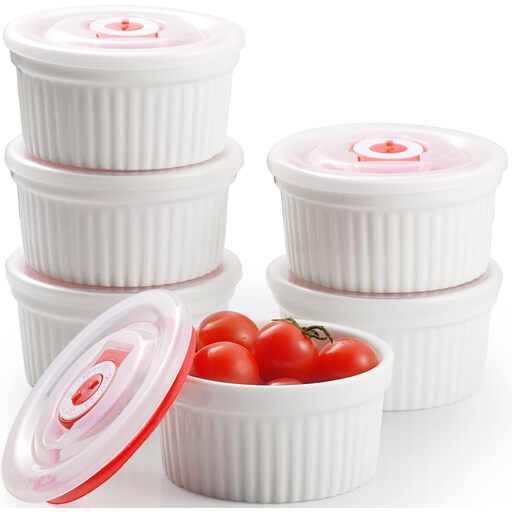
Why it's a great choice: Perfect for preparing and storing individual portions (gratins, crème br?lée, custards) without needing to transfer them. The porcelain is oven-safe and looks great on the table.
Designed for oven use, they eliminate the risk of accidents with unsuitable dishes. The real bonus: the lids feature a date dial, so you can track the freshness of your preparations at a glance.
Total versatility: for baking, storing, and serving. Smart lids with an integrated date dial. Healthy and durable porcelain.
Explore our full selection of products that meet our strict selection criteria and current safety standards.
Yes, most of the time, but with a few precautions. You should never seal the lid completely, to allow steam to escape. The best practice is to open the air vent if the lid has one, or simply place the lid on top of the dish without clipping it shut. Always check the manufacturer's recommendations: a low-quality plastic could warp from the heat.
The glass dish itself is virtually indestructible if treated well (no hard knocks!). The weak link is the lid. Over time, the clips can wear out or break, and the silicone gasket can become stained or loose. To make it last longer, hand-washing the lid is often a good idea.
Tempered glass is more resistant to physical shocks (like being dropped), but it handles temperature changes less well than borosilicate glass. For containers that will be moving between the fridge, microwave, or oven, borosilicate glass is unquestionably the safe and worry-free choice. It is specifically designed for this purpose.