
Livraison le jour même ou le lendemain

Qualité garantie

Débloquez vos offres de bienvenue: Livraison GRATUITE | Jusqu'à -80 % | 30 jours d'essai gratuits à JoyPlus
Téléchargez l'application
Switching from plastic to glass for food storage is an excellent choice for both your health and the environment. But in a crowded market, not all products live up to the hype. A container that cracks straight out of the freezer, a lid that loses its airtight seal after a few washes... these disappointments are all too common. To avoid buyer's remorse, it's crucial to see past the marketing ploys and understand the criteria that truly matter.
The desire for a healthy, organized kitchen often leads to impulse buys. To ensure you don't regret your investment, here are the key things to watch out for.
To make an informed choice, focus on the product's objective features rather than its advertising slogans.
For versatile use, the material is the non-negotiable criterion. You must opt for a borosilicate glass container. Unlike ordinary glass, it has low thermal expansion, giving it high resistance to temperature shocks (typically from -20°C to 400°C). It's this property that allows you to use the same glass dish with a lid for freezing, reheating in the microwave, or even baking in the oven (without the lid). This is an essential guarantee of durability and safety.
The effectiveness of a storage container depends on its lid. For a reliable seal, look for a locking system with sturdy clips (often on 4 sides) combined with a removable silicone gasket. This has a dual advantage: it ensures an airtight seal and allows for deep cleaning to prevent mould. For a glass meal prep container that you plan to transport, this is a fundamental point. Also, make sure the lid materials are certified BPA-free (Bisphenol A), a chemical compound to avoid in contact with food.
Think about your needs. For the storage of dry goods (pasta, rice, legumes), vertical jars with a simple lid may be sufficient. For preparing your meals for the week (meal prep) or storing leftovers, a set of glass storage containers in different sizes will be more practical. Rectangular or square formats optimize space in the refrigerator and cupboards, while round formats are often preferred for soups and salads.

Why we chose it: This 10-piece set offers a complete solution for those who prepare their meals in advance. With two different sizes, it allows you to portion main dishes and sides while optimizing refrigerator space.
The glass is made of borosilicate, designed to withstand thermal shock. The clip-locking system and gasket ensure an excellent seal for transporting your glass meal container.
A complete and uniform set of 10 pieces (5 x 1040 ml and 5 x 370 ml) for simplified organization.
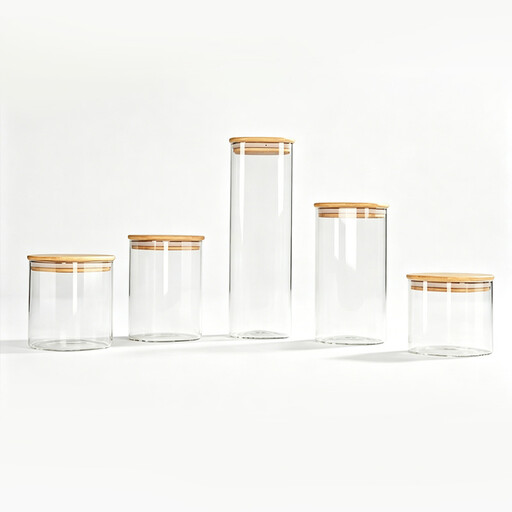
Why we chose it: Perfect for those looking to organize their dry goods with style. This set of 5 jars in various sizes (from 750 ml to 2300 ml) is ideal for storing pasta, cereal, or legumes while adding an aesthetic touch to the kitchen.
The lid features a gasket that ensures a good seal for the conservation of dry goods, protecting them from moisture and pests. The transparent glass allows you to see the contents at a glance.
A set of 5 different sizes to accommodate all types of dry foods, with a stylish design (wood-grain effect lid).

Why we chose it: This large 2-litre dish is designed for those who cook in large quantities. It's perfect for making a casserole, roasting vegetables, or storing leftovers from a family meal, going directly from the oven to the table, then to the refrigerator.
Made of borosilicate glass, it is explicitly designed for oven use (up to 400°C, without the lid). The 4-clip LocknLock system is a benchmark for airtightness.
Its large 2-litre capacity and versatility (oven, microwave, freezer) make it a single dish to cook, serve, and store.
Explore our full selection of products that meet our quality criteria and current safety standards.
As a general rule, no. The vast majority of lids are made of plastic (even BPA-free) and are not designed to withstand the high temperatures of an oven. For the microwave, some lids have a steam vent that allows them to be used, but it's safer to check the manufacturer's instructions. When in doubt, always remove the lid.
To preserve the gasket's elasticity and cleanliness, it's best to remove it from the lid for each cleaning. Wash it by hand with soapy water and let it air dry completely before putting it back. This prevents food residue buildup and mould growth, which can compromise the seal.
No, it is not unbreakable. Its main quality is its resistance to thermal shock. However, it is still glass and can break from mechanical shock (if dropped, for example). It should be handled with care, but it offers far superior durability to standard glass under normal kitchen use.