
Livraison le jour même ou le lendemain

Qualité garantie

Débloquez vos offres de bienvenue: Livraison GRATUITE | Jusqu'à -80 % | 30 jours d'essai gratuits à JoyPlus
Téléchargez l'application
Switching to glass containers is a smart move, both for your health and for the planet. Healthier than plastic and more versatile than stainless steel, glass seems to check all the boxes for the ideal material. However, not all glass containers are created equal. The wrong choice can quickly lead to disappointment: a dish that cracks in the oven, a lid that leaks in your bag, or a set of containers where half the sizes prove useless.
As the Head of Product Selection at Joybuy, my mission is to help you see things more clearly. Here’s a breakdown of the pitfalls to avoid and the essential criteria to check before you buy.
Marketing can often be misleading. To avoid buyer's remorse, focus on the technical specifications, not the promises.
To make the right choice, there are three technical criteria you need to scrutinize.
This is THE number one criterion for an oven-safe container: the type of glass.
A good seal depends on the lid-and-gasket combination.
The basic rule: always check the manufacturer's instructions. As a general rule, only the glass dish can withstand high heat. The plastic lid (even if BPA-free) and its silicone gasket should never be placed in the oven. In the microwave, some lids have a steam vent that can be opened, but the safest option is to remove the lid entirely, or simply rest it on top of the dish without locking it.
Rather than an endless list, we've selected products that meet specific needs and adhere to all the quality criteria we've just discussed.

Why we chose it: This set is perfectly calibrated for batch cooking. It focuses on two genuinely useful sizes: the large format for main dishes and the small one for sides or snacks. No more awkward, intermediate sizes that never get used.
It avoids the "value pack" trap by offering volumes truly designed for meal prep, instead of a multitude of uselessly small containers.
Its borosilicate glass ensures a safe transition from freezer to oven (without the lid), streamlining your entire prep workflow.

Why we chose it: The ultimate individual lunch box. Its size is perfect for a single portion, and its four-clip locking system is renowned for its reliability. A non-negotiable feature for leak-free transport in your bag.
It tackles the number one problem with on-the-go containers: leaks. Its 4-sided locking system and removable silicone gasket ensure a rock-solid, leak-proof seal.
Its borosilicate glass body allows it to go from the fridge to the microwave (without the lid) once you're at the office, making lunchtime a breeze.
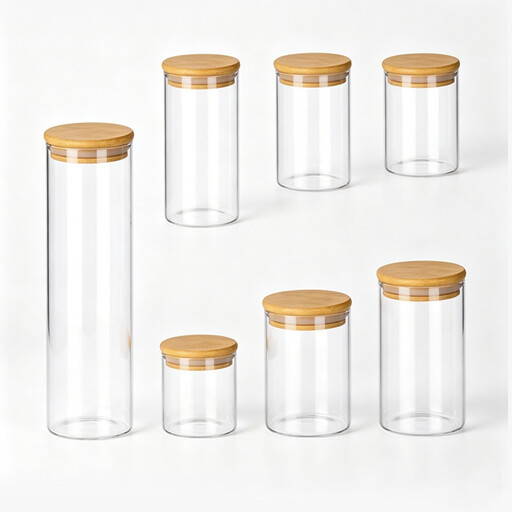
Why we chose it: Perfect for stylishly organising your dry goods (pasta, rice, lentils, cereal). This set combines several sizes with a sleek design featuring wood-effect lids, ideal for an open-plan kitchen or visible shelving.
This product has the merit of being clear about its purpose: it's an airtight jar for bulk goods, not a cooking container. It avoids any confusion by specialising in pantry organisation.
The transparent glass lets you see the contents and remaining stock at a glance, while the airtight lid protects from moisture and pests.
Explore our full selection of products that meet our quality criteria and current safety standards.
As a general rule, no. Plastic lids (even BPA-free ones) cannot withstand high oven temperatures. In the microwave, it's best to remove the lid. If it has a steam vent, open it and simply rest the lid on the dish without locking it to allow steam to escape. In all cases, read the manufacturer's instructions.
To prevent mould and ensure perfect hygiene, gently remove the silicone gasket from its groove. Wash it by hand with warm, soapy water, and don't forget to clean the groove in the lid itself. Make sure both the gasket and the lid are completely dry before putting it back in place. This simple step extends the life and effectiveness of your container.
Borosilicate glass contains boron trioxide, which gives it very low thermal expansion. This allows it to withstand thermal shock (rapid and significant temperature changes) without shattering. It is THE material to choose for an oven-safe container. Tempered glass, on the other hand, is standard soda-lime glass that has undergone a treatment to strengthen its resistance to mechanical impact. It will be more durable if dropped but remains very sensitive to thermal shock.