
Livraison le jour même ou le lendemain

Qualité garantie

Débloquez vos offres de bienvenue: Livraison GRATUITE | Jusqu'à -80 % | 30 jours d'essai gratuits à JoyPlus
Téléchargez l'application
A well-organised kitchen starts with reliable containers. Yet, choosing the right glass food storage container can quickly become a headache. Between marketing promises and the reality of daily use, it's easy to end up with disappointing products. A lid that leaks in your bag, a dish that cracks from the heat, or containers that get damaged after just a few washes: these are frustrations we've all experienced.
This article is here to shed light on the pitfalls to avoid and the technical criteria to check, helping you make an informed choice that truly fits your lifestyle.
Before diving into specific products, let's review the most common mistakes that can lead to buyer's remorse.
To avoid these disappointments, simply focus on a few objective parameters.
The real difference comes down to soda-lime glass versus borosilicate glass.
A reliable seal depends on a winning combination: the locking mechanism and the gasket. Four-sided locking clip systems, paired with a removable silicone gasket, generally offer the most secure closure. The fact that the gasket can be removed is a decisive advantage for deep cleaning, preventing the growth of mould and bacteria. This is an essential detail for a glass meal prep container intended for transport.
A good set of storage containers should help you optimise your storage. Check if the different-sized containers are designed to nest inside one another (a space-saver in cupboards) and if their flat lids allow for stable stacking in the refrigerator. This modularity is also a real bonus for organising your kitchen storage jars.
Rather than a generic list, here is a selection of products tailored to specific user profiles.

Why it's a great fit: Perfect for those who prep their meals for the week ahead. This 10-piece set with two very practical sizes (1040 ml for main courses, 370 ml for sides or snacks) allows for perfectly streamlined organisation.
The high-borosilicate glass is designed for heavy use and withstands repeated trips to the microwave and dishwasher. The clip-on lids are built for durability.
Complete and versatile set: 10 pieces to cover all your needs. Durable glass for use from freezer to microwave.

Why it's a great fit: The perfect ally for families and generous portions. This single, large-capacity dish lets you bake a casserole, store leftovers, and reheat directly, simplifying meal management.
Its borosilicate glass body is explicitly designed to be oven-safe up to 400°C (without the lid), eliminating the risk of breakage from heat. The 4-clip locking system ensures a reliable seal.
Large 2-litre capacity. Wide compatibility: oven, microwave, freezer, and dishwasher.
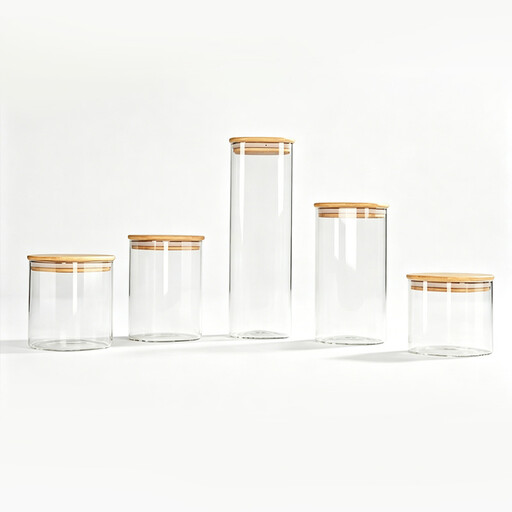
Why it's a great fit: For those who want to organise their dry goods (pasta, rice, legumes, cereals) in a way that is both beautiful and functional. These jars protect from moisture while adding a decorative touch to the kitchen.
This product doesn't claim to be an all-rounder. Its function is clear: to be an airtight storage jar for dry foods. It fulfils this mission with a lid designed for a proper air seal.
Elegant design with faux wood-grain lids. Set of 5 assorted sizes (from 750 ml to 2300 ml) to suit different types of ingredients.
While borosilicate glass is the champion of versatility, other materials have their own strengths.
Ultimately, the choice depends on your primary use: glass for maximum versatility (cooking, storing, serving), stainless steel for on-the-go durability, and plastic for its light weight and affordability.
We've curated a complete selection of products that meet our standards for quality and safety.
As a general rule, no. Plastic lids are not designed to withstand high oven temperatures and can warp or melt. For the microwave, it's recommended to remove them or simply place them on top of the container without clipping them shut to allow steam to escape. Only the glass body is intended for cooking.
For an effective clean and to prevent mould, it's best to remove the silicone gasket from the lid. Wash it by hand with soapy water, rinse it well, and let it air dry completely before putting it back. Regular cleaning will preserve its elasticity and sealing power.
Glass is a neutral, non-porous material: it doesn't stain, retain food odours or flavours, and doesn't leach any substances. Its transparency allows you to see the contents at a glance, and its heat resistance (if it's borosilicate) makes it incredibly versatile. Plastic is lighter and less fragile, while stainless steel is very robust, but neither material offers the same versatility, especially for cooking.