
Livraison le jour même ou le lendemain

Qualité garantie

Débloquez vos offres de bienvenue: Livraison GRATUITE | Jusqu'à -80 % | 30 jours d'essai gratuits à JoyPlus
Téléchargez l'application
Switching from plastic to glass for your food storage is an excellent decision for both your health and the planet. But there's a catch: the market is flooded with products making tempting promises that don't always hold up in practice. As the head of product selection at Joybuy, my mission is to help you navigate the options. Together, let's break down the most common pitfalls so you can make an informed and, most importantly, lasting choice.
Before you take the plunge, be wary of these three weak points, which are often hidden behind slick marketing.
To avoid buyer's remorse, focus on these three technical features that make all the difference in daily use.
Yes, without a doubt, if you're aiming for versatility. Unlike standard soda-lime glass, a borosilicate glass food container is designed to withstand extreme temperature changes (typically from -20°C to 400°C for the glass body). This allows you to:
It is THE material of choice for all-purpose use: from the freezer to the oven to the table.
The seal's effectiveness depends on two elements: the gasket and the locking mechanism.
Always check the lid's specifications. A good lid should, at a minimum, be dishwasher- and freezer-safe. For a glass lunch box, a microwave-safe lid (with the vent open) is an almost essential feature for hassle-free reheating at the office.
Here is a selection of products that meet specific needs, taking our quality and durability criteria into account.

Why we love it: Perfect for *meal prep* enthusiasts, this glass food container set offers two highly practical sizes (370 ml and 1040 ml) for preparing and packing meals in advance. It makes staying organised a breeze.
Its borosilicate glass body withstands thermal shock, while the locking lids ensure secure transport. Say goodbye to leaks from your glass lunch box in your bag!
A complete 10-piece set for ultimate organisation. Oven-safe (without lid), microwave-safe, freezer-safe, and dishwasher-safe.
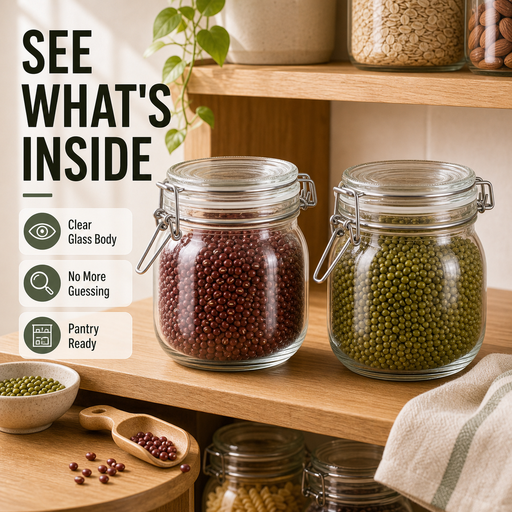
Why we love it: Perfect for glass kitchen storage, this set is designed for storing dry foods (pasta, rice, legumes, biscuits). Its transparent design lets you identify the contents at a glance.
The locking system with stainless steel clips and a silicone gasket provides a reliable barrier against moisture and pests, thwarting the "supposedly airtight" trap.
A robust mechanical closure built to last. The removable silicone gasket makes for impeccable cleaning.

Why we love it: This large 2-litre glass dish with a lid is the perfect partner for family meals. Cook your gratin, store it in the fridge, then reheat it—all in the same dish.
Made from borosilicate glass, it can withstand temperatures up to 400°C (dish only), eliminating the risk of cracking when moving from cold to hot. A guarantee of longevity.
Its large 2L capacity. The Lock&Lock 4-clip locking system, a benchmark for leak-proof reliability.
Discover our full selection of products that meet our demanding selection criteria and current safety standards.
It all depends on its material. Most plastic lids should be kept out of a conventional oven. For the microwave, it is imperative to check the manufacturer's instructions. Some lids are designed for reheating and are often equipped with a vent that should be opened to allow steam to escape. When in doubt, the safest bet is to remove the lid and use a dedicated microwave cover.
For optimal maintenance, remove the gasket from the lid after each use. Wash it by hand with hot water and dish soap. To eliminate stubborn odours (like tomato sauce or curry), you can soak it in a mixture of warm water and white vinegar or baking soda for an hour before rinsing. Make sure the gasket and the lid's groove are completely dry before putting it back in place.
Borosilicate glass contains boron oxide, which gives it a very low thermal expansion coefficient and therefore excellent resistance to thermal shock (rapid changes from hot to cold). This property is what makes it oven-safe. Tempered glass, on the other hand, is soda-lime glass that has undergone a thermal treatment to increase its resistance to mechanical shock. While it is more impact-resistant than standard glass, it performs much more poorly than borosilicate when faced with extreme temperature variations. For versatile freezer-to-oven use, borosilicate is therefore essential.