
Livraison le jour même ou le lendemain

Qualité garantie

Débloquez vos offres de bienvenue: Livraison GRATUITE | Jusqu'à -80 % | 30 jours d'essai gratuits à JoyPlus
Téléchargez l'application
Switching to a glass food storage container is a smart choice for eating healthier, reducing waste, and streamlining your organization. Whether for preparing your meals for the week (the popular "?meal prep?") or for bringing a healthy lunch to the office, glass stands out as the material of choice. However, the market is flooded with products making similar promises, and it's easy to fall into common traps that turn a good investment into a disappointment.
Before you decide, watch out for these three frequent pitfalls?:
Identifying these weak points is the first step toward choosing a product that will truly deliver on its promises in the long run.
To avoid unpleasant surprises, focus on a few technical features that make all the difference in daily use.
The secret to a durable and versatile glass dish lies in its composition. Borosilicate glass is the absolute gold standard in this field. Unlike conventional soda-lime glass, it contains boron trioxide, which gives it exceptional resistance to thermal shock (typically from -20?°C to +400?°C).
This is the quality standard used for laboratory glassware, and it's what you should demand for your kitchen.
The effectiveness of an airtight glass food container rests almost entirely on the quality of its lid. For a foolproof seal, two elements must be checked?:
A good meal prep container should simplify your life, not complicate it. Always check the manufacturer's pictograms and instructions for each part of the product?:
This simple check will prevent you from melting a lid or having to transfer your dishes unnecessarily.
Rather than an endless list, here are solutions that cater to specific needs, all while meeting the quality and practicality criteria we've just discussed.

Why it's a perfect match ? This **set of glass storage containers** is tailored for batch cooking fans. With 5 large containers (1040 ml) and 5 smaller ones (370 ml), it covers the needs for an entire week, from main courses to side dishes, while optimizing fridge space.
Its borosilicate glass withstands thermal shock, while the "snap-lock" lids and their gaskets guarantee a 100% airtight seal. No more leaks in your work bag!
A complete and cohesive set. The two sizes are perfect for variety and organizing meals. Full compatibility: oven (without lid), microwave, and dishwasher.

Why it's a perfect match ? For those who prioritize durability above all else, stainless steel is the superior alternative to glass. Unbreakable, lightweight, and perfectly hygienic, this set is built for heavy-duty use, rough transport, and impromptu picnics.
It completely eliminates the risk of breakage, whether from thermal or physical shock. The well-designed lids ensure a reliable seal to preserve freshness.
316 stainless steel is a food-grade benchmark, ultra-resistant to corrosion, and doesn't retain stains or odors. Bonus: the containers are stackable for optimized storage.
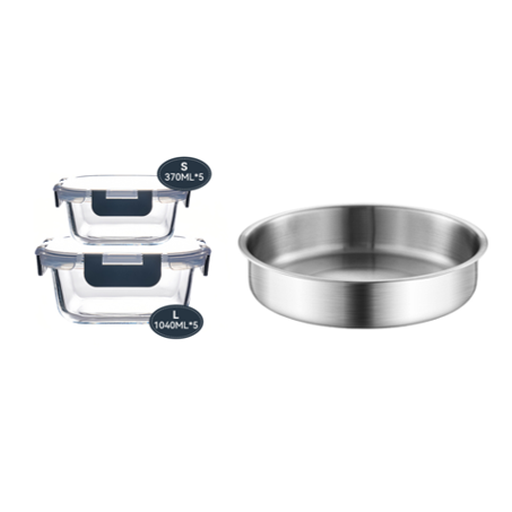
Why it's a perfect match ? Perfect for getting equipped without any guesswork. This bundle combines the 10-piece glass container set for prep and storage, and adds a durable, oven-safe stainless steel deep plate, practical for both cooking and serving.
By offering a complete and cohesive solution from the start, this kit avoids multiple purchases and the headache of mismatched pieces. You start on the right foot with reliable borosilicate glass and a durable serving dish.
Excellent value. The bundle covers all needs (storage, cooking, serving) with high-quality materials (borosilicate glass and 304 stainless steel).
We have curated a complete selection of products that meet our strict selection criteria and current safety standards.
Regular glass (soda-lime) is what our drinking glasses and jars are made of. Its weakness? It handles sudden temperature changes very poorly. In contrast, borosilicate glass is a reinforced technical glass designed to withstand thermal shock. It's this property that allows it to go from the freezer to the oven without shattering, making it the ideal material for a glass dish with a lid designed for cooking.
For the oven, the answer is almost always no. The vast majority of lids are made of plastic (even BPA-free) and should never be put in a conventional oven. For the microwave, it's often possible, provided you open a vent or do not seal the lid tightly, allowing steam to escape. A good habit to develop: always read the manufacturer's instructions to avoid melting your lid.
It's incredibly simple. The glass base is completely dishwasher safe. For the lids, opt for hand washing or place them in the top rack of the machine to preserve the gasket and clips. Our tip: remove the silicone gasket from time to time for a deep clean to prevent mold growth. Finally, let each component dry completely before reassembling them for storage.