
Livraison le jour même ou le lendemain

Qualité garantie

Débloquez vos offres de bienvenue: Livraison GRATUITE | Jusqu'à -80 % | 30 jours d'essai gratuits à JoyPlus
Téléchargez l'application
Switching to glass food containers seems like a no-brainer: it's a healthy, durable material that doesn't retain odours or stains. Yet, the market is flooded with products making tempting promises that can quickly lead to disappointment. A lid that leaks in your bag, a dish that cracks straight out of the freezer… These mishaps are avoidable, provided you know what to look for.
Before you commit, watch out for these two common pitfalls that can turn a good investment into a real regret:
To make the right choice, focus on the technical specifications that truly matter, well beyond the marketing claims.
This is THE most important criterion: the type of glass. There are two main types used for food containers:
A good glass dish with a lid must be perfectly leak-proof. To ensure this, two elements need to be scrutinised:
A good glass food container should fit seamlessly into your daily routine. Consider the size and shape. Rectangular and square formats are often easier to store in a fridge or cupboard than round ones. If you're a meal prep enthusiast, a food container set with various sizes will be a much more practical solution for portioning and optimising space. The ability to stack the containers is also a significant advantage for keeping your kitchen organised.
Here are a few models that tick all the boxes, suited for different needs.

Why we chose it: Its large 2-litre capacity is perfect for preparing family-sized dishes or several meals at once. It's the ultimate meal prep container for those who do *batch cooking* on the weekend.
Its body is made of borosilicate glass, allowing it to go safely from the fridge to the oven (without the lid). The 4-clip locking system prevents your lasagne or shepherd's pie from leaking.
Large 2L capacity, ideal for family portions. Total versatility: freezer-safe container, oven dish, and microwave-safe.

Why we chose it: The 630 ml size is perfect for a single serving. Compact and lightweight, it slips easily into a bag for the office, with zero risk of leaks.
Its clip-locking system is designed for daily transport. No more worrying about salad dressing at the bottom of your bag! The borosilicate glass also won't absorb odours from yesterday's meal.
Completely leak-proof for transport. Perfect individual size for a lunch break. Microwave-safe for reheating your meal.
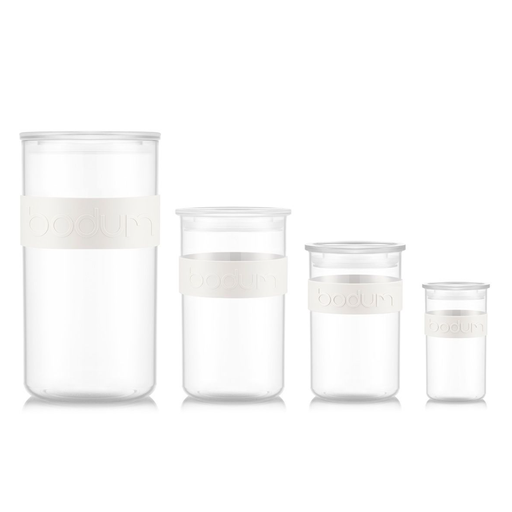
Why we chose it: For those whose priority is a perfectly uniform and organised pantry and fridge. This comprehensive set offers 4 different sizes to store everything from spices to leftovers. Note: This set is made of BPA-free plastic, an alternative for those who prioritise quantity and uniformity for organising dry goods.
Although not glass, this set meets the need for a cohesive storage system. The plastic is guaranteed BPA-free and the seal is designed to preserve the freshness of dry foods.
A complete container set of 12 pieces for perfect organisation. Stackable design that optimises storage space.
We have compiled a complete and up-to-date list of products that meet our strict selection criteria and current safety standards.
As a general rule, no. The lids are almost always made of plastic (even if BPA-free) and are not designed to withstand the high temperatures of an oven. For the microwave, it is also recommended to remove the lid or simply rest it on top of the container without locking it, to allow steam to escape. Only the borosilicate glass base is oven-safe.
For perfect hygiene and a lasting seal, it is advisable to remove the seal from the lid at least once a week. Wash it by hand with warm, soapy water, then rinse it thoroughly. Most importantly, let it air dry completely before putting it back in place. This is the best way to prevent the growth of mould and bacteria.
Borosilicate glass is engineered to have very low thermal expansion. In practical terms, it can withstand significant and rapid temperature changes without shattering. This makes it the material of choice for an oven dish or a freezer-safe container. Tempered glass, on the other hand, has been treated to increase its resistance to mechanical shocks (like drops), but it remains much more sensitive to thermal shock. For kitchen use involving temperature changes, borosilicate remains the absolute gold standard for safety.