
当日/次日达

品质保障

开启新人专享福利: 全场免邮 | 低至 2 折 | 免费试用 30 天 JoyPlus 会员
下载 Joybuy
Switching to glass food containers has become a no-brainer: they're healthier, more durable, and far more versatile than plastic. Yet, the market is flooded with promises that don't always hold up. A lid that warps, a dish that cracks straight out of the freezer, or a faulty seal can quickly turn a good investment into a major disappointment.
As the Head of Product Recommendations at Joybuy, my mission is to help you see things more clearly. Let's cut through the marketing jargon and focus on what really matters. Here's how to avoid the common pitfalls and choose containers that will serve you faithfully for years to come.
Before you take the plunge, watch out for these three weak points—often well-hidden—that can render a glass container almost useless.
To ensure you make the right choice, your future airtight glass food container must absolutely meet these two fundamental criteria.
The difference in quality primarily comes down to the material. For all-purpose use, borosilicate glass is non-negotiable. Unlike standard soda-lime glass, its thermal resistance is exceptional.
Opting for a borosilicate glass container is an investment in safety and durability, making it ideal for meal prep and oven baking.
A container is only truly airtight if its locking system is flawless. The most reliable models combine two key elements:
Rather than an endless list, we've selected a few models that meet specific needs while adhering to the quality criteria we've just discussed.

Why it's a great fit: Its 630 ml capacity is perfect for a single serving. Compact and relatively lightweight, it slips into a bag for the office or a picnic without any risk of leaks, thanks to its locking clips.
The borosilicate glass body handles thermal shock (microwave-safe), and the clip system prevents leaks. It thus sidesteps the two most common pitfalls.
Versatility: freezer, microwave (without lid), and dishwasher safe. Its silicone gasket is removable for an impeccable clean.

Why it's a great fit: With its generous 2-litre capacity, this dish is designed for casseroles, lasagnas, and roasts. It goes straight from the oven to the table, then to the fridge to store leftovers.
Its borosilicate glass body, designed for oven use, can withstand thermal shocks of up to 200°C. This eliminates the risk of cracking even with intensive use.
Its large 2 L capacity is perfect for family meals. The airtight lid keeps leftovers fresh for longer.
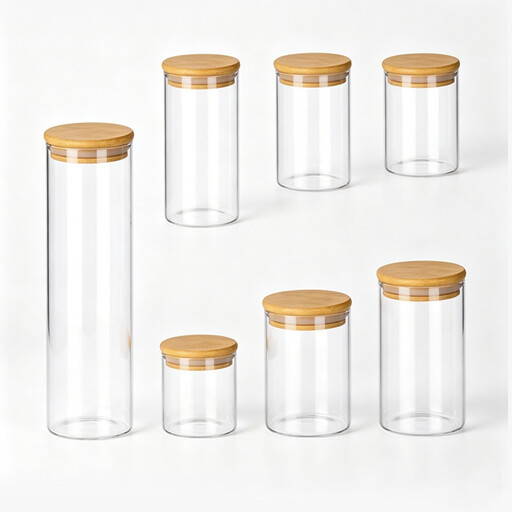
Why it's a great fit: This set of glass containers offers seven different sizes, perfect for organizing dry goods (pasta, rice, cereal, legumes). The faux-wood lid design adds a welcome decorative touch to the kitchen.
Specifically designed for dry storage, these jars have airtight lids that effectively protect against moisture and pests—an essential feature for pantry staples.
A complete set of 7 sizes (from 431 ml to 2178 ml) for streamlined and optimised organisation. The clear glass lets you identify the contents at a glance.
Explore our full selection of products that meet our strictest quality criteria and current safety standards.
Can you put the glass container's lid in the oven or microwave? As a general rule, no. The vast majority of lids are made of plastic (often polypropylene, or PP) and cannot withstand the high temperatures of an oven. For the microwave, it's best to remove it or simply rest it on top of the dish without clipping it shut, allowing steam to escape. Always read the manufacturer's instructions: only the glass dish is designed to go in the oven.
How do you properly clean the silicone gasket to prevent odours? For perfect maintenance, remove the silicone gasket from the lid after each use, especially after storing saucy or strong-smelling dishes. Wash it by hand with hot, soapy water, or place it in the top rack of the dishwasher if it's compatible. Make sure the gasket and the groove in the lid are completely dry before reassembling.
What's the difference between borosilicate glass and tempered glass? Tempered glass is soda-lime glass that has undergone a thermal treatment to improve its resistance to mechanical shock. It is therefore stronger than standard glass but still performs less well than borosilicate when it comes to thermal shock (sudden temperature changes). For all-purpose use from the freezer to the oven, borosilicate glass remains the safest choice.