
Same-day & Next-day Delivery

Quality Guaranteed

Unlock Your Welcome Offers: FREE Delivery | Up to 80% OFF | Free 30-day JoyPlus trial
Download the APP
At first glance, opting for a glass food container seems like a no-brainer: it's a durable, healthy material that doesn't retain odours or stains. Yet, the market is flooded with options that often fall short of their promises. A lid that warps, a dish that cracks under heat, or a questionable seal can quickly turn what seemed like a good investment into a source of daily frustration. To avoid disappointment, it's essential to know how to sidestep the most common pitfalls.
Navigating the jungle of food containers can quickly become a headache. To ensure you don't regret your purchase, here are three key points to keep in mind.
To make sure your future glass lunch box or storage dish lives up to all its promises, here are the technical specifications you absolutely must check.
This is arguably the most important criterion. There are two main types of glass:
The seal of an airtight food container depends on one thing: the quality of its lid and locking mechanism.
Rather than searching for a "one-size-fits-all" gem, it's better to choose a container perfectly suited to a specific need. Here are a few typical user profiles and the solutions that match them.
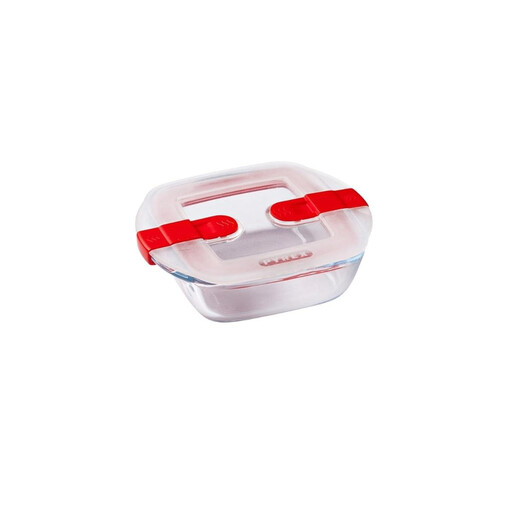
The user profile : You prepare your meals in advance and need a reliable container to go smoothly from the fridge to the office microwave. For you, practicality and safety are the key priorities.
Its lid features two steam vents, specially designed for microwave reheating. No more warped lids or splatters—the seal is preserved.
The dish is made of PYREX borosilicate glass, able to withstand extreme temperatures and go in the oven (without its lid). The lid is also guaranteed BPA-free.
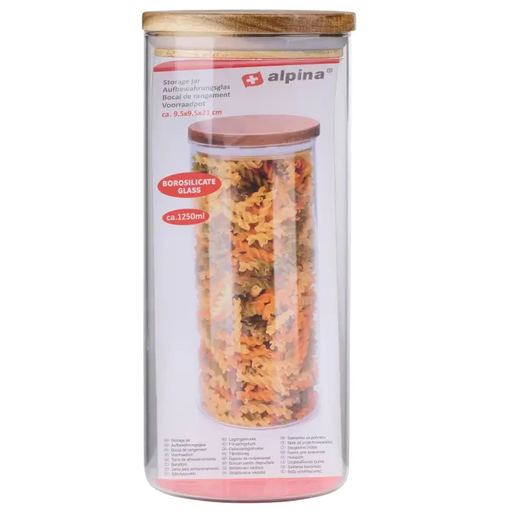
The user profile : You want to bring order (and style) to your pantry. The goal is to store your dry goods (pasta, rice, legumes) in a visible, organised way, protected from moisture.
This jar fully embraces its role: it's not universal, but it excels at dry storage. It thus avoids the trap of design sacrificing function. Its acacia wood lid is designed for this single purpose.
Its square shape allows for perfect stacking and alignment, optimising space in your cupboards. The seal ensures optimal preservation of dry foods.
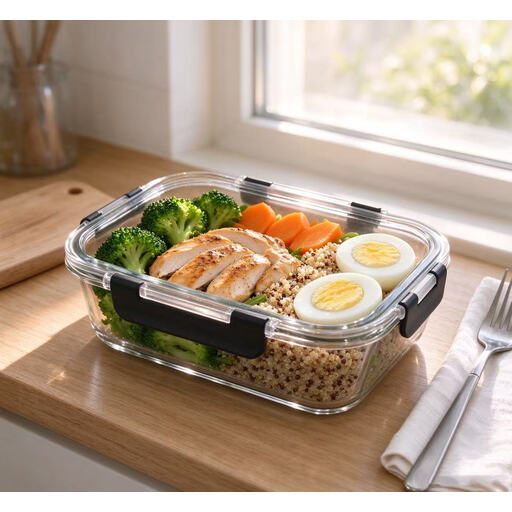
The user profile : Perfect for getting fully equipped in one go to manage leftovers, prepare meals for the whole family, or simply always have the right size container on hand.
This set is made entirely of borosilicate glass, which immediately eliminates the risk associated with non-heat-resistant glass. The sturdy clip-on lids ensure a reliable seal on every piece in the set.
The value for money. This 10-piece set (5 x 1040 ml and 5 x 370 ml) covers the vast majority of storage and prep needs. A comprehensive and consistent solution for a long-lasting setup.
We have put together a complete selection of products that meet our selection criteria and current safety standards.
As a general rule, that's a no for the oven. Lids, whether plastic, wood, or bamboo, are not made to withstand the high temperatures of a conventional oven. For the microwave, it's different: it's possible if the manufacturer clearly states so. Opt for plastic models (BPA-free) with a tab or valve that can be opened to let steam escape. When in doubt, the safest bet is to remove the lid and use a microwave cover.
The great advantage of glass is that it doesn't retain odours, unlike plastic. However, it's the silicone seal on the lid that can eventually absorb them. For a deep clean, remove the seal from its groove and wash it separately with hot, soapy water. Occasionally, you can let it soak in a mixture of water and white vinegar. Remember to dry the seal and the lid's groove thoroughly before putting it back in place.
Both types of glass have been treated to be more resistant, but not in the same way. Borosilicate glass incorporates boron oxide, which gives it a very low thermal expansion coefficient. In plain English: it's exceptionally resistant to temperature shocks. Tempered glass, on the other hand, is standard glass that has been heated to a high temperature and then cooled very quickly. This makes it more resistant to mechanical shocks (drops), but it remains vulnerable to thermal shocks. The bottom line: for versatile use from the freezer to the oven, only borosilicate glass offers optimal safety.