
Livraison le jour même ou le lendemain

Qualité garantie

Débloquez vos offres de bienvenue: Livraison GRATUITE | Jusqu'à -80 % | 30 jours d'essai gratuits à JoyPlus
Téléchargez l'application
Gel pens are popular for their smooth flow, range of colours and comfortable feel. However, a rushed purchase can come with a few unwelcome surprises: a nib that is too broad, ink that takes too long to dry or a retractable mechanism that is awkward for everyday use. To find the model that suits you, it is therefore worth looking beyond the number of pens and the design of the barrel.
A 0.5 mm nib is suitable for small annotations, notebook margins and highly structured planners. However, it requires slightly more precise handwriting. By contrast, 0.7 mm pens generally produce a more visible line that is pleasant for everyday notes, but they take up more space on a narrow line.
Descriptions such as ‘fine point’ or ‘ultra-fine’ are therefore not enough: always check the exact diameter stated in the product details.
Erasable gel pens use heat-sensitive ink that disappears through friction. This is useful for homework, diaries and drafts. However, they are not suitable for thermal receipts or documents that need to retain a permanent record. High temperatures can also alter or even remove the writing.
For contracts, forms or archive documents, choose black ink pens designed for durable writing.
A pack of 40 pens may be useful for a classroom or shared office, but completely excessive if you simply want a few colours for journaling. Conversely, an assortment of 12 shades may not meet the needs of someone who mainly writes in black every day.
Compare the number of pens, whether refills are included, the colours actually supplied and the nib type before making your choice.
For school and work, 0.5 mm fine-point pens and 0.7 mm pens cover most needs. Left-handed users should also consider quick-drying ink to reduce smudging when their hand passes over freshly written lines.
Retractable gel pens can be put away quickly and eliminate the risk of losing a cap. They fit easily into a pencil case, work bag or shared office. However, remember to check that the nib retracts properly after use: if left out, it may dry out or mark a surface.
Capped models may be better suited to decorative inks and journaling pens, particularly when the manufacturer includes an internal seal or enhanced nib protection.
A barrel with a non-slip grip improves control during long writing sessions. The pen’s centre of gravity, weight and clip shape also affect how much fatigue you feel over the course of several pages.
To maintain writing quality:

Why this choice suits this user profile : Its 0.5 mm needle tip is suitable for pupils, students and anyone who regularly corrects their notes or planners.
The diameter and erasable function are clearly stated. The product details also explain that this heat-sensitive ink is not suitable for documents that need to be kept for a long time.
Pack of 12 blue pens, soft grip, built-in friction eraser and 0.5 mm tip.
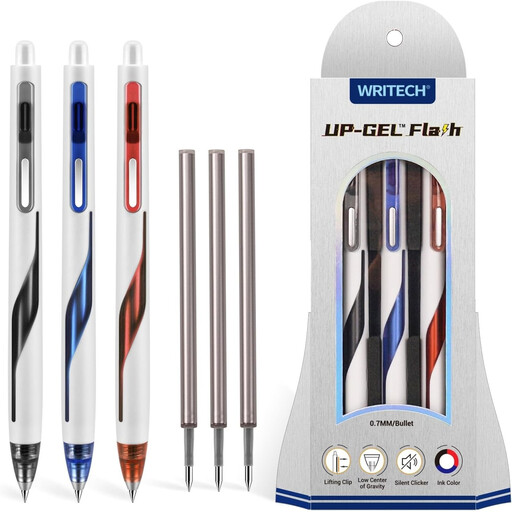
Why this choice suits this user profile : Users who value balance and quiet operation will appreciate its low centre of gravity, discreet mechanism and three included colours.
The product details specify the black, blue and red colours, the 0.7 mm diameter and the supplied refills, rather than making a vague promise of comfort.
Three pens, three additional refills, ergonomic grip and 0.7 mm double-ball tip.
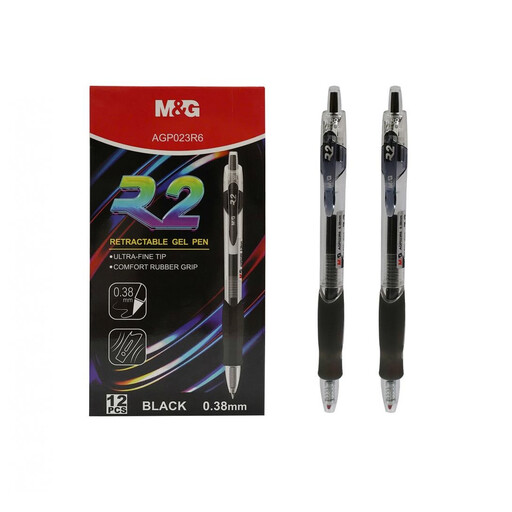
Why this choice suits this user profile : Professionals, teachers and students who write small or annotate lots of documents benefit from an extra-fine tip and a pack of 12 pens.
The 0.38 mm diameter is explicitly stated : there is no need to choose a tip simply described as ‘fine’ without a precise measurement.
Quick-drying black gel ink, retractable mechanism and soft grip.
We have put together a comprehensive selection, updated in real time, of products that meet these demanding criteria and European safety standards.
Lifespan depends on how often you write, the length of the strokes and the refill capacity. A pen used every day will naturally run out faster than one reserved for occasional annotations. Refillable versions allow you to keep the pen body and replace only the compatible cartridge.
Always check your institution’s regulations. Their heat-sensitive ink may disappear or deteriorate when exposed to heat and is not suitable for documents that need to remain permanent. For an exam or official paper, use the permitted type of ink and follow the instructions provided.
A 0.5 mm nib is suitable for compact handwriting and narrow margins. A 0.7 mm nib produces a more visible line, which is practical in lessons, meetings or on forms. If you are unsure, consider the paper you use and the size of your handwriting before ordering a pack.