
Livraison le jour même ou le lendemain

Qualité garantie

Débloquez vos offres de bienvenue: Livraison GRATUITE | Jusqu'à -80 % | 30 jours d'essai gratuits à JoyPlus
Téléchargez l'application
A gel pen may seem simple to choose… until the ink smudges on your work, the nib dries out after a few uses or the retractable mechanism decides to jam. Pupils, students, professionals, teachers and creative hobbyists do not all expect the same things from their pen. A model designed for annotations will have different qualities from one intended for journalling or drawing on black paper.
Before ordering your gel pens, it is therefore worth keeping three classic pitfalls in mind.
A very fine nib is perfect for writing in the margins, filling in a diary or drawing small details. However, it can be less comfortable during long writing sessions if the ink does not flow smoothly or the pen is uncomfortable to hold. Conversely, a wider nib produces a more visible line, but also takes up more space on the page.
The description quick-drying gel pens can help guide your choice, but it does not guarantee the same result on every type of paper. The texture, porosity and weight of the paper directly affect drying time. Left-handed users should prioritise ink advertised as quick-drying and check the product reviews available.
A pen with a cap that is not properly closed may dry out around the nib. A retractable model helps prevent this problem in a bag or when travelling, provided you always retract the nib after use. Gel pens intended for drawing, scrapbooking or colourful annotations should also be protected from heat and, where recommended on the product page, stored horizontally.
Depending on the manufacturer, the stated width may refer to the nib or the line actually produced. It is therefore better to look at the nib design — such as a needle tip, ballpoint tip or metal tip — rather than comparing only the number of millimetres.
Retractable gel pens are particularly convenient in the office, classroom or a bag: there is no separate cap to lose. A quiet button can also make a difference in a library or meeting. If you write for long periods, check whether the pen has a soft grip that is non-slip or ergonomic.
Capped models still have their advantages for certain erasable gel pens and metallic gel pens, especially when protecting the nib is more important than quick access.
For taking notes, black gel pens provide clear, classic lettering. Multicoloured sets make it easier to organise information visually and work well for revision notes, diaries and paper-based creations.
For artistic activities, look for information about opacity, drying time, water resistance and compatibility with coloured paper. This information comes from the product page and does not necessarily guarantee the same result on every surface. It is therefore best to test the pen on a small area first, particularly on coated or very dark paper.
The heat-sensitive inks used in erasable gel pens allow mistakes to be corrected by rubbing. However, they are not suitable for documents that need to remain permanent or, according to the recommendations on the product pages, for tickets printed on thermal paper. Heat and cold may also affect how they perform.
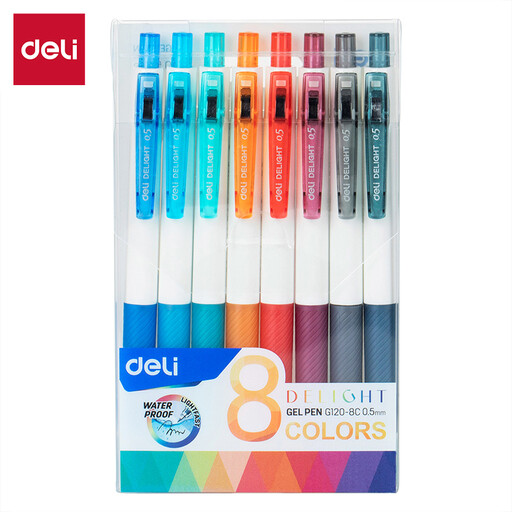
Why this choice suits this profile : This set combines eight colours with a 0.5 mm nib — a versatile combination for lessons, lists, schedules and first attempts at journalling.
The medium nib avoids committing to a line that is too fine or too thick for general-purpose use. The retractable mechanism protects the nib during transport.
0.5 mm ballpoint nib, eight colours, soft grip and ink advertised on the product page as water-resistant.
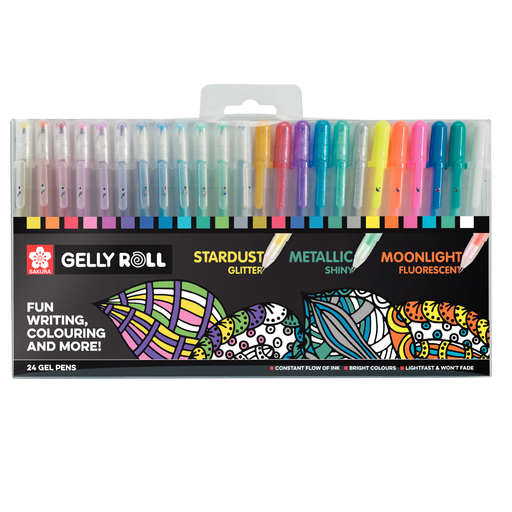
Why this choice suits this profile : This set is aimed at anyone who wants to vary effects when journalling, making cards, illustrating and scrapbooking.
The range of effects lets you adapt the finish to the surface instead of using the same ink for every creation.
Set of 24 pens with glitter, metallic, neon and opaque effects, advertised as compatible with several types of paper.
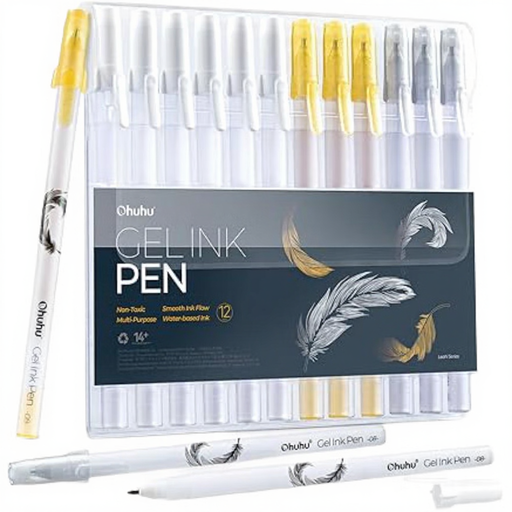
Why this choice suits this profile : This set is aimed at artists and black-paper enthusiasts looking for highly visible white, gold and silver accents.
The 0.8 mm metal nib and pigmented ink advertised as opaque are designed for dark surfaces, rather than classic fine writing.
12 pens, three metallic shades, caps with an internal seal and water-based ink advertised as quick-drying.
We have brought together a complete, real-time updated selection of products that meet these exacting criteria and European safety standards.
To keep them in good condition for longer:
A pack of 12 or 50 pens can save you from making multiple purchases for a classroom, office or workshop. Before placing your order, however, compare the number of colours, nib type and whether refills are included or available: the number of pens is not everything.
Yes, provided you choose a suitable nib. 0.5 mm models work well for notes and forms, while 0.7 mm nibs produce a more visible line. For important documents, check whether the ink is permanent, erasable or heat-sensitive.
A 0.5 mm nib is practical for outlines, annotations and small patterns. A 0.7 mm nib is better suited to headings and areas that need to stand out. On black paper, metallic or opaque 0.8 mm gel pens are generally more suitable.
It depends on the formula, how frequently it is used, whether it is properly closed and its storage conditions. A pen that is correctly closed and kept in a dry place at room temperature will generally remain usable for longer than one left open. If the nib starts to drag or the ink flow becomes uneven, gentle cleaning or replacement may be necessary.