
Livraison le jour même ou le lendemain

Qualité garantie

Débloquez vos offres de bienvenue: Livraison GRATUITE | Jusqu'à -80 % | 30 jours d'essai gratuits à JoyPlus
Téléchargez l'application
Smooth writing isn’t just about colour or price. With gel pens, certain details can make all the difference between a practical purchase and a genuine source of smudges, smears or discomfort. Pupils, students, teachers, office workers and journaling enthusiasts all have different expectations, yet the same pitfalls crop up time and again.
A tip described as “fine” doesn’t always produce the same line. Fine-tipped gel pens come in 0.38 mm, 0.5 mm, 0.7 mm and even wider. A broader tip generally gives a more visible line, while a 0.38 or 0.5 mm tip is better suited to small annotations, tables and planners.
It’s therefore better to check the exact width stated on the product page than to rely on a vague label like “extra-fine”.
A quick-drying gel pen can reduce smudging, but the result also depends on the amount of ink deposited, the paper used and the pressure applied. Left-handed writers, whose hand often brushes over the line they’ve just written, would do well to prioritise this feature.
Quick-drying ink won’t necessarily be flawless on every surface. Testing it on a sheet of the same type as your notebook or exercise book is the best way to avoid unpleasant surprises.
Capped models protect the tip effectively, but the cap can easily go missing at the bottom of a pencil case. Retractable gel pens are more convenient for regular note-taking, provided you retract the tip after use. As for the pen body, a triangular shape or a soft grip area can improve handling, though it can never replace a comfortable hand position.
The shape of the tip also matters. A needle tip makes it easier to see where you’re writing, while a ballpoint-style tip often feels more robust for daily use.
Black gel pens remain the most versatile for lessons, documents and note-taking. For journaling, corrections or visual organisation, a multi-colour pack can prove more practical.
Metallic gel pens designed for black paper need to use sufficiently opaque ink. White, gold or silver models are intended to create contrast on dark paper, kraft paper or coloured surfaces. Check the compatible surfaces rather than assuming a coloured pen will be legible everywhere.
For long writing sessions, go for a non-slip grip, a well-balanced body and a mechanism that doesn’t require heavy pressure. Pens used for several hours a day are also best bought in packs: you’ll have refills on hand and won’t have to interrupt your work.
After use, close capped models and retract the tip of click-action pens. Storing them horizontally in a dry place at room temperature can help maintain consistent ink flow. Small parts should be kept out of reach of children under 3 years old.
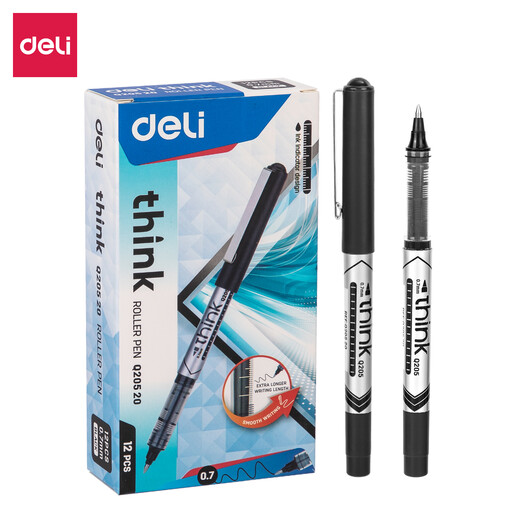
Why this choice suits this profile: this pack covers everyday use at school, the office or at home, with 12 black medium-point pens.
The 0.7 mm width is clearly stated, so you can compare it to your needs rather than relying on a vague description.
A 12-unit pack with black ink, suitable for documents, exercises and everyday notes.
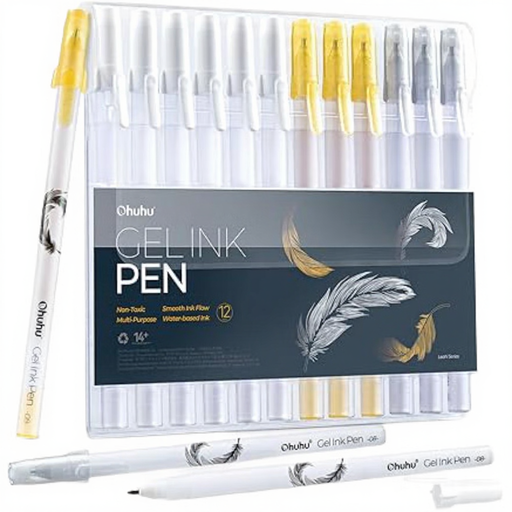
Why this choice suits this profile: this set is aimed at those who want to enhance their cards, drawings, notebooks and decorative projects on dark surfaces.
The product page details the colour breakdown: 6 white, 3 gold and 3 silver, with compatibility stated for black and coloured paper.
A 0.8 mm metal tip, water-based pigmented ink and a body with a protective cap.
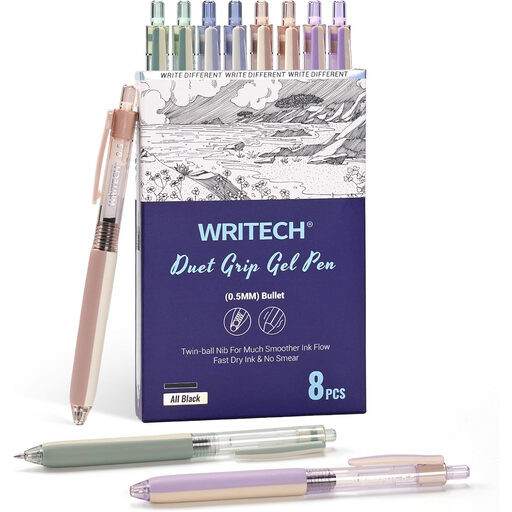
Why this choice suits this profile: the retractable mechanism and triangular grip are well suited to long note-taking sessions, drawing, creative journaling or working in the library.
The 0.5 mm tip, quick-drying ink and silent click mechanism address issues of precision, smudging and noise.
8 black pens, a 0.5 mm double-ball tip and a clip mechanism that retracts the tip.

Why this choice suits this profile: this model is aimed at pupils, students and planner users who regularly correct their handwritten notes.
The erasable function relies on thermosensitive ink and an integrated eraser, so it should only be used for documents where this property is not an issue.
A 0.5 mm needle tip, a comfort grip and quick-drying ink as stated on the product page.
We’ve put together a comprehensive, real-time updated selection of products that meet these exacting criteria as well as European safety standards.
Yes, 0.5 mm gel pens are a reliable choice for lessons, meetings, forms and planners. If you write very small, a 0.38 mm tip will offer greater precision. For headings or more expressive writing, a 0.7 mm width will be more visible.
It all depends on how often you use them, the amount of ink and storage conditions. Close the caps, retract the tips and avoid extreme temperature changes. If the pen starts writing unevenly, it may have been stored tip-down or left uncapped.
It’s best to reserve them for drafts, lessons, lists and planners. Thermosensitive ink is designed to disappear with friction and isn’t necessarily suitable for a document that needs to be permanent. For contracts, signatures and archives, choose a non-erasable ink and check the specific requirements of the document in question.