
Livraison le jour même ou le lendemain

Qualité garantie

Débloquez vos offres de bienvenue: Livraison GRATUITE | Jusqu'à -80 % | 30 jours d'essai gratuits à JoyPlus
Téléchargez l'application
A trampoline in the garden is the promise of children's laughter and unforgettable memories. But be warned: initial excitement can quickly turn to disappointment if the product doesn't live up to expectations. It's hard to navigate the gap between marketing promises and on-the-ground reality. To prevent your dream purchase from becoming a regret, here are the three most common pitfalls to be aware of.
This guide is here to arm you against these pitfalls. We will focus on the technical criteria that truly make a difference for a safe and long-lasting purchase.
To make an informed choice, you need to look beyond mere aesthetics. Here are the three technical points to inspect closely before pulling out your credit card for a garden trampoline with net.
The number one criterion for a safe trampoline? The position of its safety net.
Also, remember to check the quality of the net itself (usually polyethylene, or PE) and the sturdiness of its closure system (zipper, buckles), which should be easy for a child to operate.
An outdoor trampoline is constantly exposed to the elements. Its longevity, therefore, depends directly on the quality of its structure.
The choice of size is, of course, crucial. The most common diameters are the 244 cm trampoline (8 ft) and the 305 cm trampoline (10 ft).
Before choosing, measure the intended location. You must allow for a safety clearance zone of at least 2 metres all around the trampoline, clear of any obstacles (trees, walls, etc.).
Instead of drowning you in dozens of product pages, we have selected a few models that meet specific needs, strictly applying the safety and durability criteria we've just covered.
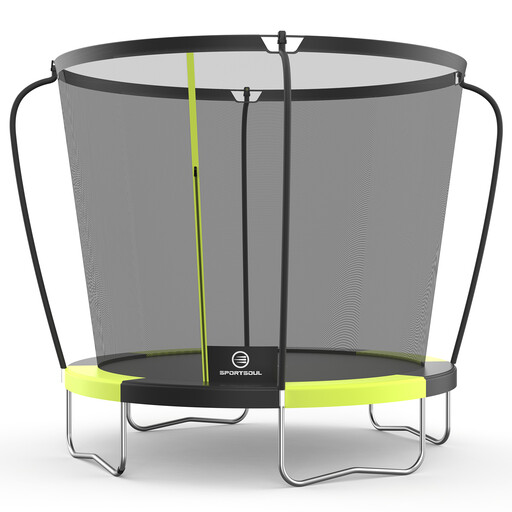
Why it stands out: With its compact 2.44 m diameter, it fits perfectly into smaller gardens. It's the ideal model for introducing the youngest jumpers to the fun in complete safety, without sacrificing essential features.
Its patented T-Socket assembly system promises assembly by two people in about an hour, far from the usual hassle. The internal net, meanwhile, eliminates any risk of contact with the springs.
Its design is engineered for easy seasonal assembly and disassembly thanks to its patented technologies. A real bonus for storing it away during the winter.
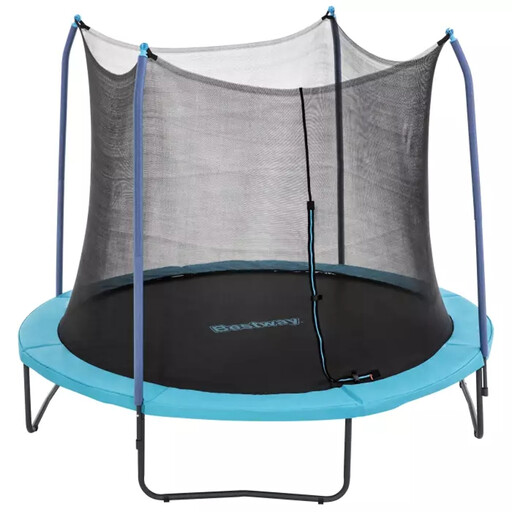
Why it stands out: It's the perfect size compromise for families. Its 3.05 m diameter offers a great jumping surface without monopolising the entire garden, making it a very versatile choice.
The "No-Gap" technology joins the net to the jumping mat, eliminating the dangerous space above the springs. Its galvanised steel frame, combined with a powder coating, provides a double barrier against rust.
The patented QuickSpring tool is included to facilitate the installation of the springs, often the most dreaded step of assembly. Smart.
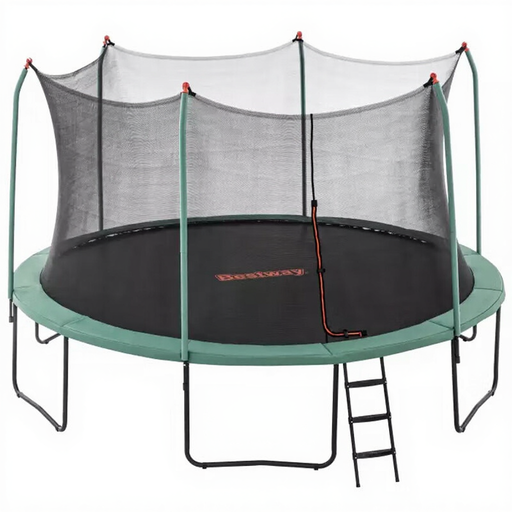
Why it stands out: Its generous 4.27 m surface and high weight capacity (120 kg) make it the perfect choice for large families or teens who need space to express themselves safely.
It comes with an anchor kit for rock-solid stability, even in windy conditions. Its sturdy galvanised steel frame is built to last, while the internal net and padded poles ensure comprehensive protection.
An all-in-one package that includes a ladder for easy access and ground anchors for a secure and durable installation right out of the box.
Be careful not to confuse a classic spring trampoline with a kids' bouncy castle, which operates with a continuous air blower and is better suited for toddlers for occasional use.
We've put together a complete selection of products that meet our strict selection criteria and current safety standards.
The trampoline assembly time varies greatly. For well-designed models with simplified assembly systems (clip-on connections, dedicated tools), expect 1 to 2 hours with two adults. For entry-level models, it's not uncommon to spend 3 to 4 hours. Our advice: always read other buyers' reviews on this specific point before you decide.
A trampoline has a large surface area and can catch a lot of wind, especially larger models. To prevent it from turning into a kite at the first gust of wind, using an anchor kit is essential. These kits consist of stakes that screw into the ground and straps that firmly secure the frame to the earth. Some packages, like the Bestway 14FT, include it by default.
A quality trampoline that is well-maintained, with a galvanised steel frame and UV-treated components, can easily last between 5 and 10 years. Of course, this will depend on its exposure to the elements and the diligence of its maintenance. Remember to regularly inspect the mat, net, and springs. Ideally, you should disassemble the net and jumping mat to store them indoors during the winter to maximise their lifespan.