
Livraison le jour même ou le lendemain

Qualité garantie

Débloquez vos offres de bienvenue: Livraison GRATUITE | Jusqu'à -80 % | 30 jours d'essai gratuits à JoyPlus
Téléchargez l'application
A cluttered garage can quickly become unusable: tools left on the floor, boxes piled up, seasonal belongings that are difficult to reach and equipment exposed to damp. A garage storage shelf can help you reclaim valuable space, provided you choose a structure suited to the weight it needs to support, the dimensions of the room and your everyday use.
However, manufacturers’ claims should be viewed critically. A total capacity of several hundred kilos does not mean that every shelf can hold any load. Similarly, an adjustable shelving unit can help you make the most of your space, but it may become less stable if it is assembled incorrectly or placed on an uneven floor.
A figure such as “875 kg” generally refers to a total static load, distributed across several levels. You should therefore check the maximum load supported by each shelf, the weight-distribution requirements and the type of items involved. Containers, toolboxes and metal parts create much more concentrated loads than a large box filled with lightweight items.
A metal shelving unit that is too deep can narrow the walkway or prevent a door from opening fully. Before ordering, measure the available width, ceiling height and maximum depth you can accommodate. Also leave enough clearance in front of the shelving unit to remove items without having to move everything else.
A tall industrial shelving unit must stand on a level surface and, where specified by the manufacturer, be secured to the wall using an anti-tip device. Even a robust structure will not compensate for poor assembly. Distribute loads evenly and place the heaviest items on the lower levels.
When fitting out a workshop or storage area subject to intensive use, choose a steel frame, ideally with a finish designed to limit wear and surface corrosion. Shelves may be made from metal, chipboard or MDF. The right choice depends on how you intend to use them: tools and heavy storage bins require a rigid shelf, while lightweight boxes offer greater flexibility.
A robust storage shelf should remain stable even when its levels are not filled evenly. Check for reinforcing bars, the assembly system and the manufacturer’s fixing recommendations.
A 5-tier shelving unit is often suitable for garages and sheds: it makes use of the available height without requiring multiple pieces of furniture. At 180 cm high, for example, it provides several storage spaces while remaining accessible to most adults, although you may need a stable step ladder for the upper levels.
In narrow spaces, an adjustable shelving unit allows you to alter the height between two shelves. This flexibility is useful for storing everything from low crates to paint tins and bulkier tools.
A boltless system can speed up installation, but the instructions must be followed precisely. Check that every component is properly slotted into place and that all connections are securely locked. Some models can be split into two units: a practical solution for organising both the garage and shed, or for sliding part of the structure under a workbench.
Before buying, also check the furniture’s weight, whether an anti-tip kit is included and which accessories are supplied. Protective gloves are recommended during assembly, particularly when handling metal components.
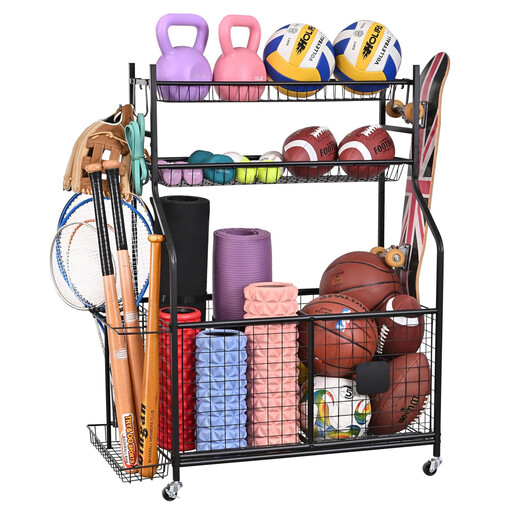
Why this choice suits this profile : This compact unit helps organise balls, yoga mats, dumbbells and accessories without requiring you to invest in a large metal shelving unit straight away.
The baskets, hooks and wheels help keep accessories separate instead of piling them together. However, this unit should be reserved for sports equipment and is not suitable for heavy loads.
Integrated basket, hooks and wheeled trolley for moving accessories easily or keeping them together in one place.
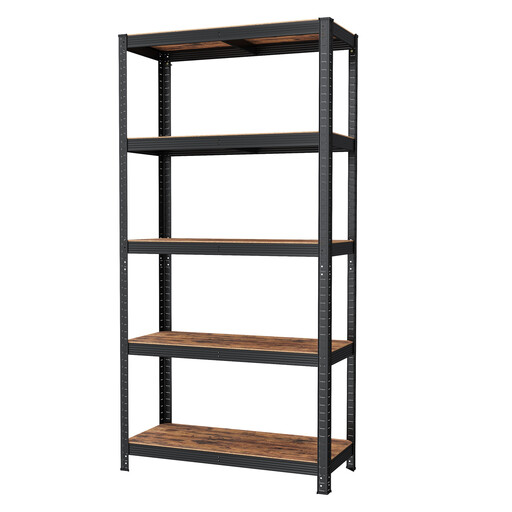
Why this choice suits this profile : Measuring 40 × 90 × 180 cm, with adjustable shelves, it is ideal for a garage organised around tools, storage bins and bulky equipment.
The specifications state 175 kg per level and 875 kg in total as a static load. These figures assume that the weight is distributed evenly and do not remove the need to install the anti-tip device.
Powder-coated steel frame, five adjustable levels, slot-in assembly and the option to divide the unit into two separate units.
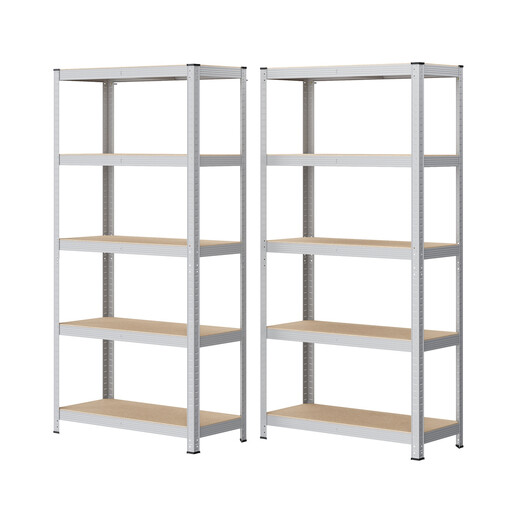
Why this choice suits this profile : This set of two units allows you to create two separate storage areas: one for tools in the garage and the other for seasonal storage in the shed, for example.
Each unit must be installed on a stable floor and secured with its anti-tip kit. Separating the two units prevents all the heavy loads from being concentrated on a single structure.
Two 5-tier units, adjustable shelves, a stated static load of 175 kg per level and 875 kg per unit.
Start by sorting items according to their weight and how often you use them. Place heavy appliances, boxes of screws and containers on the lower levels. Keep the middle shelves for tools used every week, then reserve the upper levels for decorations, tyres and seasonal equipment.
Leave space between the items and the wall wherever ventilation or inspection requires it. Flammable products should remain in their original packaging and be stored in accordance with the instructions on their labels. A garage shelving unit must never block an exit, consumer unit or access to safety equipment.
It depends on the model, the shelf in question and how the weight is distributed. For the JOYFURNOS model featured here, the specifications state 175 kg per level and 875 kg in total as a static load. These figures are only valid when the unit is installed securely, the load is distributed correctly and the anti-tip device is used in accordance with the instructions.
Use the supplied kit if the product includes one, then choose wall plugs and screws suitable for the type of surface: concrete, brick or partition wall. After assembly, check the alignment, that the unit is upright and that there is no movement. If you are unsure about the strength of the wall, it is best to seek advice from a building professional.
Its lifespan depends on the humidity in the garage, the weight stored, the quality of the assembly and maintenance. Limit water ingress, check the connections regularly and replace any deformed or rusty parts. Periodic inspections help keep a metal shelving unit stable, safe and functional.