What should you compare?
First, decide between a dedicated freezer and a fridge freezer based on how much you need to freeze and the space available. Then compare the features of models that you can actually install in your home.
| What to compare |
What to check |
What I need |
| Freezer capacity |
Compare the litres available for frozen food, not the total capacity of a fridge freezer. Check the internal layout, including drawers or baskets. |
I want to store the amount of food I usually freeze without choosing an appliance simply because it looks spacious. |
| Space and access |
Measure the width, depth and height, then check the clearance needed for the door or lid. A chest and an upright freezer take up space in different ways. |
A chest freezer appeals if I have floor space to spare. If I often need to find a particular item, I’d rather look at the drawers in an upright model. |
| Energy use and noise |
Compare kWh/year for appliances of a similar size and type, as well as their noise emissions in dB. According to the European Commission, these figures and the appliance’s capacity are shown on the energy label of relevant appliances. |
Noise matters to me too if the appliance is near a living area. ADEME points out that a freezer runs continuously. |
| Room temperature |
Check the permitted ambient temperature range or climate class for the exact model. Don’t assume that a model is suitable for a cold room just because it’s described as a ‘chest’ or ‘compact’ freezer. |
If I’m putting it in an unheated cellar or garage, I need to compare the actual room temperature with the operating conditions for the model I choose. |
| Power cuts |
Compare the stated power-cut storage time in hours for each model. Check separately whether it has an alarm if you want to be alerted to a problem. |
If power cuts are a concern where I live, I’ll check this figure before choosing, rather than assuming it depends on the appliance’s capacity. |
Which brands and models should you consider?
These model examples give you an idea of different types and features. They don’t cover every model from each brand.
Beko
The B3RMFNE314W upright freezer is worth a look if you want a large freezer capacity without choosing a chest model.
- Beko France lists a capacity of 286 L and a power-cut storage time of 10 h for this model. Its product sheet gives dimensions of 597 × 709 × 1865 mm and a climate class of SN-T.
- If you’re putting it in an unheated room, check the permitted ambient temperature range for the B3RMFNE314W rather than assuming it’s suitable because it’s an upright model.
Haier
The H4F306WDH1 upright freezer is worth measuring up if you’re looking for a capacity of 301 L and have a space around 60 cm wide.
- Haier France lists a capacity of 301 L, an energy rating of D and dimensions of 600 × 742 × 1900 mm for this model.
- Its depth of 742 mm and height of 1900 mm need to fit the available space and the access route into the room.
Whirlpool
Whirlpool France’s models show why it’s important to compare freezer capacity and power-cut storage time model by model, including when you’re considering a fridge freezer.
- Whirlpool France lists a capacity of 371 L and a power-cut storage time of 36 h for the W3RHS37EW1 chest freezer, compared with 404 L and 11 h for the WHFF6403W4E upright freezer.
- The WHK25404XBR5E fridge freezer has 106 L of freezer capacity out of a total 355 L. Its overall capacity doesn’t show how much space is available for frozen food.
Which models should you look at on Joybuy?
This selection includes a fridge freezer to consider if you’re also replacing your fridge, three small chest freezers and a compact upright freezer. For each one, compare the freezer capacity with the amount of food you need to store, and check that it’s suitable for the room where you plan to install it.
 Image unavailable
Candy CFQQ5T817EPS, 467 L four-door fridge freezer
Worth considering if you also need to replace your fridge. The 467 L refers to the total capacity of the fridge freezer, not just its freezer compartment.
The model description specifies four doors, Total No Frost and an energy rating of E. Before comparing it with a dedicated freezer, check the capacity of its freezer compartment and its dimensions.
View on Joybuy
 Image unavailable
AUCMA, 95 L convertible chest freezer
This 95 L chest freezer is worth considering for extra storage if you have enough room to open the lid from above.
The product description lists switchable fridge and freezer modes, a 7-level thermostat, a removable basket, a defrost drain and an energy rating of E. Check which mode you need and the permitted ambient temperature for your chosen location.
View on Joybuy
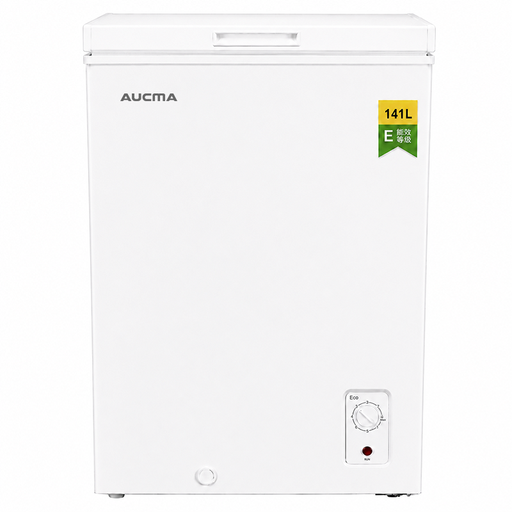 Image unavailable
AUCMA, 141 L convertible chest freezer
With a stated capacity of 141 L, this chest freezer offers more space than the AUCMA 95 L model featured here. Even so, measure the floor space it needs and check there’s room to open the lid.
It’s described as having switchable fridge and freezer modes, a 7-level thermostat, a removable basket, a defrost drain and an energy rating of E. Check the permitted ambient temperature range for the room where you plan to install it.
View on Joybuy
 Image unavailable
CHiQ JR99DWE, 99 L chest freezer
This 99 L chest freezer is worth comparing with other compact options, depending on how much room you have to open the lid and access your frozen food.
The product description lists four-star freezing, an adjustable thermostat, a removable basket, a sliding lid and an energy rating of E. Check its dimensions and the operating conditions for the room.
View on Joybuy
 Image unavailable
COMFEE' RCU60WH2(E), 60 L upright freezer
This 60 L upright model is worth considering for a small amount of extra storage, especially if drawer access matters more to you than a large capacity.
The product description specifies three drawers, a reversible door, adjustable temperature and an energy rating of E. Check the dimensions, door clearance and permitted ambient temperature before choosing where to put it.
View on Joybuy
Frequently asked questions
What should I compare on a freezer’s energy label?
Focus on annual energy consumption in kWh, storage capacity and noise, taking into account the type and capacity you need. The European Commission says these figures appear on the label for relevant appliances. You can also use the model reference to look up its information in EPREL.
Can I install any freezer in a garage or cellar?
No. Check the permitted ambient temperature range for the exact model and compare it with the temperatures in the room. Whirlpool France specifies operation down to −15 °C for the W3RHS37EW1 chest freezer, while Beko France gives a minimum of 5 °C for the FSE1174N table-top model. These figures don’t apply to other models from those brands.
How do I compare power-cut storage times?
Compare the stated time in hours for each model, rather than assuming it depends only on the type of freezer. Whirlpool France lists 36 h for the W3RHS37EW1 chest freezer and 11 h for the WHFF6403W4E upright freezer. Beko France lists 10 h for the B3RMFNE314W upright freezer.
What should I check about maintenance before ordering?
Make a note of the full model reference and, if available, check its EPREL product information. According to the European Commission, the database provides access to product features as well as repair and spare parts information. Check the delivery and service options offered by the seller separately.


