
Livraison le jour même ou le lendemain

Qualité garantie

Débloquez vos offres de bienvenue: Livraison GRATUITE | Jusqu'à -80 % | 30 jours d'essai gratuits à JoyPlus
Téléchargez l'application
The overflowing drawer, the backpack weighed down by an armada of chargers… Who hasn't experienced this daily headache? One block for the laptop, another for the smartphone, a third for the tablet… An accumulation that is not only cumbersome but also terribly inefficient.
Fortunately, a new technology has arrived to bring order to this chaos: the GaN fast charger. Thanks to gallium nitride (GaN), these next-generation adapters are much more compact, more efficient, and generate far less heat than their silicon-based predecessors. Their superpower? Charging all your devices at the same time, with a single, unified block.
This guide is here to help you make sense of it all, decipher the important features, and find the model that will change your life.
To ensure you make the right choice, let's review the key points that will make all the difference.
This is the heart of the matter: power, expressed in watts (W). A 65W GaN charger or a 67W power adapter is an excellent baseline, capable of effortlessly powering the majority of modern laptops, whether it's a MacBook charger or another laptop charger.
But be careful, the advertised total power doesn't tell the whole story. The most important thing is to check how this power is distributed when multiple ports are in use. A good multi-port USB-C charger will always detail the maximum power per port and its various distribution scenarios. For example, a 67?W charger might deliver the full 67?W to a single port, but switch to a 45?W + 20?W split as soon as you plug in a second device.
Ask yourself the right question: how many ports do you really need on a daily basis? For a professional on the go or a student, a 3-port USB-C charger is often the ideal compromise for simultaneously charging a computer, smartphone, and headphones.
Today, almost all new devices use USB-C for fast charging (via the Power Delivery standard). Prioritising a charger with multiple USB-C ports is therefore a future-proof choice. The presence of a USB-A port remains a nice bonus to ensure compatibility with older cables or accessories.
The main advantage of GaN technology is its incredible compactness. For those who are often on the road, a compact travel charger doesn't just take up less space: it's a game-changer. Look for models with retractable prongs or an extra-slim design, made to slip anywhere effortlessly.
To help you make your choice, here are three models that cater to specific needs.
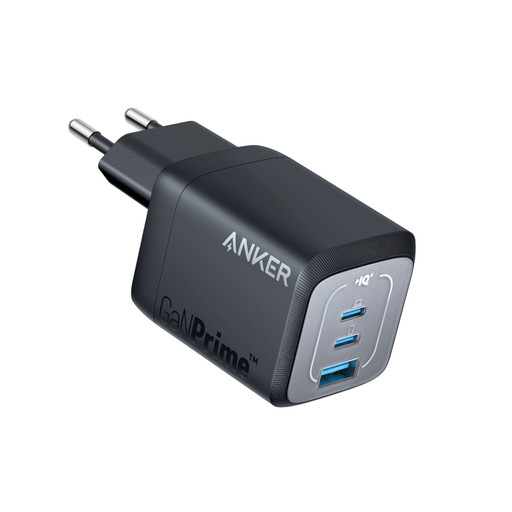
Why it stands out?
This model from Anker is a true powerhouse in a pocket-sized format. The manufacturer claims it's 51% smaller than an original 67W MacBook charger. Its foldable plug makes it the ideal travel companion. With its two USB-C ports and one USB-A port, it juggles effortlessly between new and older devices.
Pros
Who is it for? For mobile professionals and students who want a single, discreet charger for their computer, smartphone, and other accessories (smartwatch, headphones, etc.).
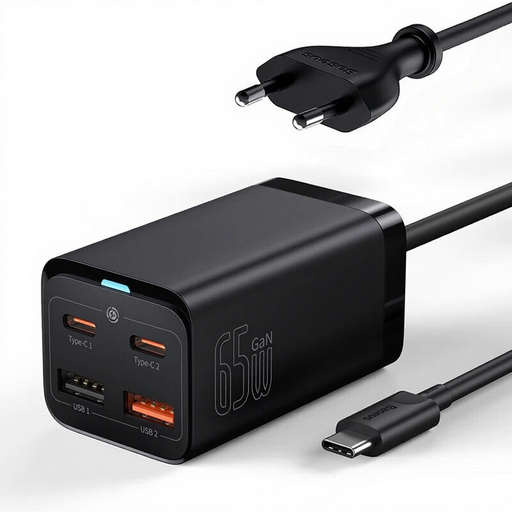
Why it stands out?
Unlike a classic wall charger, the Baseus GaN3 Pro is a remote charging station. It plugs into the mains via a 1.5m cord, allowing you to place it directly on your desk for immediate access to the ports. With its four outputs (two USB-C, two USB-A), it was designed to declutter your workspace by centralising the charging of your entire ecosystem.
Pros
Who is it for? For anyone with a fixed desk (at home or in the office) who wants to put an end to power strips and the clutter of chargers under the desk.
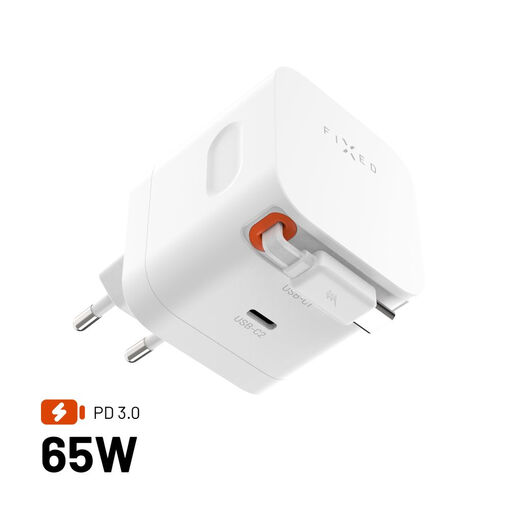
Why it stands out?
This charger incorporates an idea as simple as it is brilliant: a 64cm USB-C cable, directly integrated and retractable. No more forgotten cables at the bottom of your bag or tangled with your keys! Just pull to extend it, and it retracts automatically after use. Clever. In addition to this "always-ready" cable, a second USB-C port allows you to charge another device, with a power split of 45W + 20W.
Pros
Who is it for? The minimalist traveler's dream companion who hates dangling cables and wants an all-in-one solution to never run out of battery.
Our selection covers the most common uses, but the world of GaN chargers is much vaster. Need more than 100W of power for a gaming PC? Looking for a very specific port configuration? Other solutions exist.
Feel free to explore our complete collection of USB-C fast charging solutions to find the hidden gem that will meet all your needs.
GaN, or gallium nitride, is a next-generation semiconductor material that is replacing the silicon in our old chargers. Its advantage? It conducts electricity much more efficiently. The result: chargers that are much smaller, lighter, and run cooler, all while being capable of delivering very high power.
Absolutely not. Modern chargers and devices (smartphones, tablets, etc.) are intelligent. Thanks to protocols like USB Power Delivery (PD), your phone "communicates" with the charger to request exactly the amount of power it needs. A 65W charger will therefore only deliver the 20 or 25W requested by your smartphone, with no risk of overheating or damage.
Yes, and that's the whole point! A 65W GaN charger or 67W model is more than sufficient for this purpose. You can charge your MacBook charger at full speed when it's plugged in alone, or power all three of your devices at the same time (overnight, for example), with the power being intelligently distributed among them.