
Livraison le jour même ou le lendemain

Qualité garantie

Débloquez vos offres de bienvenue: Livraison GRATUITE | Jusqu'à -80 % | 30 jours d'essai gratuits à JoyPlus
Téléchargez l'application
By the Joybuy Team, Our Tech ExpertsPublished July 16, 2026
Tired of juggling chargers for your laptop, smartphone, and tablet? Is your bag or desk drowning in a tangle of cables and bulky adapters? Whether you're a digital nomad, a frequent traveller, or a tech enthusiast, an optimised setup isn't a luxury—it's a necessity. This is where the GaN charger comes in as a game-changer.
Thanks to gallium nitride (GaN), these technological marvels pack incredible power into a format that's far more compact and efficient than traditional chargers. Say goodbye to compromising between power and portability. This guide is here to help you find the perfect GaN charger for your needs and simplify your digital life.
Before you dive in, let's review the key criteria that make all the difference.
Power, measured in watts (W), is the name of the game. A 100W charger or higher is often essential for feeding a power-hungry laptop, like a MacBook Pro charger. Be careful, though: the total advertised power is almost always split across the different ports. So, be sure to check the maximum power a single USB-C port can deliver. For a laptop, a port capable of providing 65W is the bare minimum. A model that intelligently manages power distribution (smart charging) across multiple connected devices will be much more versatile for daily use.
A good multi-port charger must first and foremost match your devices. Today, almost all new gadgets rely on the fast-charging USB-C standard for lightning-fast power-ups. A configuration with two or three USB-C ports and a classic USB-A port is often the winning combination, offering maximum flexibility to charge a laptop, a smartphone, and accessories (earbuds, smartwatch) at the same time. Take stock of the devices you plug in daily to choose the ideal port combination.
The key advantage of GaN technology is miniaturisation. For digital nomads, a compact travel charger is a must-have. Some models take this concept even further with foldable prongs, making them perfect for slipping into a bag without scratching your other gear. This compactness transforms a simple power brick into a true portable wall charging station, ideal for use at a hotel, the office, or a café.
To help you decide, we've selected three models that cater to distinct user profiles, from the most powerful to the most portable.
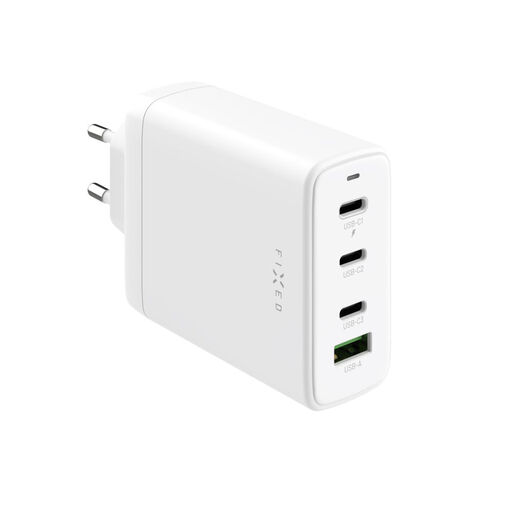
This model is a true miniature powerhouse. With a total output of 120W and four ports, it's built for the most demanding users who need to charge multiple power-hungry devices simultaneously.
For power users and professionals who juggle a high-performance laptop, a tablet, and a smartphone, and are looking for an all-in-one solution for the office or home.
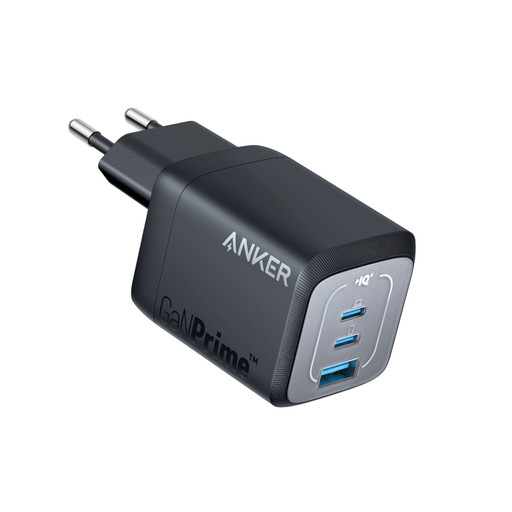
Compactness is the name of the game for this Anker charger. With its foldable prongs and tiny size, it's the ideal travel companion for those who count every gram.
For digital nomads and minimalists for whom portability is the number one priority. It's an excellent choice to accompany a MacBook Air, an iPad, and an iPhone.
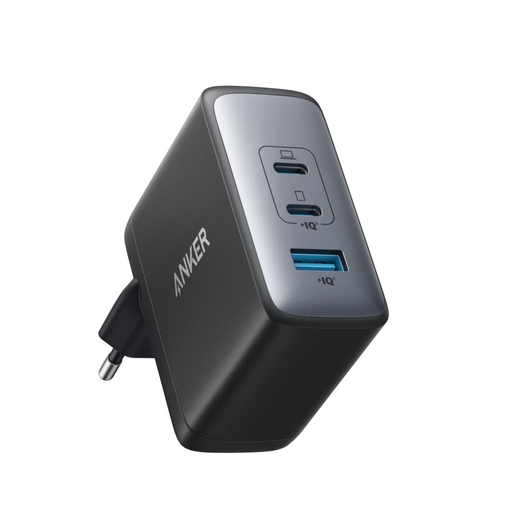
This charger strikes the perfect balance between serious power and a pocket-sized form factor. Thanks to Anker's GaN II technology, it delivers 100W in a body that's barely larger than many 65W chargers.
For professionals and creatives who need 100W of power for their laptop but want a more compact solution than the original, often bulky, power adapter.
Our selection highlights typical user profiles, but the ideal charger is ultimately a personal choice. If you're looking for different port configurations, different power levels, or specific designs, feel free to explore our full catalogue.
? Explore Our Entire Category of Portable USB Chargers
GaN, or gallium nitride, is a semiconductor material that is replacing traditional silicon in power electronics. It's more efficient, can handle higher voltages, and generates much less heat. In simple terms, this allows for the creation of chargers that are smaller, lighter, and more powerful than classic silicon-based chargers.
No, there is absolutely no risk. Modern chargers, especially those featuring the USB Power Delivery (PD) standard, communicate with the connected device to supply only the power it needs. Your smartphone will only "draw" the maximum power it can accept (for example, 25W or 45W), even if the charger can deliver 100W. The advertised wattage is a maximum available output, not a forced output.
Yes, and this is a crucial point not to be overlooked. To take full advantage of a 100W charger, you absolutely need a USB-C cable certified to handle that level of power. A standard cable could throttle the charging speed or, in rare cases, overheat. Always check that your cable is compatible with the intended wattage, especially when it comes to powering a laptop.