
Livraison le jour même ou le lendemain

Qualité garantie

Débloquez vos offres de bienvenue: Livraison GRATUITE | Jusqu'à -80 % | 30 jours d'essai gratuits à JoyPlus
Téléchargez l'application
Is your drawer overflowing with chargers of all kinds? One for your smartphone, another, much bulkier one for your laptop, and a third for your tablet? If you're dreaming of streamlining your daily life with a single, compact, and ultra-powerful solution, the GaN charger is exactly what you need. But be warned: the market is a jungle where marketing promises often hide disappointment.
As the Head of Product Recommendations at Joybuy, my role is to clear the path for you and guide you toward the best choice. Here are the pitfalls to avoid and the essential criteria to check before you buy.
To choose the right GaN charger, you need to know how to read between the lines on product spec sheets. Here are the three technical points to inspect closely.
Power (in watts, W) is the most critical factor: it dictates charging speed. Don't be blinded by the total wattage. What matters is the maximum power that each USB-C port can deliver individually.
Also, verify that the charger is compatible with the Power Delivery (PD 3.0) protocol. This is the standard used by nearly all modern devices (led by Apple) to negotiate the optimal charging power, ensuring it's both fast and safe.
A multi-port charger is designed to replace all your other power bricks. Ask yourself the right question: how many devices do you charge simultaneously on a daily basis?
For most users, a configuration with two USB-C ports and one or two USB-A ports strikes the perfect balance. This allows you to create a truly compact charging station, perfect for your desk or as a travel charger.
So, what exactly is GaN? It's the acronym for Gallium Nitride, a semiconductor material that is replacing the silicon used in our old chargers. For the user, the benefits are immediate:
Rather than an endless list, we've selected models that match specific user profiles, ensuring they tick all the boxes for performance and safety.
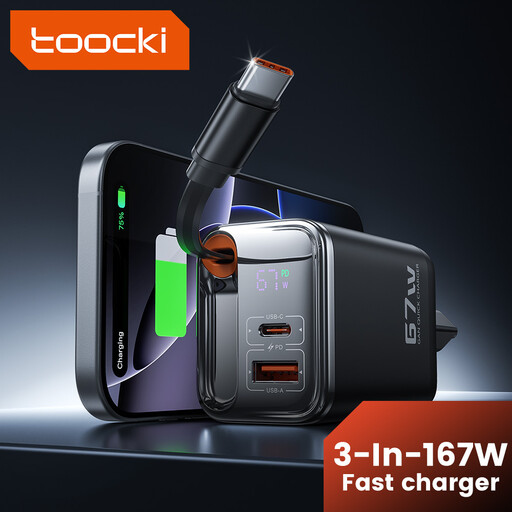
Why we chose it: Ideal for those who hate tangled cables. The integrated, retractable USB-C cable simplifies life on the go. Its 67W output is perfect for an ultraportable laptop (like a MacBook Air) and a smartphone, all in an ultra-compact form factor.
It features dynamic power distribution, which prevents performance throttling when multiple devices are plugged in.
The retractable USB-C cable is a major asset for minimal bulk in a bag.
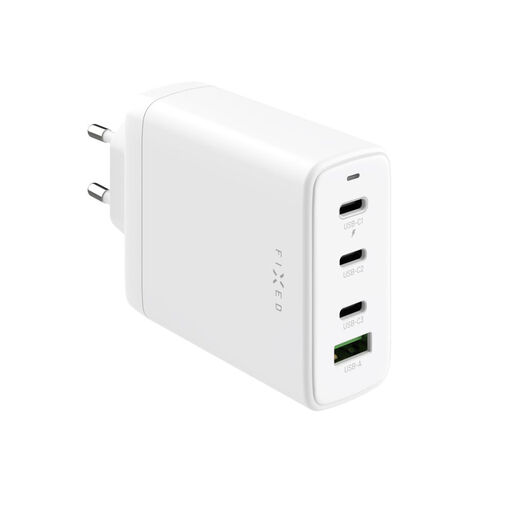
Why we chose it: For those who juggle a powerful laptop, a tablet, a phone, and accessories. With 120W of total power and four ports, it can power your entire digital arsenal without breaking a sweat.
It's transparent about its capabilities, offering a maximum output of 100W on a single USB-C port, thereby avoiding the misleading "total power" trap.
Its ability to deliver 100W via Power Delivery 3.0 makes it the ideal partner for MacBook Pros and other power-hungry laptops.
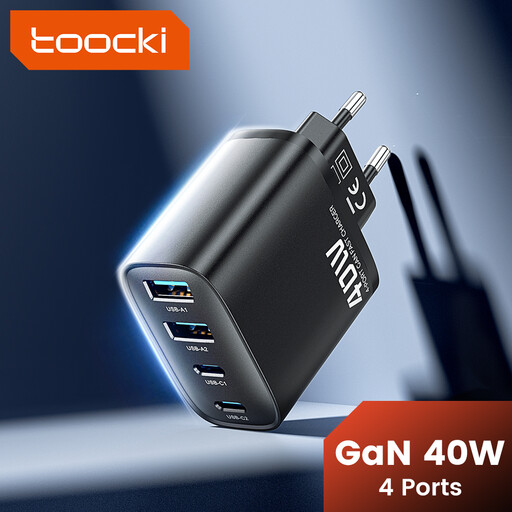
Why we chose it: The smart and affordable solution for charging all your everyday devices (smartphones, earbuds, watch) without needing the power of a laptop charger.
With its clearly stated 40W, there are no nasty surprises: it's designed for mobile devices, not for a laptop.
An unbeatable price-per-port ratio for creating a central charging hub for the whole family's smartphones and accessories.
We've curated a full selection of products that meet our strict requirements and European safety standards.
GaN (Gallium Nitride) is a semiconductor that outperforms the silicon used in traditional chargers. It allows for the creation of smaller, lighter chargers that generate less heat and waste less energy. In practical terms for you, this means a powerful fast charger that takes up almost no space in your bag.
No. A modern, certified charger doesn't "force" power into your device. Thanks to protocols like Power Delivery (PD), the charger and your device "talk" to each other to determine the ideal and safest charging power. This means a 100W charger can safely power a laptop at full speed and then securely charge a smartphone that only needs 20W.
Yes, and this is an absolutely crucial point. To take advantage of charging speeds above 60W, you must use a USB-C cable specifically rated to handle that level of power (for example, a 100W-certified cable). Using a basic cable with a 100W charger will throttle the charging speed and, in the worst-case scenario, could cause the cable to dangerously overheat. So always remember to check your cables' specifications.