
Livraison le jour même ou le lendemain

Qualité garantie

Débloquez vos offres de bienvenue: Livraison GRATUITE | Jusqu'à -80 % | 30 jours d'essai gratuits à JoyPlus
Téléchargez l'application
By the Joybuy Editorial Team, July 04, 2026
Is your bag overflowing with tangled cables and all sorts of chargers? One for your laptop, another for your smartphone, and yet another for your tablet or earbuds... It's a struggle that mobile professionals and frequent travellers know all too well. GaN (Gallium Nitride) technology promises to bring order to this chaos with smaller, more powerful, and more efficient chargers.
This guide breaks down the benefits of a GaN charger for you and helps you choose the perfect model for your needs, without the unnecessary marketing jargon. We've sifted through several models to bring you a curated selection that will genuinely simplify your life (and lighten your bag).
Before you take the plunge, let's review a few key points to ensure you make the right choice and guarantee perfect compatibility with all your devices.
Power, measured in watts (W), is the most critical factor. Determining what you need is simple: identify the most power-hungry device in your arsenal, which is often your laptop. A recent MacBook power adapter for an Air requires between 30W and 67W, while a MacBook Pro can demand up to 96W or even more.
Rest assured, most modern GaN chargers integrate technologies like Power Delivery (PD), which automatically adjust the power delivered to each device to eliminate any risk of overcharging.
One of the superpowers of a GaN charger is its ability to offer multiple ports in an ultra-compact form factor. A 3-port charger often represents the sweet spot for powering a computer, a phone, and an accessory at the same time.
Opting for a multi-device charger is the best way to travel lighter by carrying only a single power brick.
This is THE big promise of GaN: chargers that are much more compact and lightweight than their silicon-based predecessors. If you travel often, every gram and square inch counts. A good travel charger should be able to slip into any bag pocket. Some models even feature retractable prongs, a detail that makes all the difference in preventing scratches on your tablet screen at the bottom of your bag.
We have selected a few gems that stand out from the crowd, each tailored to a specific user profile.
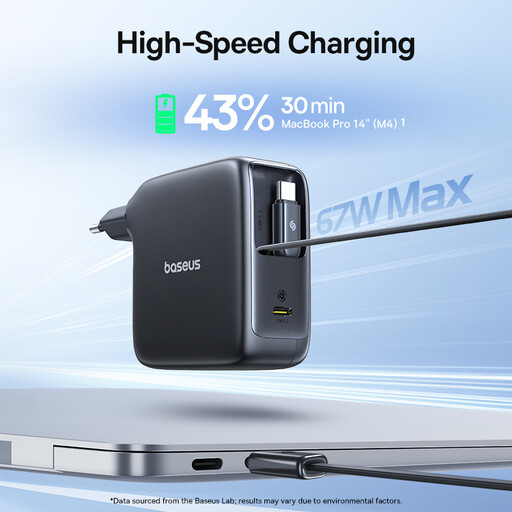
Why it stands out: The Baseus EnerCore CJ21 shines with its incredibly clever design, integrating two retractable cables (one USB-C and one Lightning). No more tangled messes or forgotten cables: this unique design frees you from the mental load of managing accessories.
Highlights:
Who is it for?: The organisational obsessive and the pragmatic traveller. If untangling cables is part of your morning routine, this all-in-one model is for you.
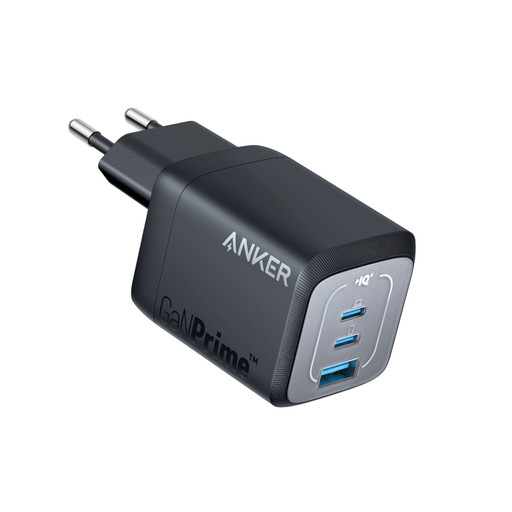
Why it stands out: This Anker charger is a true powerhouse in a tiny package. According to Anker, it's 51% more compact than the original 67W MacBook charger. Its foldable prongs make it the ideal travel companion.
Highlights:
Who is it for?: Perfect for the digital nomad and the minimalist who scrutinise every extra gram in their bag, without compromising on the charging speed of their MacBook Air, tablet, and phone.
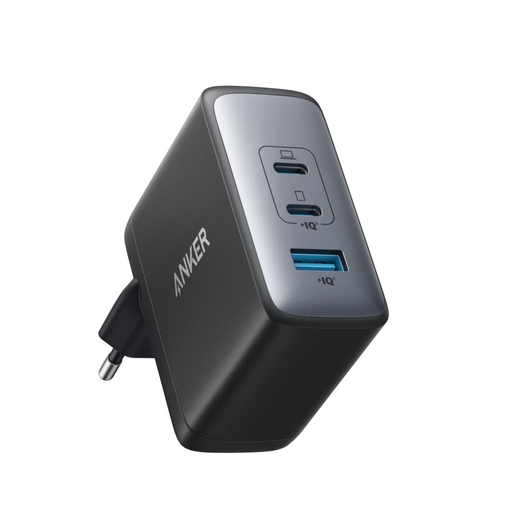
Why it stands out: With its 100W of total power, the Anker 736 is built for the most demanding users. It can bring a powerful laptop back to life at full speed while charging two other devices.
Highlights:
Who is it for?: The power user who juggles a high-performance laptop and won't tolerate any charging slowdowns, even when their phone and earbuds are plugged in at the same time.
This selection already covers many needs, but the charger market is constantly evolving. If you haven't found what you're looking for, don't worry: there are a multitude of other power and port configurations available.
? Explore our entire collection of USB Type-C Chargers to find the perfect model.
A GaN charger uses components made of Gallium Nitride (GaN) instead of traditional silicon. To put it simply, this next-generation semiconductor outperforms silicon: it can handle higher voltages and generates much less heat. In practical terms, this results in chargers that are:
Absolutely not. A certified GaN charger is just as safe, if not safer, than a conventional charger. Modern chargers, whether GaN or not, are smart. They incorporate chips (compliant with the USB Power Delivery standard, for example) that communicate with the connected device. The charger only delivers the power requested by the device, which eliminates any risk of overcharging, over-voltage, or overheating.
Yes, without any problem. That's the magic of smart charging standards. A 100W charger will detect that a smartphone only needs 20W and will automatically limit its power output. Using a more powerful charger will never harm your device. It simply means you have headroom to plug in more demanding devices or to charge several at the same time.