
Livraison le jour même ou le lendemain

Qualité garantie

Débloquez vos offres de bienvenue: Livraison GRATUITE | Jusqu'à -80 % | 30 jours d'essai gratuits à JoyPlus
Téléchargez l'application
A gaming PC case is about far more than a front panel covered in RGB LEDs. It has a direct impact on cooling, noise levels, ease of assembly and component compatibility. Choosing the wrong format or dimensions could even force you to replace your graphics card, CPU cooler or power supply.
Before placing your order, here are the pitfalls to avoid and the criteria to check when choosing a PC case that is genuinely suited to your build and how you use it in the UK.
An ATX PC case can generally accommodate an ATX, Micro-ATX or Mini-ITX motherboard. The reverse is not always true. A compact model may limit the length of the graphics card, the height of the CPU cooler or the power supply form factor.
Always check the manufacturer’s specifications carefully, particularly the maximum dimensions supported for the graphics card, CPU cooler and power supply.
A PC case supplied with fans can reduce the cost of your build, but the number of fans alone does not guarantee effective airflow. A mesh front panel, removable filters and an unobstructed airflow path are just as important.
For a gaming or content-creation build, prioritise a well-planned airflow pattern: intake at the front or lower section, followed by exhaust at the rear or top. An airflow-focused PC case with a perforated front panel is often easier to optimise than a fully enclosed model.
A PC case with tempered glass showcases your components and lighting, but the panel is heavy and particularly vulnerable to knocks on the corners. Place it on a soft surface during assembly and avoid overtightening the screws.
Glass also quickly reveals poorly managed cables and dust. A panoramic design is therefore most worthwhile if you plan to keep your cable management tidy and clean the case regularly.
Start by checking the motherboard form factor:
Next, check the length of the graphics card and the height of the CPU cooler. The Corsair iCUE 4000D RGB, for example, states compatibility with graphics cards up to 360 mm long and CPU coolers up to 170 mm high. Be sure to compare these figures with the actual dimensions of your components, including power cables.
A good airflow-focused PC case should have sufficiently wide openings and easily accessible filters. Filters positioned at the front, top and bottom of the case help limit dust build-up, provided they are cleaned regularly.
If you use water cooling, check the supported radiator size: 240, 280 or 360 mm. Also check the total thickness of the radiator and fans, as well as any potential clashes with the RAM or motherboard. The Cooler Master MasterFrame 360 Panorama supports radiators up to 360 mm and offers generous internal width. Several Lian Li O11D Mini V2 models also support a 360 mm radiator, depending on the configuration selected.
Power supply compatibility is often overlooked. The Lian Li O11D Mini V2 Flow and white O11D Mini V2 require an SFX or SFX-L power supply, so a standard ATX unit cannot be installed. By contrast, the XPG INVADER X MINI and Corsair 4000D RGB accept a standard ATX power supply.
For a tidy build, look for:
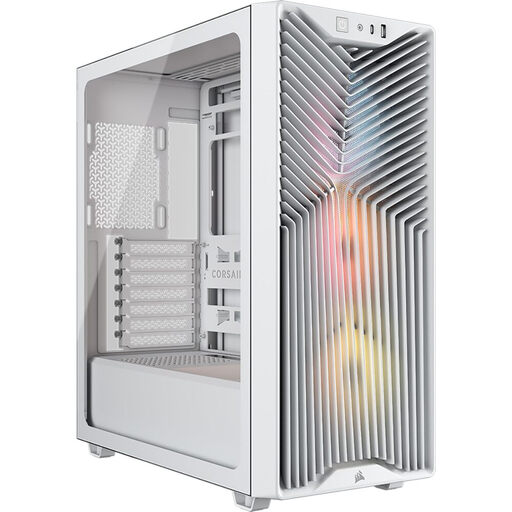
Why this choice suits this profile : This mid-tower PC case supports ATX, Micro-ATX and Mini-ITX motherboards. Its pre-installed RS ARGB fans and mesh front panel mean you do not need to buy additional fans straight away.
The high-airflow front panel and top, front and bottom filters provide a more dependable foundation than a closed case focused primarily on lighting.
Dimensions of 445 × 455 × 220 mm, tempered-glass side panel, ARGB lighting and PWM control via the motherboard.
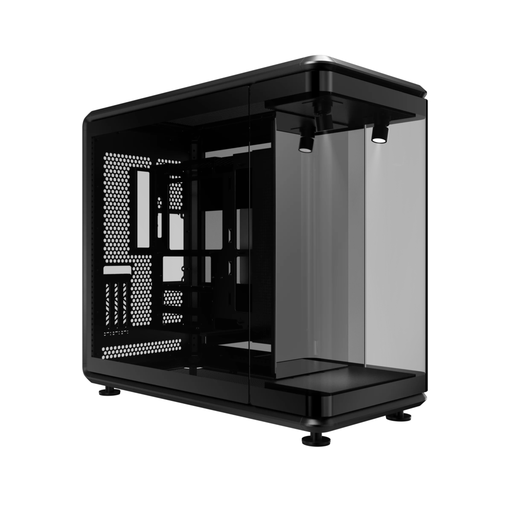
Why this choice suits this profile : With 93 litres of internal volume, it accommodates E-ATX builds, large graphics cards and advanced water-cooling setups.
The ventilation options and compatible radiator sizes are clearly detailed, making it easier to confirm a powerful build before buying.
Supports graphics cards up to 430 mm, 360 mm radiators, includes a PCIe 5.0 cable and features USB-C connectivity at 20 Gb/s.
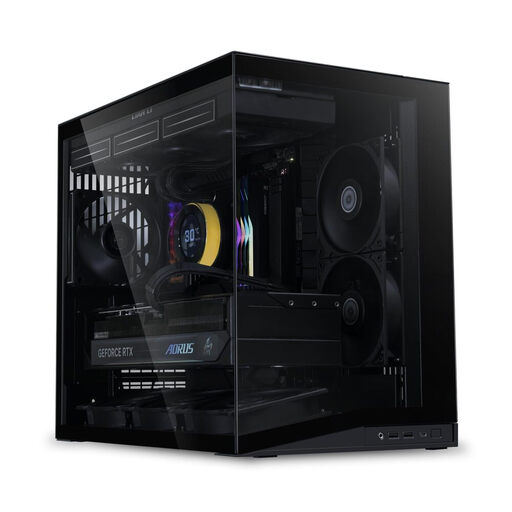
Why this choice suits this profile : This dual-chamber case separates the cables from the components while providing a front panel and side panel that promote airflow and visibility.
Compatibility is clearly limited to SFX and SFX-L power supplies. This clearly stated restriction prevents you from discovering an incompatibility during assembly.
Supports ATX, Micro-ATX and Mini-ITX form factors, graphics cards up to 395 mm and radiators up to 360 mm, depending on the mode selected.
We have put together a complete, real-time updated list of products that fully meet these strict selection criteria and European safety regulations.
An ATX PC case or a compatible ATX mid-tower model is generally suitable. However, check the graphics card length, cooler height and power supply form factor. The Corsair 3200D and 4000D state compatibility with ATX, Micro-ATX and Mini-ITX form factors.
It depends entirely on the components you are using and their power consumption. One or more front fans for intake, combined with exhaust at the rear or top, provide an effective starting point. If the case already comes with fans, check their positions and PWM or ARGB connectors before adding more.
Clean the filters regularly, do not block the openings and leave enough space around the chassis. During assembly, handle tempered glass on a soft surface, disconnect the mains power and keep cables away from the fan blades. These precautions help preserve airflow and keep your build safe.