
Livraison le jour même ou le lendemain

Qualité garantie

Débloquez vos offres de bienvenue: Livraison GRATUITE | Jusqu'à -80 % | 30 jours d'essai gratuits à JoyPlus
Téléchargez l'application
Far more than a simple accessory, a good gaming headset transforms a gaming session into a fully immersive experience. Hearing an opponent's approaching footsteps or exchanging clear commands with your team: that's what makes all the difference. The only catch: the market is a real jungle, saturated with models and often misleading marketing promises. My role, as a Product Expert at Joybuy, is to help you see things more clearly. Let's break down the criteria that truly matter for making the right choice in 2026.
Before even diving into spec sheets, it's crucial to know the common mistakes that lead to bitter buyer's remorse.
To avoid these disappointments, let's focus on the technical specifications that really make a difference.
The big question: should you opt for a wired gaming headset or a wireless gaming headset? It all depends on your usage and your priorities.
Don't be mesmerised by the size of the drivers (the speakers, often 40 or 50mm). While 50mm drivers can theoretically offer more present bass, the overall sound quality depends above all on the precision of their tuning. A well-made stereo headset provides the ideal foundation. It can then perfectly leverage the integrated audio spatialisation technologies of modern platforms to simulate a 360-degree environment with great precision.
The mission of a good gaming headset's mic: to isolate your voice from ambient noise. To achieve this, unidirectional (or cardioid) microphones prove far more effective than their omnidirectional counterparts. The small features that make all the difference mid-game? The flip-to-mute function (raising the boom to mute the mic) or a physical mute button, easily accessible without looking.
Rather than an endless list, here is our targeted selection, designed for different player profiles.
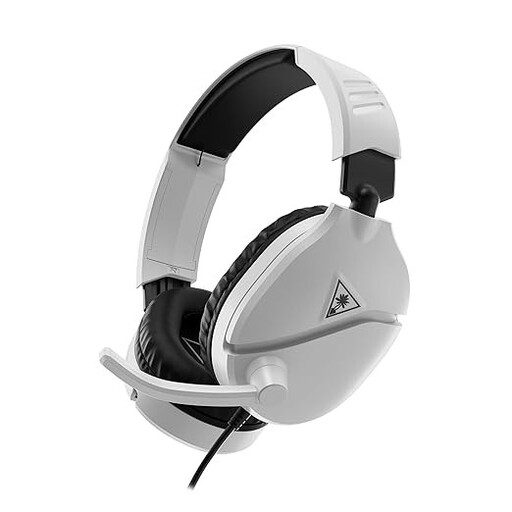
Why this choice: This headset is a safe bet to get started. It gets straight to the point: clean stereo sound, sufficient comfort for reasonable gaming sessions, and universal compatibility thanks to its 3.5mm jack.
No false promises of 7.1 sound: it delivers quality stereo sound, ready to leverage spatialisation technologies. Its flip-to-mute mic is a feature that is as practical as it is reliable, and often absent in this price segment.
Its light weight and universal compatibility make it the smart, effective choice for gaming on PS5, PS4, Xbox, Switch, and PC without breaking the bank.
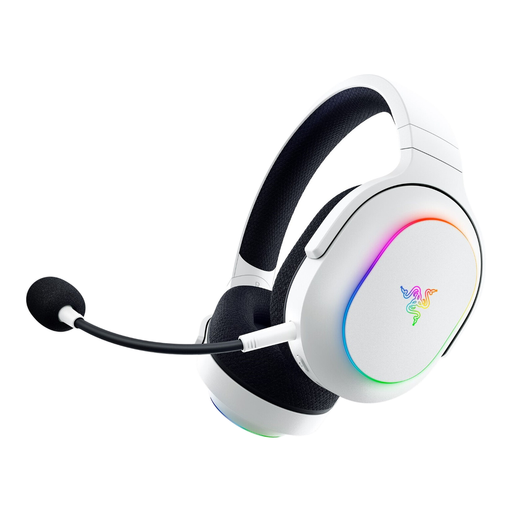
Why this choice: The ideal compromise for those seeking the freedom of wireless without sacrificing in-game responsiveness. It's a true chameleon, designed as a multi-platform headset capable of juggling a console, a PC, and a smartphone.
It sidesteps the latency trap by offering dual wireless connectivity: 2.4 GHz HyperSpeed for lag-free gaming on PC/console, and Bluetooth for mobile use. Its detachable cardioid mic ensures a clear voice, light-years ahead of low-end mics.
Its secret weapon: Razer SmartSwitch Dual Wireless technology, which lets you switch to a phone call with a single press without ever losing your game audio. Its light weight (285g) and excellent battery life make it a comfortable gaming companion, even over the long haul.
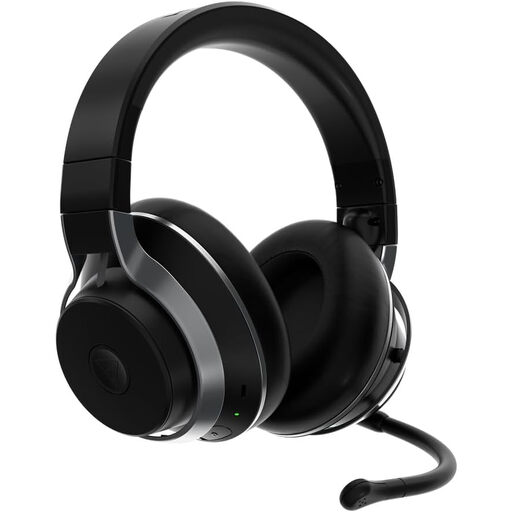
Why this choice: This model is for gamers who want to make absolutely no compromises. It checks all the boxes: first-rate audio quality, remarkably effective active noise cancellation (ANC), and an ingenious feature to ensure you never run out of battery.
Its active noise cancellation is no gimmick: it effectively isolates you from external noise for maximum immersion. The comfort is flawless thanks to premium materials, while its dual-battery system annihilates the biggest fear associated with wireless headsets.
The swappable battery system is its masterstroke. While one battery powers the headset, the second one charges on the base station. The result: infinite battery life. It's impossible to run out of power mid-game.
We have selected a full range of products that meet our demanding selection criteria.
This is the number one fear, and it's a legitimate one. Models equipped with a 2.4 GHz wireless connection (via a USB dongle) are specifically designed for gaming. Their latency is imperceptible, equivalent to that of a wired model. Be careful with Bluetooth alone, however: it can introduce a slight lag (latency) that is particularly annoying in fast-paced games (FPS, racing games...). For pure gaming, 2.4 GHz technology remains essential.
Yes, most of the time. If your PC headset has a 4-pole 3.5mm jack (which handles both audio and mic), you can simply plug it directly into the port on your PS5 or Xbox controller. With this connection, compatibility is nearly universal. For USB headsets, it's more complex: compatibility depends on each console. It is therefore wise to check this information on the product page before checking out.
It depends entirely on the build quality and the care you take of it. An entry-level, all-plastic model will show signs of wear (cracks, loose cable connections) after 1 to 2 years of intensive use. Conversely, a mid-range or high-end headset with a metal headband and robust materials can easily last you 4, 5 years, or even longer. To maximise its lifespan, there's one golden rule: take care of the cable (never pull on it!) and the ear cushions.