
Livraison le jour même ou le lendemain

Qualité garantie

Débloquez vos offres de bienvenue: Livraison GRATUITE | Jusqu'à -80 % | 30 jours d'essai gratuits à JoyPlus
Téléchargez l'application
Moving a table, sofa or wardrobe without scratching the wooden floor may seem straightforward. However, choosing the right furniture sliders requires a little care. A poorly sized model may come loose, leave marks or concentrate the entire weight on a small area of flooring.
To avoid unpleasant surprises, here are the key points to check before choosing adhesive sliders, nail-on sliders or protectors designed for castors.
A slider makes furniture easier to move, but that does not mean it is suitable for a heavy piece of furniture or one that is moved regularly. The maximum load is often stated for a set of four sliders. You therefore need to consider the total weight of the furniture, its contents and how the load is distributed.
If one leg supports more weight than the others, it may locally exceed the recommended load, even when the total weight appears to be within the limit.
A slider that is too small concentrates the pressure and may wear out more quickly. Conversely, a model that is too large may protrude beyond the leg, catch on a rug or affect the furniture’s stability.
Measure the base of each leg before placing your order. For a square leg, measure the width and depth. For a round leg, measure the diameter. Sizes 24 × 24 mm, 35 × 24 mm, 40 × 40 mm and Ø 25 mm are not suitable for the same applications.
Adhesive furniture sliders should be applied to a clean, dry and degreased surface. Dust, moisture or a highly uneven varnish may reduce their adhesion. It is also best to wait until the adhesive has properly set before moving the furniture.
For a permanent installation on wooden furniture, nail-on sliders can provide a more reliable mechanical fixing. However, they require precise positioning and are not suitable for every surface.
The stated capacity deserves careful attention. A maximum load of 300 kg for four sliders, for example, applies to an installation using four correctly fitted supports. It is not a guarantee that applies regardless of the surface, the furniture’s construction or the way it is moved.
For a sideboard, bookcase or table, add the weight of everything they contain. For a piano, billiard table or bulky piece of equipment, choose sliders designed for heavy loads and regularly check that they are still securely in place.
Honeycomb furniture sliders use a structure designed to reduce friction. Round models are generally suitable for circular legs, while square or rectangular versions are intended for legs with the same shape.
The part in contact with the floor should remain completely flat. A deformed, off-centre or partially detached slider may leave a mark, even if it is designed to protect the flooring.
Varnished wooden flooring, laminate, tiles, vinyl and carpet do not all react in the same way. The product specifications for the Scotch products shown below state that they are compatible with several types of flooring, but it is still best to test them in an inconspicuous area.
To optimise floor protection, remove grains of sand and small pieces of debris trapped beneath the furniture. Also avoid pulling it abruptly. Even anti-scratch sliders cannot prevent damage caused by an abrasive particle caught between the support and the floor.
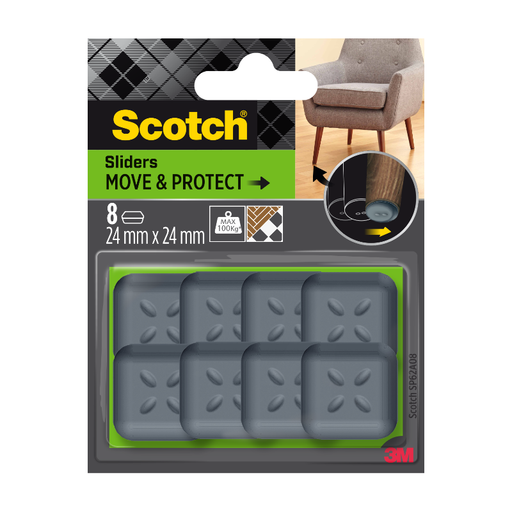
Why it’s a suitable choice : Its compact size and eight-piece pack are ideal for small items of furniture and occasional installations, whether you are renting a home or carrying out everyday rearranging.
The stated load is clearly set at 100 kg for four sliders. This allows you to compare it with the furniture’s actual weight, rather than relying solely on the promise of easy gliding.
24 × 24 mm size, adhesive backing, honeycomb structure and eight pieces per pack, according to the product specifications.
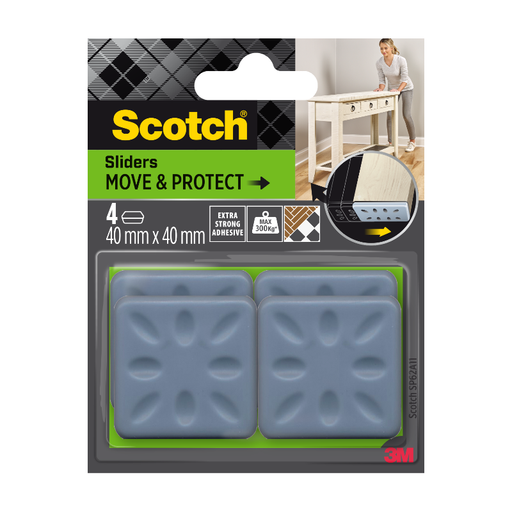
Why it’s a suitable choice : Its larger surface is suitable for furniture with square legs or better-distributed loads, when stability and discreet attachment are priorities.
The 40 × 40 mm size reduces the risk of choosing a slider that is too small, provided the leg is wide enough. The stated load reaches 300 kg for four sliders : compare this with the furniture’s actual weight.
Honeycomb structure, adhesive fixing and a stated capacity of 300 kg for four pieces, according to the product specifications.
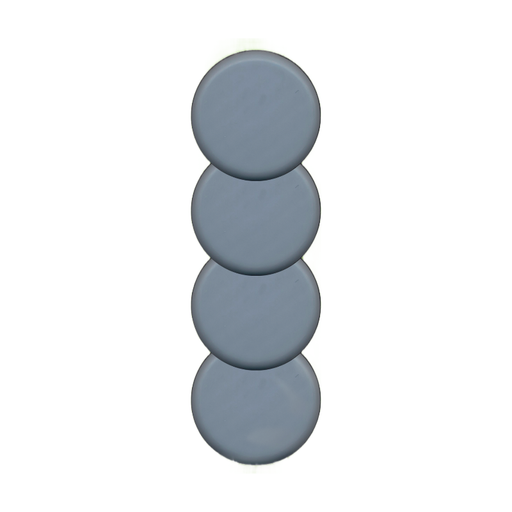
Why it’s a suitable choice : This model is designed for feet fitted with castors and for heavy furniture, such as a piano or billiard table. It protects the floor even when the load is substantial.
This is not a small adhesive slider intended for lightweight furniture, but a smooth support designed for feet with castors. The stated load is 500 kg for a set of four sliders.
65 mm diameter, smooth plastic and a design suitable for furniture feet with castors, according to the available information.
We have selected a complete, real-time updated list of products that meet these demanding criteria and European safety regulations.
Adhesive sliders are mainly suitable for static furniture or furniture moved slowly indoors. For a durable fixing on wood, nail-on sliders may be a better solution. Sliders for castors are intended for a different purpose and do not replace a standard support placed beneath a flat leg.
Place at least one slider beneath each contact point, then check the maximum load stated for the set. Beneath a long or heavy piece of furniture, four sliders may not be enough if the structure has more support points. The load must remain evenly distributed and the furniture must not become unstable.
The specifications for some Scotch sliders mention use on several types of flooring. However, the result depends on the condition of the surface, the presence of dust and the weight of the furniture. Test the product in an inconspicuous area and regularly check that the slider remains clean, centred and securely attached.
It depends on the weight of the furniture, how often it is moved, the type of flooring and the quality of the fixing. A slider fitted beneath stationary furniture may remain in place for a long time. A model subjected to frequent movement should be checked more regularly. Replace it as soon as it is cracked, detached, flattened or visibly worn.