Start by choosing a capacity that suits the amount of dry laundry your household usually waits to build up before starting a cycle. ADEME says 7 kg is enough in most cases, but that isn’t a rule for every household. A front-loader is a good fit if you have room to open the door; a top-loader can work in a narrow space, while a washer-dryer combines both functions in one appliance, with a lower drying capacity than its washing capacity, according to UFC-Que Choisir. Then compare models using their energy label information and, in France, their durability index where one is shown.
Who is this advice for?
Households that wait until they have a full load
The capacity should match the amount of dry laundry you usually build up. ADEME advises against running multiple cycles with an underfilled drum, but that doesn’t mean you need a large-capacity machine for the occasional big load.
People with a narrow laundry space
Width isn’t the only thing to consider: measure the depth too, and allow enough room to open the door or lid. UFC-Que Choisir recommends considering a top-loader for narrow spaces, but its capacity still needs to suit the loads you build up.
Households that want to wash and dry in one place
A washer-dryer combines both functions in one appliance. According to UFC-Que Choisir, its drying capacity is lower than its washing capacity, so you may need to remove some laundry before starting the drying cycle.
Which features should you compare?
Start with your usual loads and the dimensions of the room, then compare the details of models that meet both requirements.
| Feature |
What to check |
What I need |
| Capacity |
Compare the stated capacity in kg of dry laundry with your usual loads, then check whether the model can wash them without splitting them across multiple cycles. ADEME says 7 kg is enough most of the time; UFC-Que Choisir gives 7 to 8 kg as a guide for an average family. |
I’d rather have a drum that suits the loads I regularly build up than one designed for an occasional large load. |
| Water, energy and cycle time |
Check the kWh per 100 cycles, litres per cycle and Eco 40-60 programme duration, as well as the energy rating. The European Commission says this programme is the basis for the information shown on the label. |
If I wait until I have enough laundry, I also need to know how long the reference cycle takes and compare water and electricity use on the same basis. |
| Spin performance and noise |
Check the spin-drying efficiency class and spin noise in dB, along with its noise class. ADEME recommends checking this information on the energy label. |
My laundry dries indoors, or the machine is near a living area, so I want to consider both spin performance and noise. |
| Size |
Measure the width, depth and height, and allow space for the door or lid to open. UFC-Que Choisir says a top-loader can be around 40 cm wide; check the dimensions and capacity of the specific model. |
In a narrow room, I need to be able to install, open and load the machine without having to split my usual washing into several cycles. |
| Washing and drying |
For a washer-dryer, compare the washing and drying capacities separately, then check the figures for the wash-and-dry cycle. UFC-Que Choisir notes that drying capacity is lower and cycles are longer than with a separate tumble dryer. |
Combining both functions appeals to me if space is limited, as long as I can adjust the load before drying. |
| Durability |
In France, the durability index has been gradually replacing the repairability index for washing machines since 8 April 2025, according to the ministry responsible for the environment. Compare the index for the exact model where it is shown, and don’t confuse it with the energy label. |
I’d like an extra point of reference to help me choose between machines that already suit my loads and my home. For a refurbished appliance, I’ll also check the exact model, its condition and the seller’s documentation. |
Which mistakes should you avoid?
-
Choosing the largest capacity to automatically reduce the number of cycles
A large drum won’t prevent extra cycles if your usual loads don’t match its capacity. ADEME advises choosing a capacity that meets your actual needs and avoiding underfilled drums.
Estimate how much dry laundry you usually wait to build up before washing. Only opt for a larger capacity if you regularly have genuinely large loads.
-
Looking only at the energy rating letter
The letter alone doesn’t tell you how much water a cycle uses, how long Eco 40-60 takes, or how well the machine spins or how noisy it is. All of these details can help you plan your washing.
Compare the full energy label on the same Eco 40-60 basis, then check the programmes you’re likely to use.
-
Assuming a washer-dryer can dry a full washing load
According to UFC-Que Choisir, these appliances have a lower drying capacity than washing capacity. You may therefore need to reduce a full load before drying.
Check both capacities separately and choose your load size based on the cycle you’ll actually use.
UFC-Que Choisir also notes that drying takes longer than with a conventional tumble dryer and uses water during this phase.
-
Measuring the space without allowing for the door or lid to open
A front-loader needs space in front of the door, while a top-loader needs room for the lid to open and for you to load it from above. The machine’s width alone won’t tell you whether it will fit.
Measure the space, allow for the door or lid to open, and check access to the connections before deciding on a capacity or style.
Which brands should you consider?
Bosch
If you’re considering a Bosch front-loader, compare the specific model with your household’s usual loads. UFC-Que Choisir’s testing looks at factors including washing, rinsing, spinning, cycle time, consumption and noise. These are more useful than a general verdict on the brand.
- Consider the capacity, spin performance and energy label details together when assessing a model.
- Don’t assume that the features or results of one Bosch model apply to another.
Miele
Miele front-loaders should also be compared model by model. If you wait until you have a full load, the usable capacity and energy label details should suit your needs before you consider the brand.
- Check the dimensions, spin performance and noise level of the model you’re interested in.
- A brand appearing in a comparison doesn’t mean the result applies to its entire range.
Electrolux
Electrolux lists its EW6FI4805AR front-loader as having an 8 kg capacity, a maximum spin speed of 1,400 rpm, an A energy rating, 47 kWh per 100 cycles and 43 L per cycle. These figures from the manufacturer’s product information apply to this specific model.
- The published figures for the EW6FI4805AR make it possible to compare its energy label details with those of other models.
- Check the full model number: the EW6FI4805AR’s specifications don’t automatically apply to another Electrolux variant.
AEG
AEG is a brand to consider if you’re looking at a top-loader for a narrow room. Whether this style is right for you depends on the available width, access to the lid and the capacity of the model you choose.
- Loading from above means you don’t need room to open a door in front of the machine.
- Check the capacity and dimensions of the AEG model you’re considering rather than assuming every top-loader will suit your loads.
Washing machines available on Joybuy
These front-loaders and top-loaders let you compare models with stated capacities of 7 or 8 kg for washing full loads. First choose a style that fits your home, then check that the capacity suits your usual loads and compare the energy label details for the exact model.
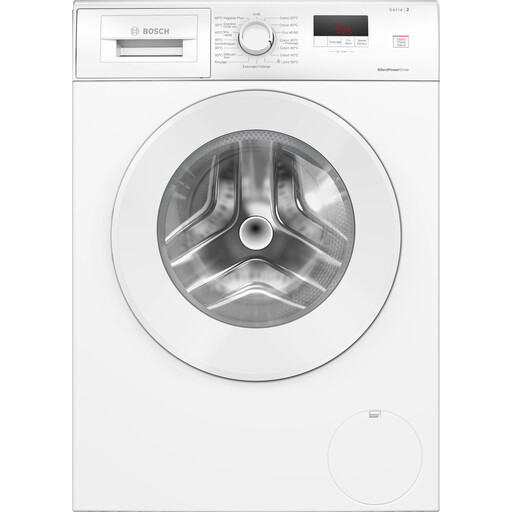 Image unavailable
Bosch WGE02407FR, 7 kg front-loader
Worth considering if your usual full loads are around 7 kg and you have enough room to open the door.
Stated maximum spin speed: 1,400 rpm. Stated energy rating: A. Compare the other energy label details too, and check the dimensions and durability index for this model.
View on Joybuy
 Image unavailable
Haier T Series 7 THASN276TM6-S, 7 kg top-loader
Loading from above is worth considering if there isn’t enough room to open a front-loading door. Check that the 7 kg capacity suits your usual full loads and that there’s room to open the lid.
Stated maximum spin speed: 1,200 rpm. Stated energy rating: A. Before ordering, check that the brand and model number on the appliance label match the model you’ve chosen.
View on Joybuy
 Image unavailable
Hisense WF5I8043BWF, 8 kg front-loader
Consider its stated 8 kg capacity in relation to the loads you regularly build up, rather than an occasional oversized wash.
Stated maximum spin speed: 1,400 rpm. Check the full dimensions, the space needed to open the door and the energy label details before comparing this model with other front-loaders.
View on Joybuy
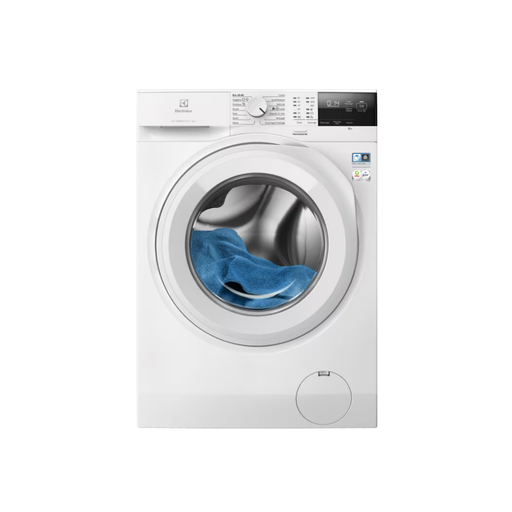 Image unavailable
Electrolux EW6FI4805AW SensiCare, 8 kg front-loader
The stated 8 kg capacity may suit you if you regularly build up loads of this size; remember to allow enough room to open the door.
Stated maximum spin speed: 1,400 rpm. Compare the noise and consumption figures for the EW6FI4805AW model, without attributing figures from another Electrolux variant to it.
View on Joybuy
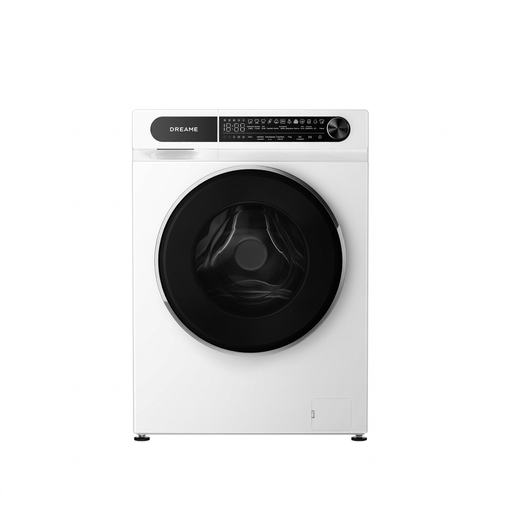 Image unavailable
Dreame DRWASHS8KG Washing Machine S, 8 kg
Consider this stated 8 kg capacity if it suits your usual loads, then check that the appliance and loading style fit the space you have in mind.
Compare the spin performance, noise and consumption figures on the exact model’s energy label. If durability is part of your decision, check its French durability index rather than treating it as equivalent to another score.
View on Joybuy
Frequently asked questions
What capacity should I choose if I wait until I have enough laundry to start a cycle?
Choose a machine based on your usual loads of dry laundry, not just the biggest wash of the year. ADEME says 7 kg is enough most of the time; UFC-Que Choisir gives 7 to 8 kg as a guide for an average family. Check whether those figures suit your own washing habits.
Which figures should I compare on a washing machine’s energy label?
Compare the energy rating, kWh per 100 cycles, litres per cycle, Eco 40-60 duration, spin-drying efficiency and spin noise. The European Commission bases the reference figures on the Eco 40-60 programme, so they don’t necessarily tell you how long a quick or specialist programme will take.
Can a washer-dryer dry the whole load it has just washed?
Not necessarily: UFC-Que Choisir says its drying capacity is lower than its washing capacity. Check both figures on the model’s product information and be prepared to reduce the load if you want to run a drying cycle afterwards.
What is the durability index for a washing machine in France?
It gives you an additional indication of a product’s durability, but doesn’t replace the energy label or the need to choose a suitable capacity. According to the ministry responsible for the environment, the index has been gradually replacing the repairability index for washing machines since 8 April 2025. Check the index for the exact model where it is shown, and don’t assume that another score displayed is the same index.


