What should you check ?
When choosing herbal tea to serve with meals in a care home, check the ingredients before comparing flavour profiles and pack sizes. The taste also depends on the preparation instructions for the product you choose.
| Criteria |
What to check |
What matters to consumers |
| Ingredients for each resident |
The full ingredients list, particularly for liquorice, and the guidance that applies to the resident. |
If herbal tea is served regularly, I want to check its ingredients against each resident’s guidance; around 36 % of consumers put this compatibility first. |
| Full flavour |
The ingredients and flavour profile, followed by the volume of water and brewing time given for the product. |
I’m looking for a cup with a flavour that holds its own at mealtimes, without assuming that the word “strong” means the same thing across different products; around 29 % of consumers put flavour first. |
| Tea or caffeine content |
Whether the ingredients include green tea, black tea or other sources of caffeine, as well as when the drink will be served. |
If a resident needs to avoid caffeinated drinks, I can’t rely on the word “herbal tea” alone. Around 21 % of consumers put the absence of these ingredients first. |
| Serving format |
The number of tea bags and the preparation instructions per cup before choosing a pack for service. |
When preparing several cups at mealtimes, I want a suitable pack size and easy-to-follow instructions; around 14 % of consumers put service organisation first. |
An aromatic herbal tea on Joybuy
This product is worth considering if you’re looking for a blend with hazelnut and roasted rice notes to serve with a meal. Before adding it to your regular service, check the ingredients on the packaging and make sure it’s suitable under each resident’s individual guidance.
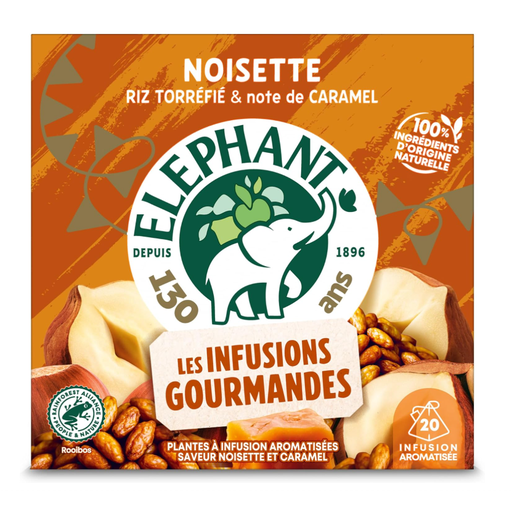 Image unavailable
ÉLÉPHANT Hazelnut and roasted rice with a hint of caramel — 20xPYR
Consider this if hazelnut and roasted rice notes suit the flavour you’re looking for at mealtimes, subject to checking the ingredients for each resident.
Auchan’s product information for an Éléphant blend with the same flavour notes lists liquorice, so check the ingredients on the product you receive before serving it regularly. Also follow the preparation instructions on its packaging.
View on Joybuy
Frequently asked questions
Is a “wellbeing” or “after-meal” herbal tea a healthcare product ?
No. These marketing descriptions don’t prove that a product has a therapeutic effect. When choosing a drink to serve with a meal in a care home, consider its ingredients, the resident’s individual guidance and the taste of the prepared drink, without presenting it as a treatment.
Can you serve herbal tea containing liquorice every day ?
Don’t decide to serve liquorice every day without asking the relevant team to assess the residents’ circumstances. Anses says that high and repeated consumption can lead to hypokalaemia and high blood pressure. Check the ingredients and any warnings for the product you choose.
Does the word “herbal tea” guarantee that a drink is caffeine-free ?
No : check whether the blend contains green or black tea, for example. Anses notes that tea naturally contains caffeine, so your choice should take account of the resident’s guidance and when the drink will be served.
How can you prepare consistent cups at mealtimes ?
Keep to the instructions for the product you’ve chosen, including the volume of water, temperature and brewing time. These may vary from one blend to another, so don’t automatically use the preparation method for a different product.


