If you prefer deep-frying, choose a deep fryer and plan how you’ll manage cooking smells and used oil. A model that filters oil won’t necessarily deal with smells in the kitchen. An air fryer is for those who want to cook using hot air, but check its capacity, noise level and the space it takes up. If your oven already meets your needs, another appliance could be redundant, as Que Choisir points out.
Who are these options for?
Households bothered by frying smells
If the smell of deep-frying bothers you in the kitchen, distinguish between an odour filter and oil filtration. An air fryer uses a different cooking method, circulating hot air. The right choice also depends on the results you’re looking for.
Households that want to keep deep-frying
To make handling oil after cooking easier, check how the specific model collects the oil and which parts can be removed. If smells are also a concern, check the lid filter and care instructions separately.
Small kitchens that already have an oven
An air fryer may suit households that regularly cook portions that fit its basket. Before making room for one, compare its usable capacity, dimensions and noise level with how you already use your oven.
What criteria set the options apart?
First choose between deep-frying, hot-air cooking and appliances you already own; then compare the cleaning and space each option requires.
Deep fryer
Worth considering: if you want to cook by immersing food in oil.
Bear in mind: you’ll need to handle hot oil, maintain the appliance and dispose of the oil after use.
Oil-filtering deep fryer
Worth considering: if you want to keep deep-frying and make it easier to collect the filtered oil.
Keep in mind: filtering residue from oil is not the same as filtering cooking smells.
Air fryer
Worth considering: if you prefer hot-air cooking for portions suited to the appliance.
Bear in mind: you’ll need space for the appliance and will need to clean its interior parts as instructed in the manual.
Oven or frying pan you already own
Worth considering: if you rarely cook these dishes or your oven already suits your usual cooking habits.
Bear in mind: this avoids having another appliance to store, but won’t necessarily give you the same results as deep-frying.
| Priority | What to check | For my needs |
|---|
| Managing smells |
For a deep fryer, distinguish between oil filtration and an odour filter; check the filter type, compatibility and care requirements. Also consider your kitchen’s ventilation. |
Deep-frying smells bother me: I want to know exactly what the filter does, without assuming it will remove every smell. |
| Cleaning |
Check which parts can be removed and consult the manual for washing instructions. For an air fryer, also check how to clean the interior and heating element, following the guidance Philips provides for the relevant appliances. |
After cooking, I’d like to know which parts I can wash separately and which surfaces will need to be cleaned by hand. |
| Capacity and space |
Compare the usable capacity with your usual portions, then measure the space available and allow for the clearances specified by the manufacturer. If you have an open-plan kitchen, check the model’s noise level too. |
I need enough room for the portions I cook, but I don’t want to clutter the worktop with a model that’s difficult to put away. |
| Cooking method |
Choose between immersing food in oil and circulating hot air. If you already use an oven, think about how often you’d use another appliance; Que Choisir warns that it could be redundant. |
I’m looking either for deep-frying or for a hot-air appliance I’ll use often enough to justify making room for it. |
| Used oil |
Plan how you’ll cool, store and dispose of the oil after cooking. ADEME advises against pouring it down the sink or toilet, or throwing it away in the countryside. |
If I choose deep-frying, I need to be able to manage the used oil after each period of use. |
What should you look out for before buying?
-
Confusing oil filtration with an odour filter
A system that removes residue from oil doesn’t, by itself, prove that the appliance deals with cooking smells.
Separately check whether the lid has an odour filter, its reference number and its care instructions. For example, SEB recommends replacing its SS-994692 filter after around 80 uses; this guidance applies to that specific filter.
A replaceable filter means finding a compatible part and allowing for its replacement.
-
Going by an air fryer’s stated capacity alone
A small basket may mean cooking in several batches, while a larger appliance takes up more space.
Compare the cooking surface and shape with the portions you make, then measure the space available on your worktop and in your cupboards.
-
Assuming an air fryer is the same as a deep fryer
An air fryer cooks by circulating hot air. It doesn’t work by immersing food in oil, and results depend on the model and the food you’re cooking.
First decide which cooking method you want, then look at the documented cooking results and care requirements for the model you’re considering.
-
Forgetting about used oil
Deep-frying means letting the oil cool, storing it in a suitable container and disposing of it properly. ADEME says it must not be poured down the sink or toilet, or thrown away in the countryside.
Check your local council’s collection guidance before deciding where to take your used oil.
What guidance do the brands offer?
Tefal
The range includes deep fryers with different oil-filtration features, depending on the model.
- According to Tefal, the Oleo Clean Inox & Design FR804015 filters the oil and collects it in a dedicated container.
- Tefal says the Filtra Pro FR516070 has a permanent metal filter in the lid. These features don’t show that it removes smells from the kitchen.
Philips
When comparing its Airfryers, check the care instructions for the model you’re interested in.
- Philips provides instructions for cleaning the interior and heating element with a soft sponge and hot water.
- Washing the removable parts may not be enough to maintain the inside of the appliance.
Ninja
If you’re looking at a Ninja air fryer, start with the size and features of the specific model rather than the range name.
- Models with multiple drawers may suit households that want to cook different foods separately; check the controls on the model you choose.
- Measure the space available and check the noise level if you’ll be using the appliance in an open-plan kitchen.
A hot-air option at Joybuy
This model is designed for hot-air cooking and has two drawers. If you want to deep-fry, remember that oil filtration and odour filtration are separate considerations.
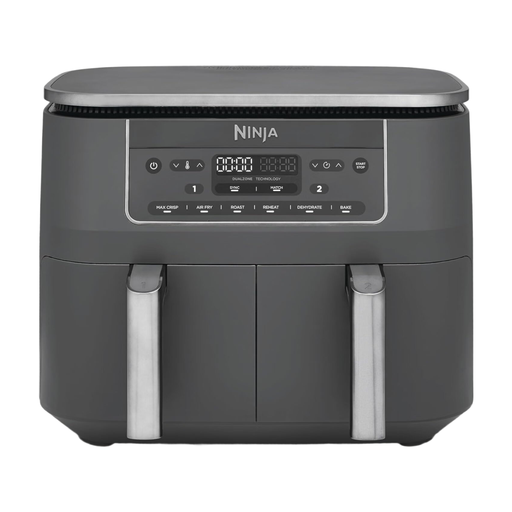 Image unavailable
Ninja Dual Zone DZ300EU, 7,6 L, two drawers, metallic grey
Worth considering if you want to cook using hot air in two drawers rather than immersing food in oil.
The model name lists six functions, including Air Fry, Max Crisp, Roast, Bake and Warm, and baskets described as dishwasher-safe. Check the space and clearances needed before setting it up; these features alone don’t tell you how noisy it is or what cooking smells to expect.
View on Joybuy
Frequently asked questions
Does a deep fryer that filters oil get rid of smells?
No. Removing residue from oil and filtering smells are two different functions. If smells are a key factor in your choice, check whether the specific model has an odour filter, and confirm its compatibility and care requirements. For example, SEB recommends replacing its SS-994692 filter after around 80 uses, but this interval doesn’t apply to every model.
Does an air fryer always replace an oven?
No. Que Choisir points out that an air fryer could be redundant if you already have an oven. Before adding a hot-air appliance, consider the portions you cook, how often you expect to use it and the space you have available.
What needs cleaning in an air fryer?
Check the manual for instructions on cleaning the removable parts and interior surfaces. For the relevant Airfryer models, Philips also recommends cleaning the interior and heating element with a soft sponge and hot water. Washing the basket may not cover all the care the appliance needs.
What should you do with used frying oil in France?
Following ADEME’s guidance, don’t pour it down the sink or toilet, or throw it away in the countryside. Let it cool, keep it in a sealed container and check with your local council where to take it.


