
Livraison le jour même ou le lendemain

Qualité garantie

Débloquez vos offres de bienvenue: Livraison GRATUITE | Jusqu'à -80 % | 30 jours d'essai gratuits à JoyPlus
Téléchargez l'application
A frying pan may seem simple to choose. However, the material, coating and hob compatibility can genuinely change your everyday cooking experience. A pan that food sticks to, heats unevenly or weighs a tonne will soon end up at the back of a cupboard.
Before you are won over by a price or a marketing promise, check three things: the cooking material, the usable diameter and the care requirements. Here are the criteria to consider when choosing a frying pan suited to your kitchen and cooking habits.
A 28 cm frying pan does not necessarily offer a 28 cm cooking surface. The stated diameter may refer to the external width, including the rim. For preparing an individual omelette, 20 to 24 cm may be enough. For a family, stir-fried vegetables or several pieces of meat, it is better to look at models measuring 26 to 30 cm.
A pan that is too small packs the food together and can lead to less even cooking. Conversely, a large model may become heavy and awkward if the cooking zone is narrow.
A non-stick frying pan makes it easier to release food and clean up afterwards. It is not indestructible, however: heating it empty, using metal utensils and cleaning with abrasive sponges can quickly damage it. Claims such as “reinforced” or “long-lasting” do not replace proper care.
Ceramic coatings can also lose their effectiveness if the pan is heated too strongly or cleaned with harsh products. Always check the instructions and the limits specified by the manufacturer.
A pan compatible with gas or ceramic hobs will not automatically work on an induction hob. When choosing an induction frying pan, look for a compatible magnetic base. A magnet sticking to the underside can be used as an initial test, but the product details remain the definitive reference.
A multi-layer base combining stainless steel and aluminium can help distribute heat more evenly. This alone does not guarantee perfect cooking, though: the hob’s power and the diameter of the cooking zone must also be suitable.
The terms PFAS-free, PTFE-free and PFOA-free are not interchangeable: they do not refer to exactly the same substance. To check what you are buying, consult the product composition and compliance documents rather than relying solely on a slogan.
A depth of 4 to 7 cm is suitable for most everyday cooking. For preparing sauces, stews or generous portions, a deep frying pan or an induction wok will often be more practical.
A lid can be used to finish cooking, retain moisture or reheat food without splashes. Check that one is included in the box, as some models are sold on their own. A frying pan with a lid can also occasionally replace a sauté pan.
If you use the oven regularly, check the maximum temperature supported by both the pan body and its handle. A steel handle can go in the oven, but it will become extremely hot. As for non-stick models, they are generally best washed by hand with a soft sponge, even when advertised as dishwasher-safe.
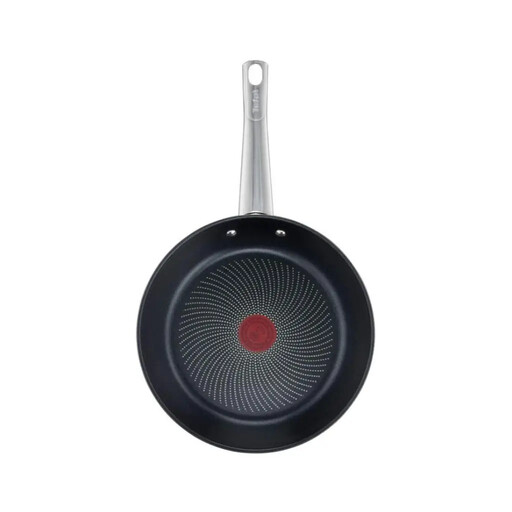
Why this choice suits this profile : At 28 cm, this model is suitable for everyday meals. Its non-stick coating makes those first dishes easier to prepare without requiring the technique needed for a stainless steel pan.
The product details specify compatibility with gas, electric, ceramic and induction hobs, as well as the limitations for oven use.
Thermo-Signal indicator, 28 cm diameter, riveted steel handle and advertised dishwasher-safe cleaning.
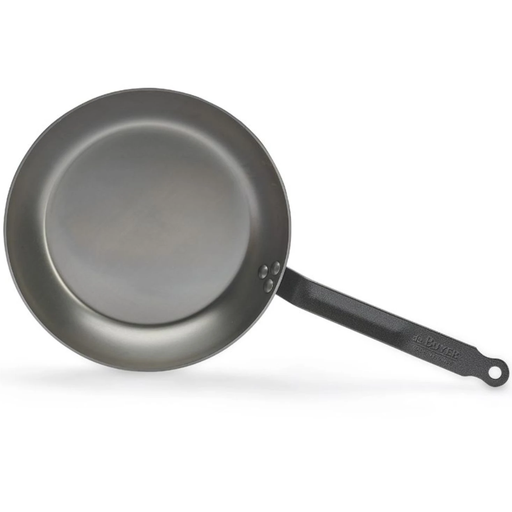
Why this choice suits this profile : This 3 mm iron model is aimed at those who enjoy high-temperature cooking and are prepared to spend a little time looking after it.
The product details specify that the pan must be seasoned and dried after every wash. You therefore know what to expect, without any illusion that it requires no maintenance at all.
3 mm iron, induction compatibility and made in France according to the product details.
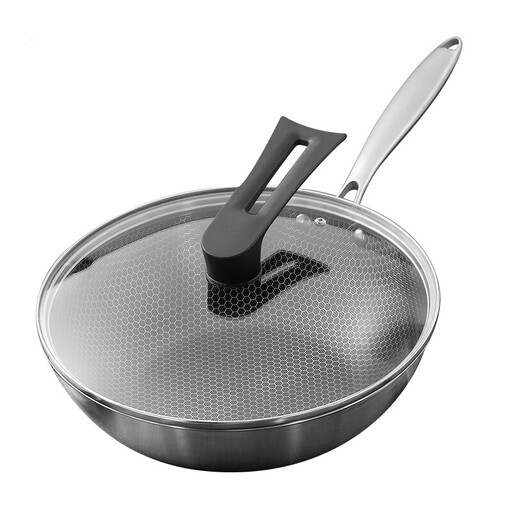
Why this choice suits this profile : With its 4.7 l capacity and glass lid, this model is suitable for families alternating between stir-fries, stews, braised dishes and frying.
The product details explain the multi-layer structure, compatibility with induction, gas, electric and ceramic hobs, as well as the precautions associated with the glass lid.
30 cm size, 4.7 l capacity, lid included and silicone-covered handle.
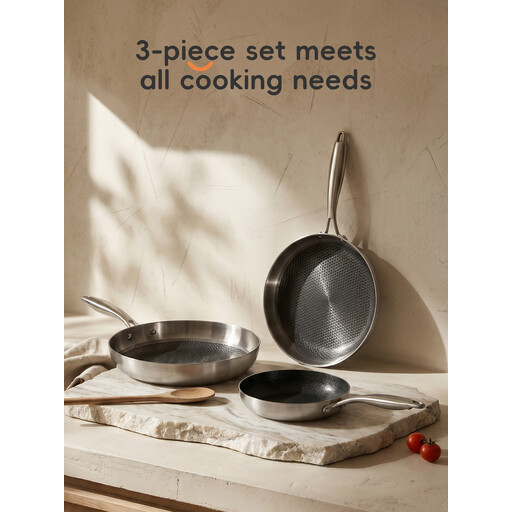
Why this choice suits this profile : The three sizes—20, 26 and 30 cm—make it easy to choose the right pan for the quantity being prepared, from an individual meal to a family feast.
The set clearly distinguishes between the sizes and specifies a multi-layer base compatible with induction, gas and ceramic hobs.
Set of 304 stainless steel frying pans, three diameters and rims designed for cleaner pouring.
We have put together a comprehensive, real-time updated selection of products that meet these strict criteria, as well as European safety regulations.
A diameter of 26 to 30 cm is generally suitable for family meals. The right choice also depends on the size of the induction zone and the weight of the pan once full. At 28 cm, a versatile model can accommodate vegetables, eggs, meat and most everyday portions.
Yes, particularly if it has not been preheated properly or if food is added too soon. To reduce sticking, heat the stainless steel pan gradually, add the fat, then lower the heat if necessary. A non-stick pan requires less technique, but its coating must be protected from scratches and overheating.
Observe the stated maximum temperature, avoid leaving an empty pan to heat for too long and wait for it to cool before washing it. With a non-stick or ceramic coating, opt for wooden, silicone or heat-resistant plastic utensils. For a steel pan, dry it immediately and apply a thin layer of oil after every cleaning.