
Livraison le jour même ou le lendemain

Qualité garantie

Débloquez vos offres de bienvenue: Livraison GRATUITE | Jusqu'à -80 % | 30 jours d'essai gratuits à JoyPlus
Téléchargez l'application
Choosing a new frying pan? A simple task, you might think. Yet, it often turns into a real minefield. You're probably familiar with the disappointment?: a brand-new pan that warps, loses its coating after just a few uses, or heats up disastrously on your induction hob. These headaches aren't inevitable; they're the result of well-oiled marketing traps.
As Head of Product Recommendations at Joybuy, my mission is to arm you against technical jargon and empty promises. Let's forget the marketing and get down to specifics. Here are the 3 classic mistakes that cost buyers dearly—and more importantly, how to avoid them to make the right choice, once and for all.
To ensure you never make a mistake again, remember these three technical points. They account for 90% of a pan's performance.
On an induction hob, the quality of the base is non-negotiable. A good base must be?:
There isn't one coating that is superior to all others, but rather coatings adapted to different needs.
The size of the pan should correspond to both the size of your household and the size of your cooking zones.
Also, consider oven compatibility. An oven-safe pan, identifiable by its metal handle, vastly expands your cooking options by allowing you to start a dish on the hob and finish it in the oven.
To move from theory to practice, here are three models that perfectly illustrate these criteria and meet specific needs.
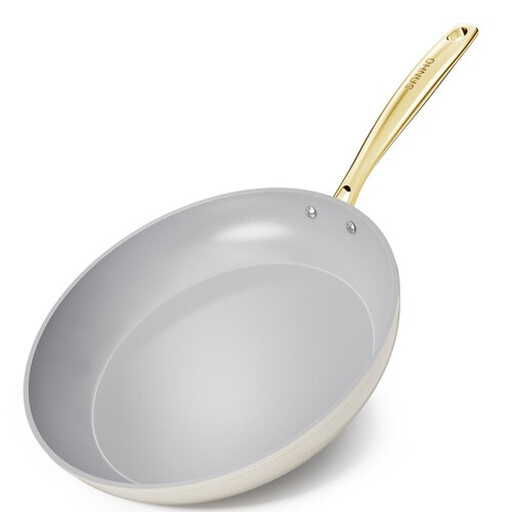
The profile : Ideal for individuals or health-conscious couples, this compact pan is designed for daily cooking with little to no oil. Its size is perfect for small meals, from fried eggs to fish fillets.
It directly addresses material concerns by guaranteeing a composition that is PFAS, PFOA, PTFE, lead, and cadmium free, offering peace of mind for daily use.
Its thick die-cast aluminium body ensures fast, even heating, and it's oven-safe up to 260 °C, a rare feature for a non-stick pan.
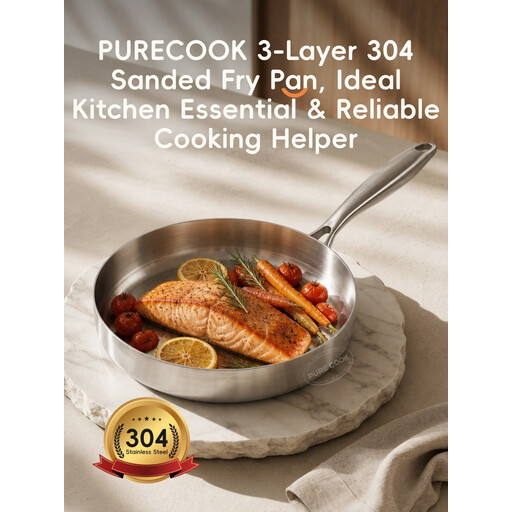
The profile : For those who prioritise longevity and love to get the perfect sear on their meats, vegetables, or scallops. Stainless steel is a material that gets better with time and isn't afraid of high heat or metal utensils.
It completely bypasses the trap of worn-out coatings. Its tri-ply structure guarantees optimal performance on induction, avoiding the "for show" compatibility issue.
The 304 stainless steel construction with an aluminium core ensures rapid and uniform heat conduction, which is essential for successful searing. It's a long-term investment.
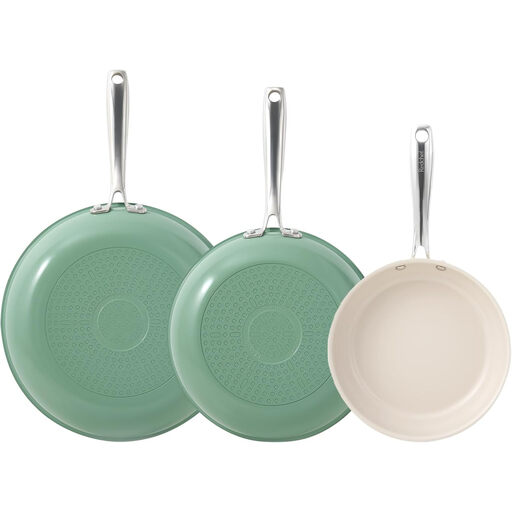
The profile : This pan set is the all-in-one solution for outfitting a family kitchen. With three essential diameters (20 cm, 24 cm, and 28 cm), it covers every need, from a solo meal to a dish for the whole family.
It provides a complete and cohesive solution, saving you from buying several mismatched pans. The ceramic coating is a modern alternative to classic non-sticks, and all-hob compatibility is guaranteed.
Remarkable versatility : the set is compatible with all hobs including induction and is oven-safe to a high temperature (450 °C according to the manufacturer), allowing you to easily brown or finish dishes.
We have curated a complete selection of pans that meet our quality criteria and European safety standards.
The foolproof trick is the magnet test. Take a magnet (a simple fridge magnet will do) and place it on the bottom of the pan. If it sticks firmly, the pan is induction-compatible. The spiral logo is also an indicator, but the magnet test never lies.
For a good-quality non-stick pan with proper care (no overheating, no metal utensils, hand washing), you can expect a lifespan of 2 to 5 years. Beyond that, the coating will gradually lose its effectiveness. It's a consumable item, unlike a stainless steel pan which can last for decades.
No, as long as you master a simple technique! The secret is preheating. Heat the stainless steel pan empty over medium heat. After a minute or two, do the water drop test: if a drop of water beads up and glides across the surface, the temperature is perfect. You can then lower the heat, add your fat, and then your food. This technique, which is like a quick seasoning, creates a thin vapour barrier (the Leidenfrost effect) that prevents food from sticking.