
Livraison le jour même ou le lendemain

Qualité garantie

Débloquez vos offres de bienvenue: Livraison GRATUITE | Jusqu'à -80 % | 30 jours d'essai gratuits à JoyPlus
Téléchargez l'application
A good frying pan is the cornerstone of any kitchen. Yet, choosing one can quickly become a headache. Between marketing promises and a jungle of materials, it's easy to end up with a pan that warps, starts sticking after three uses, or worse, is incompatible with your hob. To avoid buyer's remorse, it's best to know the pitfalls to avoid to make an informed and, above all, durable choice.
Here are the 3 most common pitfalls to avoid:
To cut through the noise, focus on three essential points. These determine the performance, durability, and user experience of your future pan.
This is the number one criterion. The material dictates everything: heat distribution, responsiveness, weight, and ease of maintenance.
A pan, no matter how high-performing, is worthless if it doesn't suit your equipment and needs.
On a daily basis, it's the details that make the difference. A handle that stays cool to the touch, a well-balanced weight for easy handling, or the ability to put the pan in the oven are valuable assets. Also consider maintenance: while some coatings are dishwasher-safe, hand washing is often recommended to preserve their longevity.
There's no need to search for a universal, do-it-all pan. The best model is the one that perfectly matches your needs. Here is a selection to guide you.
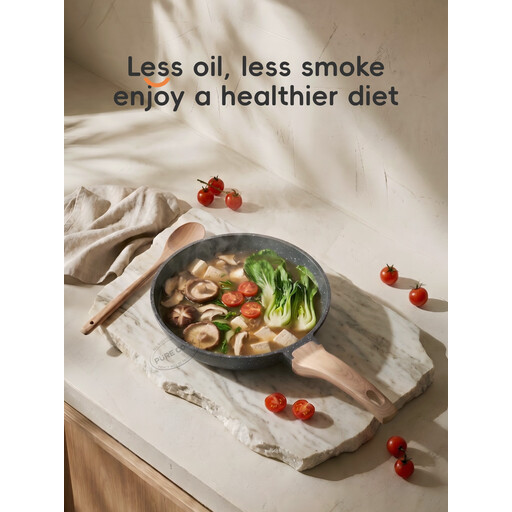
Why it's a match: Ideal for quick, everyday meals (eggs, pancakes, sautéed vegetables). Its compact size and light weight make it very easy to handle, while its coating facilitates cooking and cleanup for hassle-free use.
This model focuses on simplicity and clarity: an aluminium body for fast heating, a non-stick coating for easy use, and clearly stated induction compatibility. No over-the-top promises, just the essentials.
Lightweight and heats up quickly. Its wooden handle stays cool to the touch, offering a comfortable and secure grip.
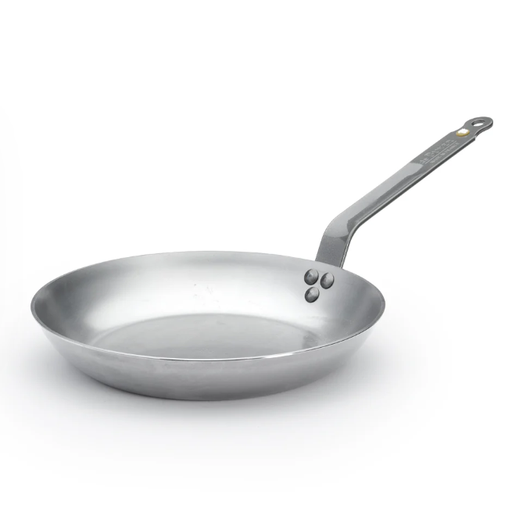
Why it's a match: For those who prioritise cooking performance above all else. Carbon steel is the material of choice for achieving a perfect caramelisation (Maillard reaction) on meats, fish, and vegetables.
This model is the antithesis of the short-lived "miracle" coating. It has no artificial coating. Its non-stick surface is built up naturally over time with use (seasoning), making it a virtually indestructible utensil.
Cooking performance and durability. The more it's used, the darker it gets, and the better its non-stick properties become. It's a tool that gets better with age.
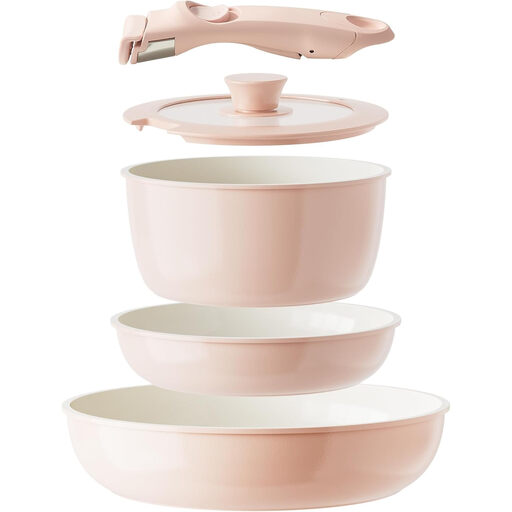
Why it's a match: This cookware set is a complete solution for those short on space. The removable handle allows the pans and saucepan to be stacked, freeing up precious cupboard space. The different sizes can handle most cooking scenarios.
It directly addresses the problem of storage and versatility. The ceramic coating is clearly presented as being free of PTFE, PFOA, and PFAS, which clarifies the "healthy cooking" promises.
A significant space-saver thanks to the detachable handle and stackability. The set is also compatible with all hobs, including induction, and is oven-safe once the handle is removed.
The longevity of a non-stick pan depends on the quality of its coating and its care. An entry-level model can lose its properties in less than a year, while a high-quality pan, used with wooden or silicone utensils and washed by hand, can last for several years. The warning sign? When food consistently starts to stick.
It's very simple. Turn the pan over and look for the coil-shaped pictogram (it looks a bit like a spring). If it's there, you're good to go. If not, do the magnet test: if a magnet sticks firmly to the outer bottom, your pan is induction-compatible.