Parents of children who are sensitive to bits
For brunch, you’re looking for blended fruit or a smooth texture, perhaps in a little pot. Yoghurt with bits is still an option if your child likes that texture.


If your child doesn’t like bits, start by looking for a smooth texture or blended fruit, then check the product description: a little pot of fruit dairy may be fromage blanc rather than yoghurt. To choose between brunch options, compare the nutritional information per 100 g, the ingredients and the allergens, and don’t forget portion sizes. Finally, follow the storage temperature and use-by date shown on the packaging.
For brunch, you’re looking for blended fruit or a smooth texture, perhaps in a little pot. Yoghurt with bits is still an option if your child likes that texture.
You want to compare sugars, fat, ingredients and allergens rather than relying on the word ‘mild’ in the product marketing.
You’re planning to serve several flavours and formats at the same table. You’ll need to consider both texture preferences and how many portions you’ll need.
For a family brunch, start with the texture your child will enjoy, then compare the ingredients and portion sizes of products that suit your guests.
| Criteria | What to check | Who is it for? |
|---|---|---|
| Texture and portion | Look for ‘blended fruit’ or ‘fruit pieces’, check the product description and the weight of the pot. | If my child avoids bits, I look for a smooth texture and a portion that suits them; around 36% of consumers are said to prioritise this. |
| Ingredients | Compare sugars and fat per 100 g, then read the ingredients and allergen information and check whether sweeteners are included. | When choosing between several recipes, I want to know what they contain beyond the way they’re presented; this is said to be the main criterion for around 29% of consumers. |
| Variety to share | Check the number of pots, their weight, the flavours and the texture of each selection. | When everyone around the table has different tastes, I look for portions and flavours to suit the guests; around 21% of consumers are said to prioritise this. |
| Organic and stated origin | Check for organic certification on the product you choose and, if stated, the origin of the milk. | If organic certification or stated origin is my main reason for buying, I check it on the specific product; this is said to come first for around 14% of consumers. |
The Danonino product described by Auchan is fromage blanc with fruit, while Panier de Yoplait offers fruit yoghurts. Don’t confuse their product descriptions, portion sizes or ingredients.
Read the product description on the packaging, then compare the nutritional information per 100 g and per pot.
According to Yoplait, its creamy Panier recipe contains whole milk and cream, while its Panier 0% range contains sweeteners. These claims therefore relate to different criteria.
Choose the texture you’re looking for, then check the ingredients list and nutritional values of the specific variety separately.
A fruit selection can contain pieces even if the yoghurt itself is creamy. The flavour doesn’t tell you whether the texture is smooth or chunky.
Look for a description such as blended fruit or smooth texture, and check the format before you buy.
Service-Public.fr reminds shoppers that breaking the cold chain can make a product unsafe before its use-by date.
For chilled products, follow the storage temperature on the packaging during transport and until serving, and check the use-by date.
The fruit variety described by Auchan is fromage blanc in 24 pots of 50 g, with blended fruit and a texture described as creamy.
The range offers a yoghurt with fruit pieces, a creamy recipe and a 0% variety, so you can choose according to your preferred texture and ingredients.
Carrefour’s range includes various fruit dairy products for children, including drinkable formats.
E.Leclerc offers, among other products, a fruit yoghurt with pieces in a pack of 16 pots of 125 g.
The fruit products featured include a classic recipe and an Auchan Bio recipe with fruit pieces.
This strawberry-flavoured option comes in four individual cartons. If you’re looking for a spoonable fruit yoghurt for brunch, first check the product description and how it should be consumed on the label.
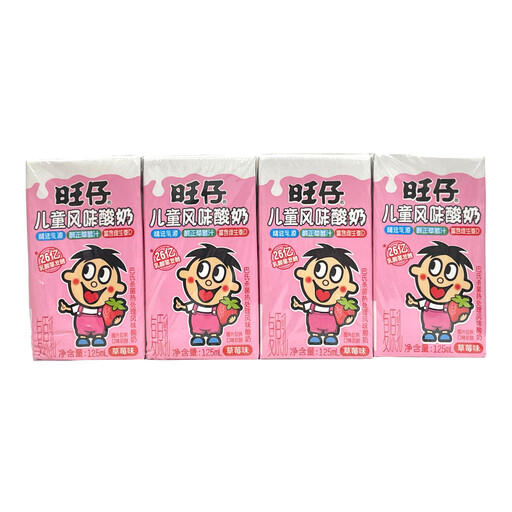 Image unavailable
The four-portion pack may work well for individual servings at brunch. Check the product description before comparing it with pot-served fruit yoghurt.
The product listing flags the E120 colourant and includes a warning about children’s activity and attention. Read the label before serving it to a child.
Start by comparing products from the same category using their nutritional values per 100 g, ingredients and allergen information. Manger Bouger recommends using the Nutri-Score, when shown, to compare like-for-like products; also check the texture and weight of each pot.
Follow the temperature shown on the packaging of the product you buy. The DGCCRF reminds shoppers to follow the storage instructions on the product; for chilled products, make sure the cold chain is maintained until brunch.
No. Don’t serve a product after the use-by date shown on its packaging. Service-Public.fr also notes that this date assumes the product has been stored as instructed: breaking the cold chain can make it unsafe before then.
No. The Nutri-Score helps you compare the nutritional properties of similar products; it can’t tell you whether a child will enjoy fruit pieces. Also check the texture description, pot size, ingredients and allergen information for the specific product.