People limiting added sugars
You want to distinguish between sugar added to the preserving liquid and sugars naturally present in the fruit. The ingredients list and the ‘of which sugars’ figure answer two different questions.


If you’re keeping an eye on your intake, compare the sugar and energy per 100 g, the ingredients list and the drained fruit weight when choosing fruit in syrup. Don’t rely on the word ‘light’ alone. A ‘no added sugar’ recipe can still contain sugars naturally present in the fruit. As for packaging, fruit cups come in individual portions, while a large tin means you’ll need to serve each portion yourself.
You want to distinguish between sugar added to the preserving liquid and sugars naturally present in the fruit. The ingredients list and the ‘of which sugars’ figure answer two different questions.
You’d rather choose a fruit cup than serve fruit from a large tin, especially if you’re taking a dessert or snack with you. The drained weight tells you how much fruit each cup contains.
You’re looking for a tin to divide between several servings or use in cooking. Check the drained fruit weight and the storage instructions after opening before choosing a size.
The DGCCRF lists the nutrition declaration and ingredients list among the information to check on a label. First compare recipes on the same per-100 g basis, then choose a format that suits the number of portions you plan to serve.
| Criteria | What to check | Who is it for? |
|---|---|---|
| Sugars and recipe | Sugars and energy per 100 g, followed by the ingredients in the preserving liquid. | If I want to avoid added sugars, I need to distinguish this claim from the total sugar content. This is a priority for around 42% of consumers. |
| Portion | The number of containers and the drained net weight per container. | If I want to take a portion with me without opening a large tin, I prefer individual containers; this is the main need for around 33% of consumers. |
| Larger format | The drained net weight, the number of portions planned and the instructions for storing the product after opening. | If I’m planning several servings, I can portion out a large tin myself, as long as I can use the remainder in line with the instructions. Around 25% of consumers prioritise this need. |
Fruit contains naturally occurring sugars, which are included in the nutrition information. An Auchan product listing for a St Mamet fruit mix labelled ‘no added sugar’ shows 12 g of sugars per 100 g.
Read the claim alongside the ingredients list and the ‘of which sugars’ figure per 100 g.
This description isn’t enough to compare the sugar or energy content of two fruit-in-syrup recipes.
Compare their nutrition information per 100 g and check the ingredients to identify the preserving liquid.
The preserving liquid is part of the contents of a tin or fruit cup. So the total weight doesn’t necessarily match the amount of fruit you’ll serve.
Check the drained net weight when comparing formats or preparing several portions.
Carrefour offers fruit preserved in pineapple juice, as well as a Carrefour Classic' fruit cocktail in light syrup.
Auchan offers St Mamet fruit mixes labelled ‘no added sugar’.
ALDI offers Baccara fruit cups in light syrup and a 500 g Baccara fruit cocktail.
These two fruit-in-syrup options come in different formats: three fruit cocktail cups or a tin of mango that you can portion yourself. If your priority is avoiding added sugars, check the ingredients list: both recipes include sugar.
 Image unavailable
If you prefer individual portions, this fruit cocktail in syrup comes in 3 × 125 g cups. The ingredients list includes sugar; check the drained net weight per cup on the packaging to compare the amount of fruit you’ll be serving.
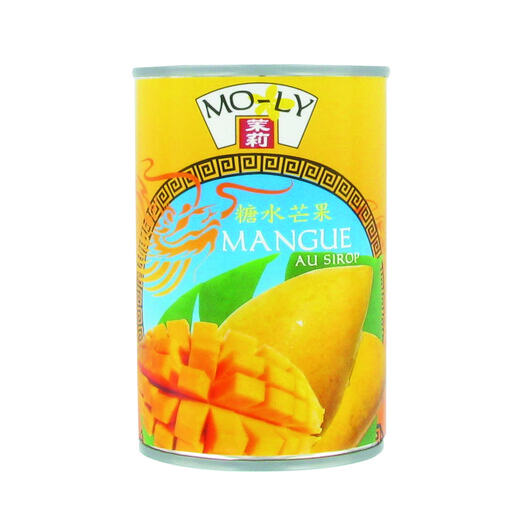 Image unavailable
If you want to serve several portions yourself, this mango in syrup comes in a 425 g tin. The ingredients list includes sugar; check the drained weight and storage instructions after opening on the packaging.
No. Fruit can contain naturally occurring sugars even when no sugar has been added. For example, an Auchan product listing shows 12 g of sugars per 100 g for a St Mamet fruit mix labelled ‘no added sugar’. Check the ‘of which sugars’ figure for the recipe you choose.
Compare sugars and energy per 100 g, then check the ingredients list and drained net weight. The DGCCRF includes the nutrition declaration and ingredients list among the labelling information for prepacked foods. The drained weight helps you compare the amount of fruit, rather than the contents including the liquid.
No. A fruit cup keeps portions separate, but its format doesn’t determine the sugar or energy content of the recipe. Compare the nutrition information and drained weight per cup with the amount you plan to serve from a tin.