Hosts keeping an eye on salt
You’d like to take a guest’s dietary preference into account. Checking the value on the label of the product you buy lets you compare products without relying on a claim about sugar.


When choosing fruit in syrup for a christening buffet, first compare the ‘salt’ value per 100 g on the products you’re considering. ‘Light syrup’ and ‘no added sugar’ tell you nothing about salt. Then weigh up large tins and individual pots by drained weight, number of guests and how you plan to serve the fruit. Two St Mamet products listed by Auchan show ‘salt < 0.01 g’ per 100 g, but that figure alone isn’t enough to describe them as ‘reduced salt’.
The right pack depends both on how important salt information is to you and on how you plan to arrange and serve the buffet.
You’d like to take a guest’s dietary preference into account. Checking the value on the label of the product you buy lets you compare products without relying on a claim about sugar.
You’re planning to serve the fruit in a large bowl or in several dishes. Drained weight helps you work out how much fruit you’ll have to serve, excluding the preserving liquid.
You’d rather hand guests individual pots than portion fruit from a large tin as they arrive. In that case, the number of pots and their total drained weight are key.
For a christening buffet, check the salt, the amount of fruit after draining and how you’ll serve it separately. A claim about sugar doesn’t answer the question of salt content.
| What to compare | What to check | Who is this for? |
|---|---|---|
| Declared salt | Compare the ‘salt’ value per 100 g on the labels of the exact products you’re considering. Don’t confuse it with claims about sugar. | If I want to take a preference for less salt into account, I need to be able to compare the values shown. Around 42% of consumers would prioritise this check. |
| Drained weight | Check the drained weight of each tin or multipack, then add the amounts together based on the number of guests. | To fill a serving bowl, I need to know how much fruit I’ll have, not just the weight of the container and its liquid. This would be the top priority for around 33% of consumers. |
| Individual portions | Check the number of pots and their total drained weight. If sugar also matters to you, read the ‘of which sugars’ line separately. | When I’m serving guests individually, ready-portioned fruit saves me from arranging it at the last minute. Around 25% of consumers would prioritise this convenient way to serve. |
These claims refer to different things. The DGCCRF advises checking the nutrition information on prepacked foods to compare salt; nutrition claims are also covered by European rules.
Look for the ‘salt’ value per 100 g on the exact product, and don’t assume it is ‘reduced salt’ based on a figure alone.
The preserving liquid isn’t fruit you can serve. Auchan’s product pages list 475 g drained for a St Mamet fruit salad and 260 g drained in total for a multipack of four St Mamet pots.
Work out how much to serve using the drained weights, then choose between a serving bowl and individual pots.
If you don’t plan for the drained weight, you could end up with too little fruit to serve or too many leftovers.
Once opened and served, fruit needs to be stored carefully. Anses notes that poor storage and cross-contamination can increase microbiological risks.
Serve the fruit in stages and follow the storage instructions for each product, including for opened packs and leftovers.
These brands and retailers offer pack sizes to consider for your buffet. Check the information for the specific product rather than assuming its salt content from the brand name.
St Mamet products listed by Auchan include fruit salads and individual pots.
Carrefour’s range includes fruit in syrup in larger packs and individual portions.
Auchan’s range includes individual pots and tins of fruit in syrup, light syrup or juice.
ALDI France lists Baccara individual pots of fruit in light syrup in a 280 g pack.
These three packs of fruit in syrup are suitable for serving from a bowl at your buffet: a fruit cocktail, pear halves and rambutans. When planning portions, always distinguish the product’s total weight from its drained weight.
 Image unavailable
This fruit cocktail can be shared between guests when served in a bowl. Its Joybuy product page lists ‘salt < 0.01 g’ per 100 g; check the drained weight on the product to work out how much fruit you’ll have to serve.
 Image unavailable
These pear halves are a good fit for a buffet where the fruit will be arranged in a dish rather than served in individual pots. The product name gives a drained weight of 455 g; check this on the pack you buy and read its ‘salt’ value separately.
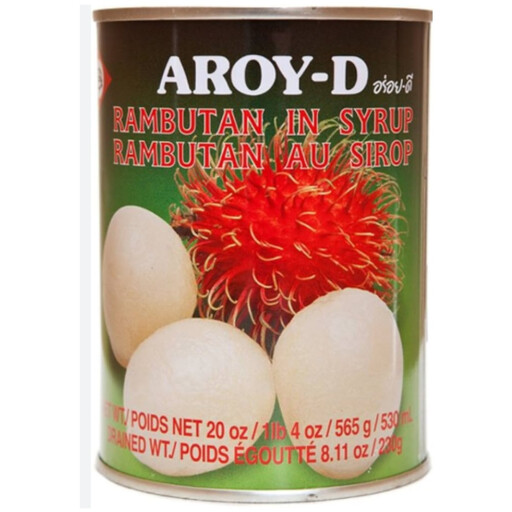 Image unavailable
Rambutans add a different fruit to a selection served from a bowl. The pack is listed as 565 g; to work out portions and compare salt, check the drained weight and ‘salt’ value on the product label.
No. These phrases refer to different characteristics. Compare the ‘salt’ value per 100 g on the exact products you’re considering. The ‘salt < 0.01 g’ per 100 g value shown on two St Mamet product pages at Auchan isn’t enough, by itself, to support a ‘reduced salt’ claim.
Use the drained weight, which tells you how much fruit is left after the liquid has been removed. To compare pack sizes, Auchan’s product pages list 475 g drained for a St Mamet fruit salad and 260 g drained in total for a multipack of four St Mamet pots. Then adjust the amount to suit how you plan to serve it.
Follow the instructions on the product you buy and store any leftovers as directed. For its 425 g fruit cocktail in syrup, Joybuy recommends keeping it in a suitable container in the fridge for 3 to 4 days after opening. Don’t automatically apply this storage time to other products.
If you can, it’s better to open and serve the fruit in stages, then follow the storage instructions for opened products. Anses highlights the importance of avoiding poor storage and cross-contamination; these general guidelines alone don’t tell you how long the fruit can be left out on the buffet.