Managers keeping a close eye on portions
You compare the amount of usable fruit in different pack sizes and want to avoid opening a tin only to be left with an awkward amount to serve.


For a workplace canteen, choose the pack size based on the number of diners and the time available for serving. A tin for sharing needs to be portioned out, while individual pots already come in separate portions. Then check the drained fruit weight, ingredients and storage instructions after opening. ‘In juice’, ‘in light syrup’ and ‘no added sugar’ describe different criteria, so check the label for each product.
You compare the amount of usable fruit in different pack sizes and want to avoid opening a tin only to be left with an awkward amount to serve.
You check the ingredients, sugar content and drained weight to choose a product that suits your menu and specification.
You need to divide the fruit between diners and plan how to store opened containers. Choosing between a tin for sharing and individual containers affects how much handling is needed at serving time.
Start by planning portions and how they’ll be served, then compare the drained fruit weight and the exact recipe. You’ll also need to account for each product’s storage instructions after opening when planning your service.
| Criterion | What to check | Relevant to |
|---|---|---|
| Usable fruit | Drained weight and the number of portions you can serve from the pack size you choose. | When I’m planning desserts for a service, I want to know how much fruit can actually be served, without counting the liquid as a portion of fruit. Around 27% of consumers would put this yield first. |
| Ingredients and menu | Ingredients list, sugar per 100 g and the exact description of the recipe. | If my menu calls for a particular recipe, I need to distinguish between fruit in syrup, fruit in juice and products with no added sugar. This would be the priority for around 33% of consumers. |
| Portioning | Type of container, quantity per container and the handling needed at serving time. | When several diners arrive at once, I favour a serving method the team can manage easily. Ease of serving would come first for around 20% of consumers. |
| Storage after opening | The product’s storage instructions and whether you can use all of the opened contents. | I want to be able to manage leftovers from a service without applying the same storage time to every product. This would be the top criterion for around 20% of consumers. |
For fruit in liquid, the total weight and the drained fruit weight are not the same. A bigger tin doesn’t tell you on its own how many portions of fruit you’ll be able to serve.
Compare the drained weight of the products you’re considering and use it to work out the portions you need.
These terms describe different recipes. For example, the ingredients list for Auchan pears in light syrup includes sugar, so the recipe name is no substitute for checking the label.
Check the ingredients list and nutritional information for the product you choose, particularly the sugar per 100 g.
Storage instructions after opening vary from product to product. St Mamet’s product information for an 850 g fruit cocktail says to keep it in a suitable container in the fridge for three to four days. That guidance doesn’t apply to every product.
Choose a pack size that suits the portions you need and follow the instructions on its packaging after opening.
A container that’s too large for one service may leave fruit to use up before the stated storage time is over.
Carrefour’s range includes pears and fruit cocktails in tins, as well as some smaller pack sizes.
Auchan’s range includes fruit in tins and individual pots, with recipes in light syrup or juice depending on the product.
E.Leclerc’s range gives you the chance to compare fruit cocktails in tins and individual pots.
Aldi’s Baccara range includes a fruit cocktail in a tin and fruit in individual pots.
The brand offers products including fruit cocktails and pears in syrup.
Auchan’s range includes Del Monte pineapple in juice and peaches in juice.
This selection includes fruit in syrup in packs for sharing, as well as a pack of three small tins. For a canteen, distinguish the stated drained weight from the total weight and check whether the pack still needs to be portioned out.
 Image unavailable
Serve the pear halves among your diners; the stated 455 g is the drained weight. Check the storage instructions for the container after opening.
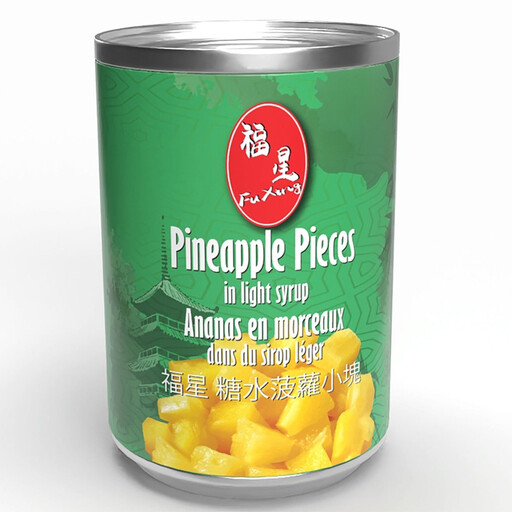 Image unavailable
When planning portions of pineapple, use the drained weight of 260 g rather than the 565 g net weight. Follow the product instructions if you don’t use the whole contents.
 Image unavailable
This 850 g fruit cocktail can be portioned out at serving time. Check its drained weight when working out how many portions of fruit you’ll have. After opening, St Mamet’s product information says to keep it in a suitable container in the fridge for three to four days.
 Image unavailable
This 425 g pack of mango slices is suitable for a service where portions are prepared from one shared container. Check the drained weight and storage instructions after opening to plan your service.
 Image unavailable
You can open the three tins as needed for each service. This pack isn’t described as three ready-to-serve individual pots, so allow time for portioning if your set-up requires it.
Use the drained weight to estimate how much fruit is available, excluding the liquid. The DGCCRF says this weight must be shown when a product is sold in a covering liquid. Make sure you distinguish it from the total weight stated on the packaging.
Follow the instructions for the product you’ve opened rather than applying the same storage time to every tin. St Mamet’s product information for its 850 g fruit cocktail says to keep it in a suitable container in the fridge for three to four days. Check the label for any other product.
GEMRCN recommendations are not, in themselves, a general legal requirement for a workplace canteen. In 2017, DRIAAF Île-de-France described them as recommendations. Check separately what is required under your canteen contract and specification.
Check the product name, ingredients, nutritional information, net quantity and stated date. For fruit in a covering liquid, also check the drained weight, as specified by the DGCCRF.