What should you check before buying?
First, check the fat content for the exact recipe, then choose how much you’ll open at the campsite. The sugar information answers a different question.
| What to consider | What to check | Who is this for? |
|---|
| Fat content |
Check the value per 100 g for the exact product. For solid food, EU Regulation (EC) No 1924/2006 sets a maximum of 3 g per 100 g for a ‘low fat’ claim. |
If I’m choosing this fruit primarily because of its fat content, I want to be able to check it rather than rely on the name of the syrup. Around 29% of consumers make this their priority. |
| A portion with no leftovers |
Compare the number of individual pots and the amount in each portion with the number of people in your group. If both are shown, distinguish between the drained weight and the total weight. |
If there’s nowhere chilled to keep an opened tin, I’d rather open only what we’ll eat. Avoiding leftovers is the priority for around 36% of consumers. |
| Sugars in the recipe |
Check the ingredients list, the ‘no added sugar’ claim and the ‘of which sugars’ line per 100 g separately. |
I want to avoid added sugars, while bearing in mind that fruit and its juice can contain sugars. Around 21% of consumers prioritise this type of recipe. |
| A format to share |
Check how much fruit you’ll need to serve and the storage instructions for after opening before choosing a large tin. |
For a group dessert, I can choose a large tin if we’ll finish it or store the remainder properly. Sharing is the main consideration for around 14% of consumers. |
Fruit in syrup available on Joybuy
These tins of fruit in syrup come in different sizes to suit the dessert you’re planning for your camping trip, from a tin of peaches with a stated drained weight to larger formats for sharing. To choose between them, check the fat content and after-opening instructions for each product.
 Image unavailable
ST MAMET peach halves in light syrup, 230 g drained
Worth considering if you’re looking for a tin of peaches with a stated drained weight to help you plan dessert.
Plan to finish the contents or check the storage instructions for after opening.
View on Joybuy
 Image unavailable
ST MAMET fruit cocktail in syrup, 425 g
The 425 g format is better suited to a dessert to share than to an individual portion with no leftovers.
Check how much fruit you’ll need to serve and how to store it if you don’t finish the tin.
View on Joybuy
 Image unavailable
AROY-D mango slices in syrup, 425 g
This 425 g tin of mango is an option for a dessert to share.
If the amount of fruit, rather than the total weight including syrup, determines your portions, check the drained weight on the packaging.
View on Joybuy
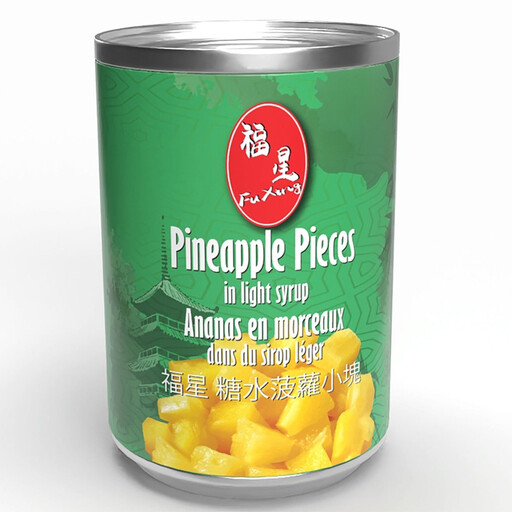 Image unavailable
FU XING pineapple pieces in light syrup, 565 g including 260 g drained
For a dessert to share, the drained weight of 260 g helps you distinguish the amount of fruit from the total weight of 565 g.
The ‘light syrup’ description doesn’t replace checking the fat and sugar content per 100 g.
View on Joybuy
 Image unavailable
ST MAMET fruit cocktail in syrup, 850 g
This 850 g format is worth considering if several campers can share it or if you can store the remainder according to the label.
The Joybuy France listing states that it contains less than 0.5 g of fat per 100 g. Check the drained weight if you need to work out how much fruit each person will get.
View on Joybuy
Frequently asked questions
Does ‘light syrup’ mean low in fat?
No: check the fat content per 100 g for the product you buy. For solid food, EU Regulation (EC) No 1924/2006 sets a maximum of 3 g per 100 g for a ‘low fat’ claim; the name of the syrup doesn’t tell you this value.
Is fruit in juice with ‘no added sugar’ sugar-free?
No: sugars may still be present in the fruit and juice. For example, the Auchan listing for St Mamet’s 475 g fruit cocktail in juice with no added sugar states that it contains 12 g of sugars per 100 g. If this matters to you, check the ‘of which sugars’ line.
Can you keep an unopened tin in a tent or car boot?
Follow the storage instructions for the tin you’ve chosen, particularly those relating to heat. For the 500 g Martin’s International fruit cocktail sold by Auchan, the unopened tin should be stored at room temperature, away from heat and humidity. So avoid leaving it in direct sunlight or in a very hot vehicle.
What should you do with an opened tin while camping?
Follow the instructions for storing your product after opening, or choose a format you can finish straight away. The Auchan listing for Martin’s International’s 500 g fruit cocktail says to transfer the remainder to a sealed food container, refrigerate and consume within three days. If you can’t do this, an individual portion avoids leftovers.


