Students looking to avoid added sugars
“No added sugars” addresses your first concern, but it doesn’t tell you how much sugar the juice naturally contains. Check it alongside the “of which sugars” figure in the nutrition information.


To go with your lunch at uni, choose a juice with a clear product description and ingredients list, then take a quantity that matches how much you plan to drink. “No added sugars” doesn’t mean “sugar-free”: also check the “of which sugars” figure per 100 ml. Manger Bouger, the Santé publique France website, recommends limiting juice to one glass a day and choosing whole fruit instead.
“No added sugars” addresses your first concern, but it doesn’t tell you how much sugar the juice naturally contains. Check it alongside the “of which sugars” figure in the nutrition information.
The bottle size matters just as much as how much you plan to drink. A 50 cL bottle may be easier to carry than a 1-litre one, but it still might hold more than a single serving.
The product description and ingredients list help you tell the difference between apple juice, a mixed-fruit juice, a nectar and a fruit drink. A fruit drink may contain water and added sugar, for example.
For juice to take to uni, start by checking the sugar claim and nutrition information. Then choose a bottle size that suits your planned serving and how you’ll store any leftovers.
| Criteria | What to check | Who it matters to |
|---|---|---|
| Added sugars and sugars present | Look for “no added sugars”, then check “of which sugars” per 100 ml and for the amount you plan to drink. | If I’m trying to avoid added sugar, I don’t want to mistake this claim for a juice that contains no sugars at all. Around 36% of consumers may prioritise this distinction. |
| Portion to take with you | Compare the container size with the amount you plan to have at lunch; 50 cL isn’t necessarily a single serving. | When I have lunch away from home, I want to be able to carry my juice without feeling I have to finish the bottle. Having a portion I can manage may be a priority for around 29% of consumers. |
| Storage after opening | Read the instructions on the packaging and consider whether you’ll be able to store or share what’s left. | If I open a large bottle at lunchtime, I need to know what I’ll do with the leftover juice. Around 21% of consumers may put this question first. |
| Variety and ingredients | Check the product description and ingredients list, particularly for a mixed-fruit juice. | I want to choose a flavour I enjoy while knowing which fruits are in the recipe. Ingredients may be the top consideration for around 14% of consumers. |
Sugars naturally present in the fruit remain in the juice. The Auchan product page for Joker Le Fruit apple juice with no added sugars, for example, states that it contains 9.8 g of sugars per 100 ml.
To compare two bottles, check “of which sugars” per 100 ml and take into account how much you plan to drink.
A bottle intended for several servings may be impractical if you can’t share the juice or store what’s left after opening.
Before taking it with you, check the bottle size and storage instructions.
If you can’t follow the storage instructions after opening, it may be difficult to use up the remaining juice.
Assurance Maladie says grapefruit juice can increase the absorption of certain medicines, potentially leading to an overdose or toxic effects.
If you take medication, check the patient information leaflet and ask a pharmacist or doctor for advice if you’re unsure.
These product descriptions don’t necessarily mean the same ingredients. A Joybuy product page for a granini fruit drink lists water, juices from concentrate and sugar.
Check the product description and ingredients for the one you choose, especially if you want to avoid added sugars.
Its apple and mixed-fruit options let you compare juices carrying the “no added sugars” claim.
These ranges include different sizes to compare, including a 50 cL Carrefour Extra smooth orange juice with no added sugars.
The brand offers fruit-based recipes, so check the ingredients for each product individually.
The E.Leclerc range includes a 1 L pink grapefruit juice with no added sugars.
These two 1 L bottles suit different tastes: one is a mixed-fruit juice and the other is apple juice. If you’re having lunch on your own, plan how much you’ll drink and how you’ll store the rest after opening.
 Image unavailable
Worth considering if you prefer a blend of fruits and can spread a 1 L bottle over several servings.
Check the “of which sugars” figure and storage instructions for this product before deciding how much to take with you.
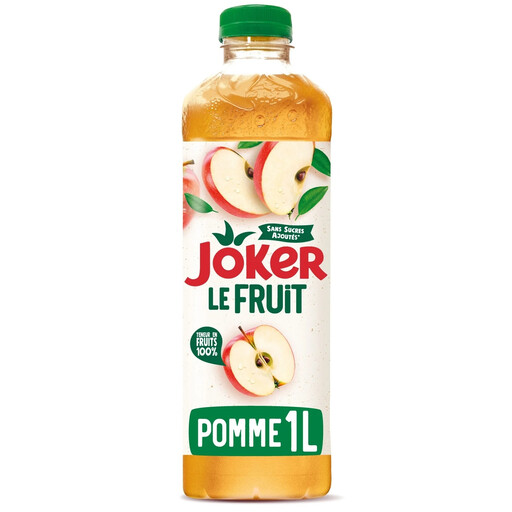 Image unavailable
Worth considering if you’d like an apple-based recipe and can spread a 1 L bottle over several servings.
Read the nutrition information and storage instructions on the bottle you choose: “no added sugars” doesn’t mean “sugar-free”.
No. Sugars naturally present in the fruit remain in the juice. For example, the Auchan product page for Joker Le Fruit apple juice with no added sugars states that it contains 9.8 g of sugars per 100 ml. Check the “of which sugars” figure for the product you’re buying.
Don’t treat juice as the equivalent of a whole piece of fruit. Manger Bouger, the Santé publique France website, recommends choosing whole fruit and limiting juice to one glass a day.
Take an amount that matches how much you plan to drink and what you can store afterwards. Even a 50 cL bottle may be more than you intend to have with lunch; a 1 L bottle is intended to provide several servings.
Check the patient information leaflet for your medication first. Assurance Maladie says grapefruit juice can increase the absorption of certain medicines. If you’re unsure, ask a pharmacist or doctor for advice.