Cyclists planning their carbohydrate intake
If your ride lasts more than an hour, the carbohydrate content per 100 ml and the amount you actually drink will tell you more than the ‘no added sugar’ claim alone.


For a cycle ride, choose a juice with no added sugar based on its carbohydrate content per 100 ml and how much you plan to drink, rather than relying on the claim on the front of the pack alone. Juice can be part of your fuelling plan, but you still need to count the sugars that occur naturally in it. If you’re mainly looking for a drink to sip regularly during exercise, consider your hydration plan separately: undiluted juice isn’t automatically a suitable sports drink.
If your ride lasts more than an hour, the carbohydrate content per 100 ml and the amount you actually drink will tell you more than the ‘no added sugar’ claim alone.
If you plan to drink regularly during exercise, distinguish between juice as part of your fuelling plan and your main drink.
If this claim guides your purchase, also check the product description, ingredients and the ‘of which sugars’ line in the nutritional information.
First decide whether you want the juice to contribute to your carbohydrate intake during the ride, or whether you’re mainly looking for a drink to sip regularly. Then check the figures per 100 ml and the product’s exact description.
| Priority | What to check | Who it’s for |
|---|---|---|
| Count your carbohydrates | Check the carbohydrate content per 100 ml and calculate how much you’ll get from the amount you plan to drink. A 2015 review in Nederlands Tijdschrift voor Geneeskunde cites 30 to 60 g of carbohydrates per hour for exercise lasting 1 to 2.5 hours; this guideline alone doesn’t determine how much juice you should have. | On a long ride, I want to know what my drink actually contributes to my fuelling plan. Around 42% of consumers would put calculating carbohydrates first. |
| Plan your hydration | Compare the juice’s carbohydrate concentration with your drinking plan for exercise. In 1996, the American College of Sports Medicine cited solutions containing 4 to 8% carbohydrates for intense exercise lasting more than an hour; the Auchan and Carrefour product details for the juices mentioned here list 8.6 to 11 g per 100 ml. | When cycling, I want to be able to drink regularly without relying on juice for all my hydration. Around 33% of consumers would make this their priority. |
| Understand the label | Check the product description — juice, pure juice, nectar or fruit drink — along with the ingredients and the ‘of which sugars’ figure per 100 ml. | I want to avoid added sugars without mistaking this for a sugar-free drink. Around 25% of consumers would make reading the label their top priority. |
Sugars that occur naturally are still listed in the nutritional information. For example, Auchan’s product details for Joker 1 L mixed fruit juice show 11 g of sugars per 100 ml, despite there being no added sugar.
Check both ‘carbohydrates’ and ‘of which sugars’, then take into account how much you’ll drink.
A juice’s carbohydrate concentration alone doesn’t tell you how to plan your hydration during exercise. The figures declared for the juices mentioned here don’t automatically fall within the 4 to 8% range cited by the American College of Sports Medicine for some types of intense exercise.
Separate your carbohydrate intake from the drink you plan to sip regularly, and try out your approach during training.
Juice, nectar and fruit drinks are different product categories. A claim highlighted on the packaging doesn’t replace checking the product category and ingredients.
Check the exact product description before comparing its nutritional values with those of a juice.
Storage instructions vary from product to product. Auchan’s product details for Tropicana 1 L apple juice say to keep it at a maximum of 7 °C and consume it within five days of opening; Carrefour’s product details for Carrefour Extra 3 citrus juice say to keep it between 0 °C and +6 °C.
Choose a container to suit your planned rides and follow the storage instructions on the packaging.
Auchan’s product range includes Joker mixed fruit juices with no added sugar in 1 L and 1.5 L packs. Compare the specific product rather than relying on the brand name alone.
Auchan’s 1 L sweet apple juice lets you look at a product whose listed ingredients are apple juice and ascorbic acid.
Carrefour’s 3 citrus juice with no added sugar may appeal to shoppers looking to consider a citrus-based blend.
E.Leclerc’s range includes several pure juice products, as well as a Jafaden product described as ‘reduced-sugar mixed fruit juice’.
These Joker juices are options to consider if you’d like to include fruit juice in your cycling fuelling plan. The pack size is shown in each title. To decide how much to drink, compare the product’s nutritional information with your hydration plan.
 Image unavailable
Worth considering if you’re looking for a mixed fruit juice to plan your fuelling. Compare its carbohydrate content per 100 ml with the amount you plan to drink; the ‘no added sugar’ claim alone doesn’t tell you how much it contributes.
 Image unavailable
This 1.5 L pack could be a good option if you plan to spread the juice across several occasions. Check the carbohydrate content per 100 ml, the amount you’ll pour and the storage instructions after opening.
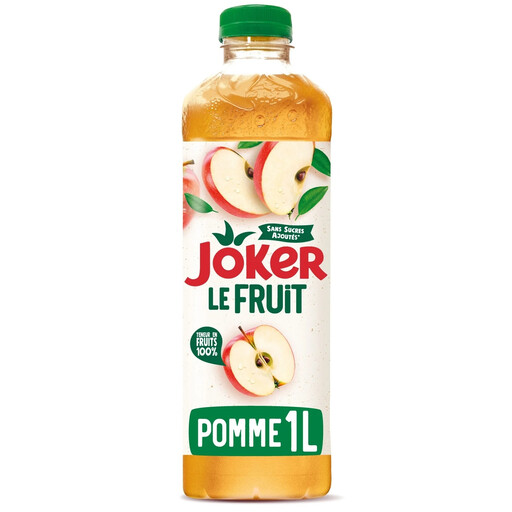 Image unavailable
Worth considering if you’d prefer apple juice to a mixed fruit juice as part of your fuelling plan. Check the product description and carbohydrate content per 100 ml before deciding how much to take with you, and read the storage instructions on the packaging.
No. Sugars that occur naturally may still be present in the juice. Auchan’s product details for Joker 1 L mixed fruit juice list 11 g of sugars per 100 ml; check the ‘of which sugars’ line for the product you choose.
Don’t assume so just because it has no added sugar. For intense exercise lasting more than an hour, the American College of Sports Medicine cited solutions containing 4 to 8% carbohydrates in 1996. Compare your juice’s concentration with your plan for drinking during the ride.
These terms describe different product categories: seeing the word ‘fruit’ on the front of the pack isn’t enough to tell them apart. Check the exact product description, then look at the ingredients and nutritional information for the product you’re considering.
Follow the instructions for the product you’ve bought. For example, Auchan’s product details for Tropicana 1 L apple juice say to keep it at a maximum of 7 °C and consume it within five days of opening. Check these details when choosing your pack size.